


Good Evening:


#OperationTaya Update: Taya sent me the other day these pictures of her at the College of Europe. Thanks to everyone who has contributed to her tuition. The #GreekChorusFoundation also made its first payment to the family of Sasha Kurbanov. Further information about the foundation’s projects is available in prior dog shirts and at the foundation’s web site.
A reminder that if we make all of our financial commitments by the end of October, I will join the famed Dyed Red Hair Club:

On today’s #DogShirtTV, the estimable Holly Berkley Fletcher and I discuss evangelical anger at Aslan being voiced by Meryl Streep and welcome Max Johnston to discuss the plague of furry airplane pilots.
Friday On Lawfare
Compiled by the estimable Athena Smith
The FBI Data Breach Is a Counterintelligence Disaster
Justin Sherman argues that the FBI data breach is a potential counterintelligence nightmare, exposing thousands of FBI personnel to profiling and foreign intelligence targeting—and, more broadly, to doxing and even violent retribution from threat actors ranging from foreign adversaries to domestic extremists. Sherman explains that the FBI and the U.S. government first need to verify the authenticity of the incident and understand its scope before taking both cyber and physical security measures to mitigate the harm to impacted employees.
The supposedly breached FBI data, exploited years down the line, would be as if a nation-state hacked a U.S. military academy, stole information on all the cadets, and used that data to start building dossiers on every single person in the data, so that someone who later goes into a special forces unit, intelligence role, or senior commanding position could have their names and personal data laid out clearly from the initial breach. Novel artificial intelligence data analytic capabilities make this problem even worse, allowing nation-states that could access this or other breached data to conduct more sophisticated pattern analysis and anomaly detection within datasets. The end goal is all about exploitation against U.S. security interests.
The Full Stack of U.S.-China Cyber Competition
Eugenio Benincasa reviews Ahana Datta Fasel’s book, “Full Stack Spies: Cyber Espionage in the Age of US-China Competition,” which traces U.S.-China cyber espionage across the three levels of tradecraft, statecraft, and instability. Benincasa explores the book’s useful “upstairs-downstairs” approach, which illustrates both top-level geopolitical decisions and the substructure of hackers operationalizing them, but also notes that the book’s broad scope led to some overreach.
For readers already immersed in cyber threat intelligence or Chinese cyber operations, some of the book’s interpretations will invite debate, particularly where public attribution remains uncertain or where historical examples are used to sustain broader claims about the evolution of China’s cyber ecosystem. These tensions are most visible in the book’s treatment of attribution, where its own emphasis on ambiguity and incomplete information makes some of its broader conclusions harder to sustain.
Bring On the AI Lawsuits
In the latest edition of the Seriously Risky Business cybersecurity newsletter, Tom Uren explores Treasury Secretary Scott Bessent’s argument that frontier artificial intelligence (AI) labs should not be exempt from liability amid hacks by rogue AI, how Chinese and Russian hackers are putting AI to different uses—with China diversifying its malware to complicate attribution and Russia cyberattacks are using AI to automate operations and evading detection—, and more.
Bessent made his comments while testifying at a hearing of the House Financial Services Committee. When asked about AI safety, he replied that “the best way to guarantee safety” is for those creating the technology to be “liable for what they build and generate.” Frontier labs, he added, are instead asking for liability shields or antitrust waivers to coordinate on safety—meaning that they are not liable for what they build. Headlines detailing various frontier lab models escaping cybersecurity training and embarking on hacking sprees have been coming thick and fast. Most recently, the Wall Street Journal reported last week that Google’s Gemini model had hacked three companies during a cybersecurity test in May.
Podcasts
On Lawfare Daily, Natalie Orpett sits down with Ariane Tabatabai and Julia Curlee to discuss the ongoing war in Iran. The group explores where the conflict stands today and how the gutting of the national security apparatus in Washington has affected the way the government is waging the war.
Videos
On Friday, Sept. 25, at 4 p.m. ET, I sat down with Molly Roberts, Anna Bower, Roger Parloff, and Eric Columbus to discuss the latest developments in litigation surrounding the Trump administration, including President Trump’s bans on CNN, MS NOW, and Politico from the White House, updates in third-country removal litigation, and more.
Today’s #BeastOfTheDay is the adolescent T-rex, seen here mummified and partially excavated from a huge block of stone:
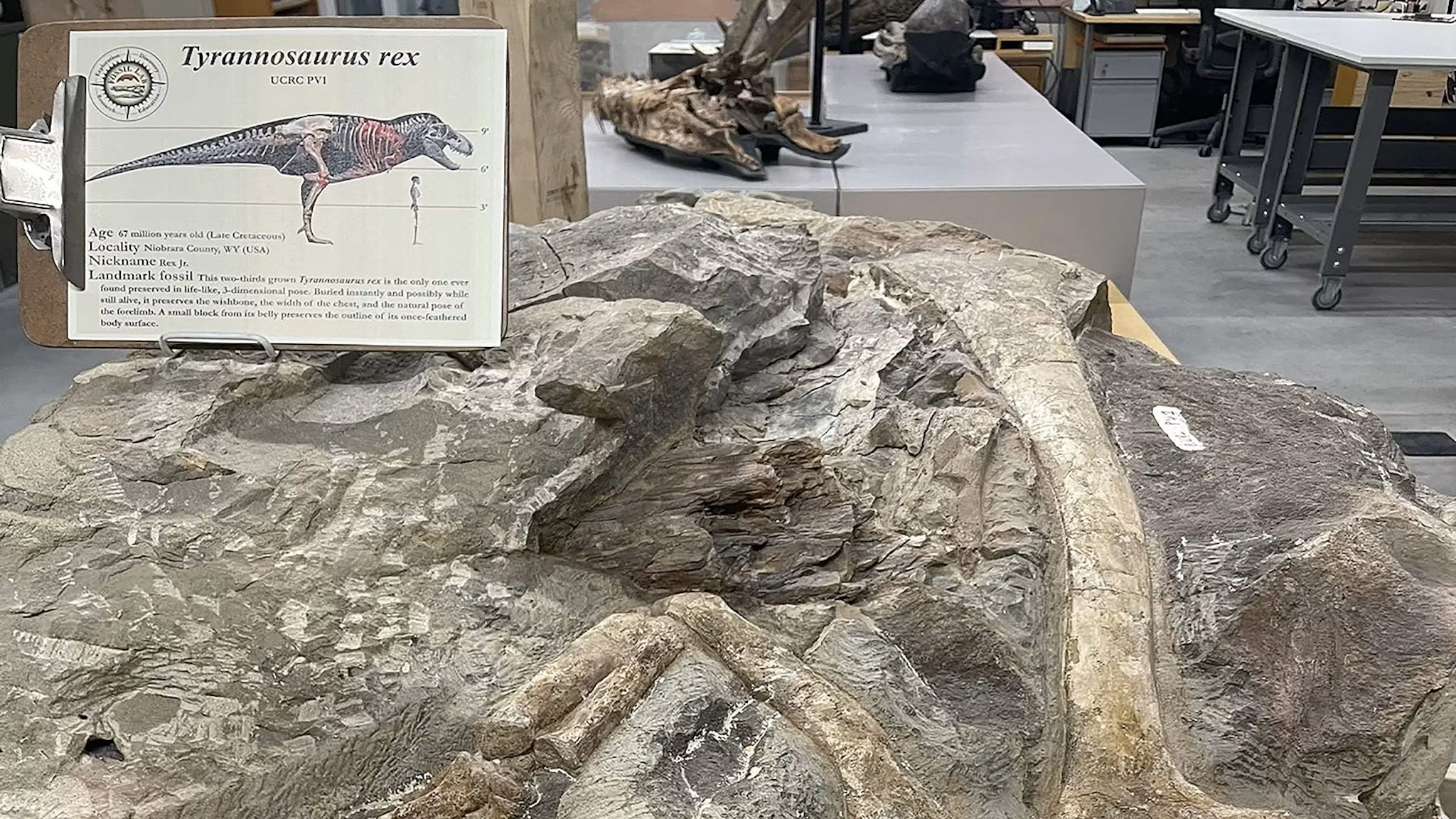
A partial but perfect Tyrannosaurus rex skeleton from eastern Wyoming is poised to upend everything the world thought it knew about the Tyrant Lizard King.
“Rex Junior” is one of the many spectacular fossils currently being studied at the University of Chicago’s Fossil Lab. It’s the partial skeleton of a sub-adult T. rex found on the legendary Zerbst Ranch near Newcastle…
Many details on Rex Junior are still secret, pending publication, but Sereno said this specimen from the newly discovered “mummy zone” will redefine what we know about T. rex, inside and out…
The first big revelation was the articulated right arm. Every bone was there, from the long, thin scapula to the very tips of the claws, perfectly articulated as they would have been when Rex Junior was alive.
“It was the only complete T. rex hand and forearm ever found,” Sereno said. “Every single bone, in place outside of the ribcage. I was totally shocked.”
As of 2026, the preparation of Rex Junior continues. The primary 5,000-pound concretion has been mostly prepared on one side, revealing the right arm and most of the ribcage.
“It looks like we’ve got both arms, the torso, and the base of the neck,” Sereno said. “There are five or six small blocks that fit into it, and you can see the knee coming up to the chest, so we’re probably going to get most of the (right) leg.”
…
Rex Junior is a mummified dinosaur skeleton. It was found at the top of the mummy zone that also produced other mummified dinosaurs from eastern Wyoming, including several Edmontosaurus from the Zerbst Ranch.
However, simply calling Rex Junior “mummified” isn’t doing the specimen justice, from Sereno’s perspective.
What immediately stood out to him was that Rex Junior was three-dimensionally preserved. None of the articulated bones are squashed, distorted, or scattered.
It was like the dinosaur went to sleep, completely undisturbed…
“I personally believe that it was buried alive in a flood,” he said. “I don’t think it was a carcass. This looks like it was breathing when it was suddenly buried, like it didn’t have a chance to escape.”
…
Sereno did give one big hint about another revelation from Rex Junior that could change T. rex forever.
Modern scientists accept that there is an unbroken evolutionary lineage between prehistoric dinosaurs and modern birds. Rather than being closely related to each other, today’s birds are all on a surviving branch of the dinosaur family tree.
Fossils found and reexamined over the last 30 years have revealed that many non-avian dinosaurs, like Velociraptor, were covered in feathers or feather-like integuments.
Because Wyoming’s mummified dinosaurs are covered with skin impressions, the same might be expected for a mummified T. rex from Wyoming’s mummy zone.
“We have an extraordinary chance, with a mummy of the largest predator to grace the face of the earth, to understand more about its body position and, maybe, its integument,” Sereno said.
Sereno isn’t revealing anything about what has or hasn’t been found on or around Rex Junior’s fossils. He did confirm that there are some spots they’re studying with great interest, for what might or might not be there.
“I’m not going to let slip the secret, but I’ll say this: there are no scales,” he said.
In honor of today’s Beast, please do read the rest of this article. Absolutely everything about today’s Beast is extremely cool.