


Good Morning:
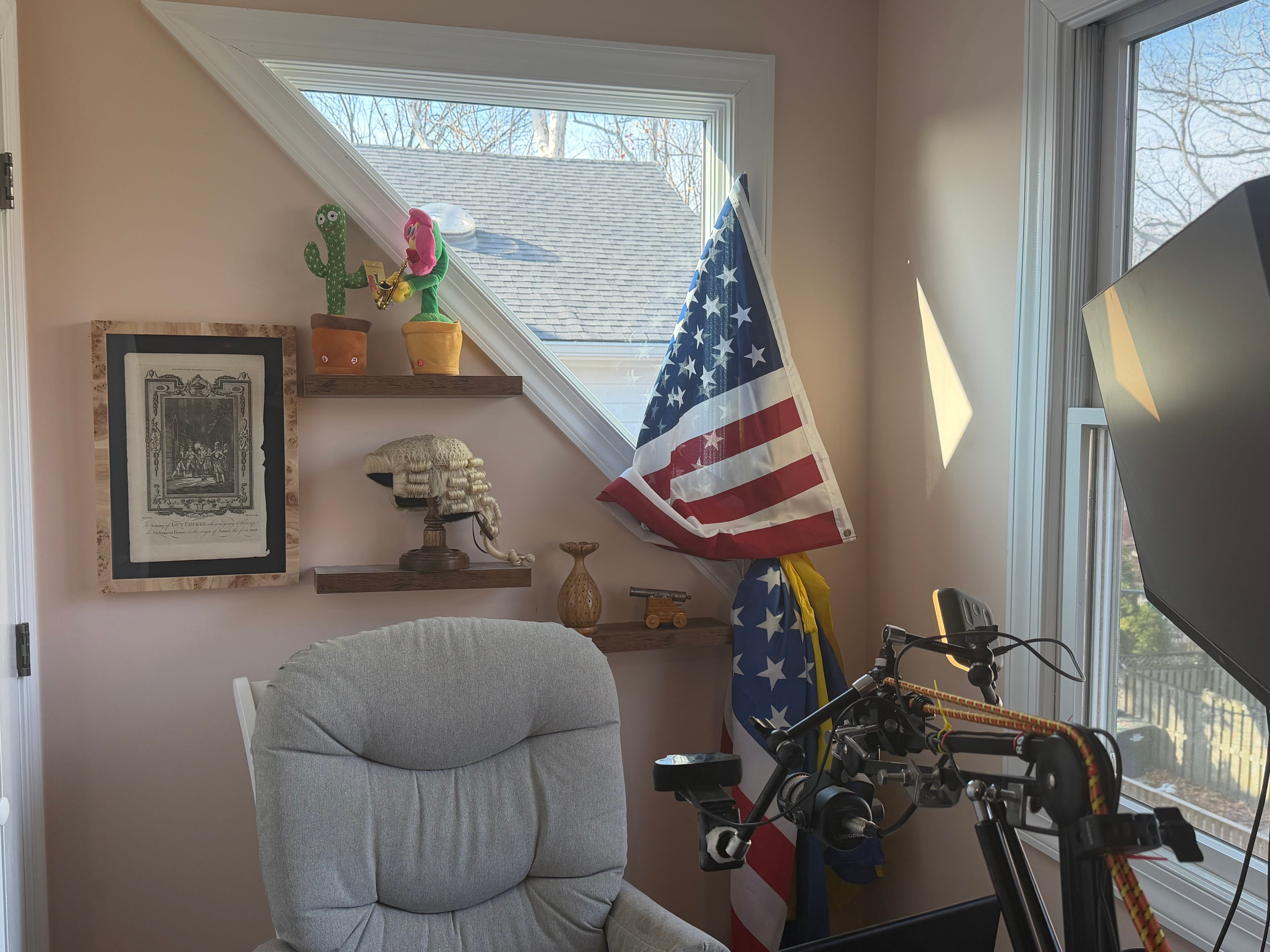
The new studio space is almost finished.
Monday on #DogShirtTV, the estimable Holly Berkley Fletcher and I discussed a #BeastOfTheDay from last week:
Yesterday on #DogShirtTV, the estimable Mike Feinberg explained why dystopian fiction doesn’t work in our dystopian reality. The estimable Holly Berkley Fletcher and the estimable Jonathan Rauch speculated on their own future sex scandals.
Operation Brahms
Today’s installment is Five Poems for voice and piano, Opus 19. It’s a very pretty little work, performed here by soprano Juliane Banse, tenor Andreas Schmidt, and bass Helmut Deutsch. I’m not sure I have all that much to say about it, but it’s lovely and you should listen to it:
Lawfare Out Loud?
Here’s a question I’ve been thinking about: Should create a podcast feed in which I read Lawfare articles out loud? We already have a text to speech function on the Lawfare site, but it is an AI-generated voice, not human, and it doesn’t feed a podcast feed. I was thinking of using the Read With Me feed on this site, which is currently just running the audio of #DogShirtTV, to do articles—either episodically or regularly. My question is whether you would find this useful?
The Situation
In Monday’s “The Situation” column, I discuss the Trump administration’s recent National Security Strategy, including its peculiar strategic focus on border security, an unusual tone and structure, and its evident racial animus.
The National Security Strategy is a very strange document—strange in what it includes, strange in what it leaves out, strange in its bombastic personalization of policy to President Trump, strange in displaying a certain meta-quality, and strange in its all-but-overt racism. Needless, perhaps, to say, this does not read like the national security strategies of any prior administration.
The meta-quality gives the racism a weirdly-organized sheen. The document spends the first seven of its 33 pages explaining what a strategy is, why previous American national security strategies have all sucked, what the United States (meaning the Trump administration) wants from the rest of the world, and what means are at its disposal to get what it wants. The document spends time justifying the proposition that it can’t focus on everything and has to prioritize—though it actually does bounce from subject to subject a great deal in a fashion that does not reflect rigorous prioritization.
Recently On Lawfare
Compiled by the estimable Isabel Arroyo
The Troubling Defense of the Second Strike
Scott R. Anderson and Natalie Orpett evaluate the Trump administration’s legal defense of its second Sept. 2 airstrike on alleged drug smugglers in the Caribbean. The authors unpack the administration’s argument for treating trafficked drugs like chemical weapons and parse the second strike’s permissibility under domestic military guidelines and the international law of armed conflict.
In our view, Congress must continue its inquiry. Separate and apart from whatever order Hegseth might have given, the decision to pursue the second strike presents profound questions about compliance with the international law of armed conflict and contradicts longstanding Defense Department guidance. Perhaps more importantly, it may also be a symptom of more fundamental problems with how the Trump administration’s legal justification for its military campaign is shaping operational considerations. If so, it is unlikely to be the last.
Embracing Climate Realities: The Climate Security Implications of COP30
Erin Sikorsky and Siena Cicarelli analyze this year’s United Nations Climate Change Conference, highlighting the degrading effects of the Trump administration’s hostility toward climate change mitigation, China’s progress on clean energy, and the emergence of the conference as an arena for power-projection and contestation rather than climate problem-solving.
Absent strong leadership from the U.S. and China, COP30 negotiations sputtered; the final agreement took a step backward by not mentioning fossil fuels and resulting in only minimal new commitments of climate finance. To navigate this new more competitive environment among great powers, developing countries framed issues like climate justice, debt relief, indigenous representation, and finance as sovereignty and security issues. Meanwhile, middle powers aimed to leverage the COP as a platform to elevate themselves and their national industries, with mixed success. Oil-producing Saudi Arabia was able to ensure weak language on emissions, Indonesia used the meeting to sell carbon credits, while host nation Brazil failed to secure much funding for its marquee new fund for forests.
Four Things to Know About Hybrid Air Denial
In the latest installment of Lawfare’s Foreign Policy Essay series, Maximilian K. Bremer and Kelly A. Grieco discuss the ins and outs of hybrid air denial, a gray-zone tactic in which adversaries use low-cost aerial technologies to disrupt air traffic and travel while probing a state’s defenses.
The initiative underscores how Europe is racing to counter a new kind of gray-zone threat: hybrid air denial. This strategy adapts the wartime logic of air denial to peacetime, combining traditional, coercive airspace incursions with low-cost, hard-to-attribute technologies—like commercial drones operating in the air littoral—to disrupt commercial activity, impose economic and political costs, and probe defenses. Like other forms of “hybrid” warfare, it deliberately blends peacetime coercion with tactics traditionally associated with war, allowing adversaries to achieve strategic effects without triggering full-scale war.
Unexpected Questions in Learning Resources v. Trump
Peter E. Harrell and Jennifer Hillman argue that several issues raised during oral argument in the tariffs case—including the limits of the embargo power and the distinction between regulatory and revenue tariffs—point back to the conclusion that the International Emergency Economic Powers Act does not authorize tariffs.
The government argues that the phrase “regulate … any importation or exportation of … any property in which any foreign country or a national thereof has any interest” includes the power to tax imports of such property, whereas plaintiffs argue that the phrase does not include a tariff or taxing power.
At oral argument the justices, the parties, and the government made various straightforward arguments about the textual interpretation of the phrase as well as IEEPA’s statutory history, with dueling views of whether the plain meaning of the term “regulate” includes a power to tax or impose a fee and what Congress intended when it passed the statute nearly 50 years ago. But the justices and the parties also spent much of the oral argument debating several issues that received much less attention in the written briefs and in lower court rulings on Trump’s tariffs. While these unexpected questions are complex, a close analysis shows that each of them ultimately reinforces the arguments that IEEPA does not authorize tariffs.
California Enacted AI Bills. Now Officials Must Define Them.
Justin Curl warns that developers might leverage ambiguous and qualifying language to avoid complying with California’s recent spate of artificial intelligence (AI) legislation. Curl urges lawmakers to clarify the operational meaning of vague terms before the laws take effect.
With laws on AI on the books in California, it’s easy to declare victory. Officials could let terms like “frontier model” and “reasonable measures” be defined through the standard process of enforcement actions and litigation. Companies would make their best guesses about compliance. Public prosecutors and private plaintiffs would sue. Courts would issue conflicting rulings. Eventually, after years of litigation, something resembling clarity would emerge.
Podcasts
On Monday’s Lawfare Daily, Orpett sits down with Anna Bower, Michael Feinberg, Molly Roberts, Roger Parloff, Eric Columbus, and James Pearce to discuss the arrest of a suspect in the attempted bombing of the Democratic and Republican National Committee headquarters on Jan. 6, 2021, a hearing in NPR’s lawsuit over the Trump administration cutting its funding, where the prosecutions of Letitia James and James Comey stand, and more.
On Tuesday’s Lawfare Daily, Renée DiResta sits down with Jimmy Wales to discuss Wales’s new book, “The Seven Rules of Trust,” how Wikipedia—which Wales founded—has managed to remain one of the most trusted sites on the internet, and threats to Wikipedia from Congress, Russia, and Elon Musk’s “Grokipedia.”
On Scaling Laws, Graham Dufault joins Kevin Frazier to discuss how small- and medium-sized enterprises (SMEs) are navigating the EU’s AI regulatory framework, The App Association’s recent survey of SMEs, and more.
Today’s #BeastOfTheDay is the horse, seen here making itself available to be hugged:
In honor of today’s Beast, hug someone.