


Good Morning:
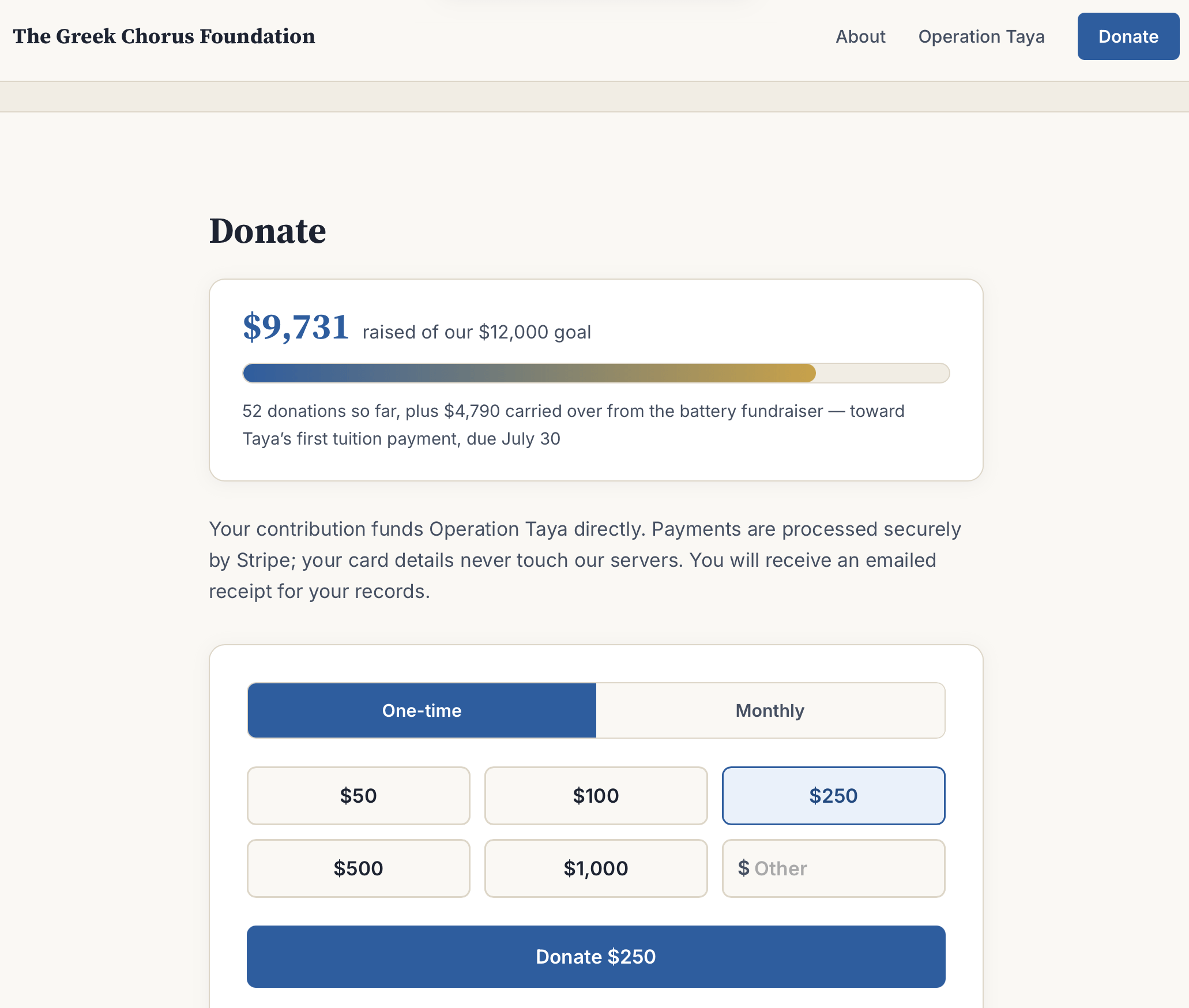
Thanks to everyone who has leapt to contribute to the #GreekChorusFoundation’s first project, #OperationTaya, which is our scheme to send a young staffer working at the Ukrainian Ministry of Defense to graduate school so she can become a master of the universe. In case you missed Monday’s announcement of the foundation and its initial undertaking, here it is:

Taya’s first tuition payment of ten thousand euros is due at month’s end, so there is some urgency to the matter. If you haven’t yet contributed, please do so. And please share this project with others you think may be interested.
And of course:
Monday on #DogShirtTV, we announced the launch of the Greek Chorus Foundation:
Yesterday on #DogShirtTV, the estimable Holly Berkley Fletcher came on the show with two agenda items: xenophobic violence in South Africa—and Canoe Guy:
Recently On Lawfare
Compiled by the estimable Sarah Willrich
Everything Trump’s Election Speech Did Not Prove
Anna Bower, Julia Curlee, Renée DiResta, Michael Feinberg, Molly Roberts, and Loren Voss unpack President Trump’s recent speech on the integrity of the 2020 elections and the declassified document releases that accompanied it. They break down each of Trump’s allegations, the administration’s playbook for politicizing intelligence, and the consequences such rhetoric could have ahead of the 2026 midterm elections.
The audience is invited to treat these separate allegations as mutually reinforcing evidence of a single stolen-election plot. But they do not corroborate one another. Evidence that China acquired voter data is not evidence that it altered registrations. Evidence that intelligence analysts disagreed about the goals of Chinese influence is not evidence that any intelligence was concealed, or that analysts believe the influence effort had meaningful impact. A vulnerability is not an intrusion; a fraudulent registration application is not a fraudulent vote.
The White House’s case depends on erasing those lines.
The Short-War Illusion: What Iran Teaches Beijing About Taiwan
Curlee considers what lessons China may be taking from the U.S and Israeli war with Iran for its own potential invasion of Taiwan. She highlights three key takeaways: decapitation strikes have limited efficacy alone, chokepoints are cheap to deny but costly to reopen, and together, these factors mean the illusion of a short conflict can quickly turn into a drawn-out war of attrition—one Taiwan may not be prepared to endure.
Beijing’s likely takeaway is not that decapitation is useless, but that it cannot be the failure point for the entire plan. We should expect the PLA to pair leadership strikes with moves to deepen the island’s isolation—severing the two dozen undersea cables that carry nearly all of Taiwan’s connectivity, a vulnerability Chinese-linked vessels have already rehearsed cutting. Beijing is likely to leverage cyberattacks to cripple domestic communications so that a surviving government cannot communicate with the outside world, coordinate its military, or reassure its public, and expand the on-island subversion and disinformation capabilities it has spent years building to ensure Taiwan cannot—as Iran did—quickly name a successor.
Governance Fragmentation and Collapsing Health in Wartime Yemen
In the latest edition of Lawfare’s Foreign Policy Essay series, Safa Al-Saeedi and Christina Bouri analyze how the ongoing conflict in Yemen has driven the collapse of the country’s healthcare system. They explain that, in addition to the U.S. cutting funding last year, Yemen’s split between the Houthi authorities and the internationally recognized government has left aid organizations navigating rival health systems, identification documents, and supply chains—resulting in a patchwork system susceptible to politicization.
Rival factions have also treated humanitarian assistance and health facilities as patronage resources and instruments of control, further disrupting the delivery of health services. They have diverted essential commodities—including food, medicine, and fuel—to loyalists and cut off populations that are not supportive enough. For example, in 2018, Houthi authorities diverted an estimated 15,000 food baskets per month from the education ministry; these had been intended for vulnerable families but were instead sold on the black market or redirected to frontline fighters. This strategy has created deep inefficiencies in aid delivery, pervasive shortages, and the breakdown of health services, thereby accelerating outbreaks of disease and unnecessary loss of life.
Within Bounds: State Authority to Regulate Federal Contractors
David S. Rubenstein analyzes how courts have allowed and disallowed states from regulating federal contractors operating in their jurisdictions. He explains that states are largely allowed to enforce generally applicable laws against contractors, but cannot use regulation to single them out. Rubenstein also explores how states can leverage their market influence to indirectly regulate federal contractors.
So long as states do not directly regulate the federal government or single out federal contractors for discriminatory treatment, the intergovernmental immunity doctrine leaves room for neutral state health and safety rules. Under these principles, states concerned about an influx of new immigration detention facilities, for instance, can require health department inspections, fire suppression, and adequate egress for private facilities housing large numbers of people.
The Legal Risks That Chill Good-Faith Security Research
Belen Pisaniello, Sunoo Park, and Daniel R. Thomas discuss the chilling effects that contract and anti-hacking law can have on researchers who expose vulnerabilities in good faith.
One particularly alarming manifestation of these chilling effects is “stockpiling,” in which researchers discover security vulnerabilities but choose not to disclose them out of fear of legal consequences. Instead, they hold onto this information, making it a prime target for hacking, bribery, and coercion. One researcher reported being approached by a mysterious individual offering a large sum of money to buy their stockpile and their silence.
Podcasts
Lawfare Daily: The Trials of the Trump Administration, July 17: I sit down with Eric Columbus, Bower, Roberts, and Roger Parloff to discuss the Senate confirmation hearing for acting Attorney General Todd Blanche, subpoenas sent to New York Times reporters, a judicial opinion voiding President Trump’s settlement with the IRS, and more.
Lawfare No Bull: Confirmation Hearing for Director of National Intelligence Nominee Jay Clayton: Sarah Willrich shares edited audio of the July 15 confirmation hearing before the Senate Intelligence Committee for Jay Clayton, President Trump’s nominee for director of national intelligence.
Lawfare Daily: How To Make a Patriot, with Fabian Hoffman: Anastasiia Lapatina talks to Fabian Hoffman about what it would take for Ukraine to produce Patriot interceptor missiles, if the United States gave it the license to do so.
Scaling Laws: Courtney Cox on AI in Adjudication: Courtney Cox joins Kevin Frazier to discuss her forthcoming article, “Hardwiring Hercules?,” in which Cox argues that the debate over a “right to a human decision” has missed a central problem: normative uncertainty.
Today’s #BeastOfTheDay is the raven, which new research finds does not follow wolves in order to feed on their kills. Instead, the ravens predict where wolves are likely to kill things and show up in advance. A March 2026 study finds that:
Ravens benefited from their associations with wolves but demonstrated a more dynamic strategy than simply following individual wolves or packs. Instead of consistently remaining near carnivores, ravens periodically returned to areas of high carnivore activity or past kill sites based on anticipated food availability, while primarily foraging elsewhere…
Ravens’ movements toward wolf kills were often highly directional, covering distances of up to 155 km in a single day. Because wolf kills are clustered in particular areas of northern Yellowstone and not randomly distributed, we propose that ravens find kills by relying on spatial memory, possibly represented as a cognitive map of long-term average wolf presence and/or wolf kill abundance…[R]avens may learn and remember areas where wolf kills are abundant and where they are not.
In honor of today’s Beast, read the study. They put GPS trackers on all the Beasts and tracked them for years. It’s neat.