


Good Morning:

I’m delighted to announce that the #GreekChorusFoundation is now live and accepting donations for #OperationTaya, our first project.
What is the #GreekChorusFoundation? It’s the institutionalization of #ProjectBattery, my effort earlier this year with the estimable Anastasiia Lapatina to raise money to buy batteries for Ukrainian families who had no electricity in a frigid winter. With the help fo the audience of #DogShirtTV and the readership of #DogShirtDaily, we raised about $130,000 and spent it all very quickly helping real people do real things. In response, the #GreekChorus—our name for the audience of the show and the readership of the site—decided to create a foundation so that donations for future projects would be tax deductible and wouldn’t be running through my personal accounts.
And thus the #GreekChorusFoundation was born.
The Foundation will operate as a communal project of #DogShirtTV and #DogShirtDaily. Major decisions about projects will be discussed on the show and voted upon in polls on #DogShirtDaily. The decision to constitute the Foundation itself was approved by the readership in almost Stalin-level numbers:

And the decision to take on our first fundraising project was adopted with an overwhelming vote as well:
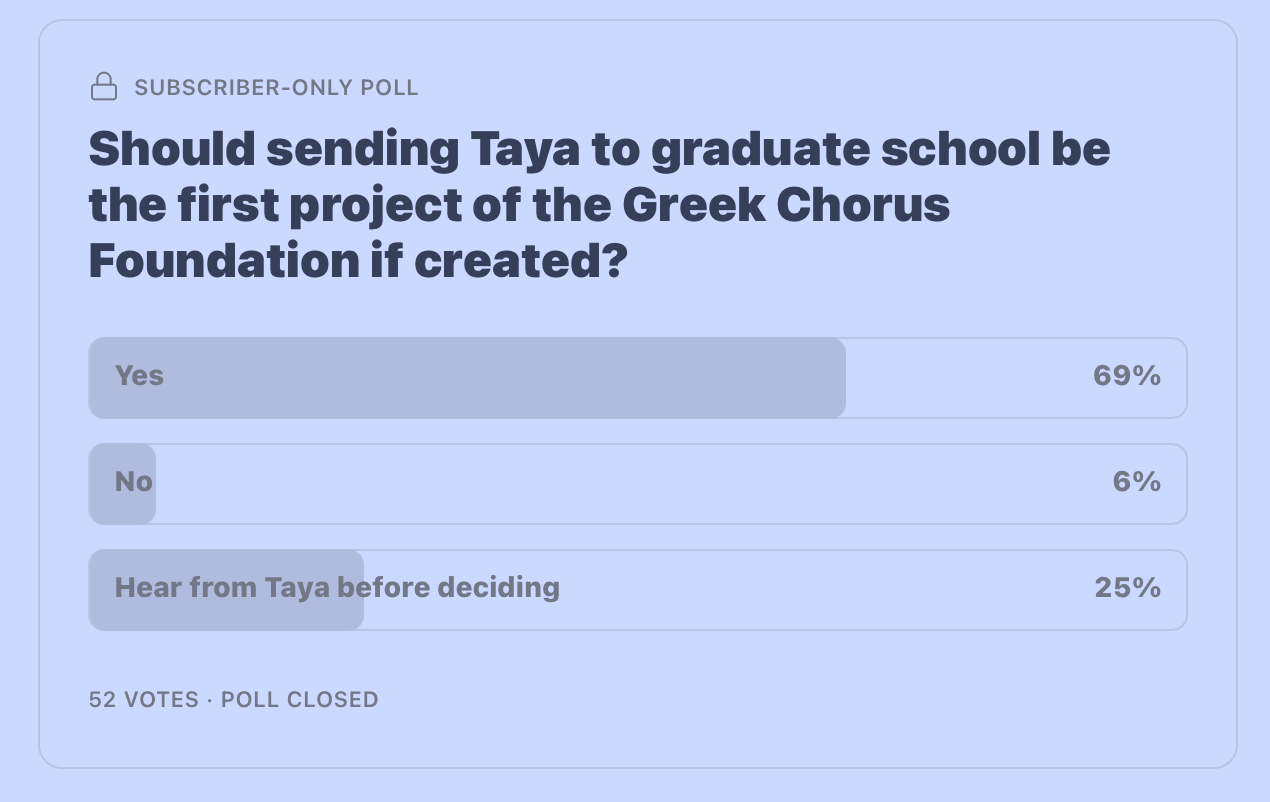
And that brings me to Taya, a young staffer who works with the Ukrainian Ministry of Defense. We are not releasing Taya’s full name publicly right now, because of the circumstances of her employment. But she has been accepted into a two-year joint Master of Arts in Transatlantic Affairs at the College of Europe and the Fletcher School, the cost of which is prohibitively expensive. We figure we can do something about that.
Taya writes:
During my lifetime, I never had the luxury of experiencing a stable, safe Ukraine. Instead, it was full of life-changing events: two revolutions, waves of economic and political instability, and now a war. These experiences taught me lessons no classroom ever could. I learned early that ignorance is not an option here; it is a privilege we simply cannot afford. And, perhaps most importantly, that impact requires more than good intentions: it requires knowing your own capabilities, finding others who share your purpose, and building something together.
These were not abstract lessons. They became the logic for every decision I made about my education and my career. From a young age, I understood that the value of my work would be measured by its social impact, by whether it moved something forward for the people around me.
My career has taken me through regional administration, the Parliament, the Ukrainian Red Cross, and now the Ministry of Defence. In each of these roles, one thing has remained constant: the extraordinary commitment of the people around me, colleagues determined to reform our institutions, deepen ties with our allies, and build a country worth the sacrifices being made for it.
But this experience has also taught me something less obvious. We are very good at articulating what Ukraine needs. We are far less practiced at understanding how our partners think: how their institutions weigh decisions, build consensus, and shape policy. As Ukraine’s path toward the EU and NATO advances, I believe closing that gap will matter as much as any technical expertise we bring to the table. What is needed now are people fluent in both worlds, grounded in Ukraine’s realities, yet equally capable of reading and navigating the logic of our international partners.
That realization is one of the main reasons I applied for Political and Governance Studies in the Master of Arts in Transatlantic Affairs programme. I don’t simply want to gain another degree, I want to challenge the way I think, learn directly from people who shape transatlantic policy, and bring that perspective back to Ukraine. I believe that would allow me to contribute to my country on a much greater level than I can today.
Taya’s tuition will cost €30,000 for each of the two years of the program. We mean to cover it all.
One matter of urgency related to #OperationTaya. Taya’s first tuition payment of €10,000 is due on July 30.
So let’s get on it:
Wednesday on #DogShirtTV, the estimable Mike Feinberg and I welcomed the estimable Julia Curlee, fired NSC director, to talk about Trump’s destruction of the NSC:
Thursday on #DogShirtTV, the estimable Molly Roberts came on the show to speculate wildly about Trump’s speech:
And Friday on #DogShirtTV, the speech had occurred, and Molly came back, along with the estimable Amanda Carpenter, to discuss it:
Recently On Lawfare
Compiled by the estimable Sarah Willrich
Takeaways for Iran a Year After the Syria Sanctions Rollback
Rachel Alpert, Claire O’Neill McCleskey, and Naomi Maxwell consider what lessons from the end of U.S. sanctions on Syria could be applied to Iran. The authors explain that the rollback of sanctions in Syria required continuous effort from the executive branch, Congress, and its international partners and argue that the process would likely be even more complicated in the case of Iran.
Syria’s SST designation proved to be sticky even after a decisive regime change. In Iran, unlike Syria, the conduct underlying its SST designation is ongoing, and the country is now led by what some observers have described as a new generation of “technocratic” IRGC leaders. As long as Iran remains a designated SST and the IRGC remains designated as a FTO, U.S. companies will be exposed to significant legal risk for dealing with anyone linked to the IRGC. Because the IRGC is deeply embedded across Iran’s economy—from energy and construction to telecommunications—that exposure is difficult to avoid in practice, and it will continue to deter investment even if broader sanctions are lifted.
Driven by AI, the Future of Cybersecurity Will Resemble the Past
Jason Healey reviews how cyberattacks historically transitioned from taking advantage of vulnerabilities to relying on deception. He argues that the development of artificial intelligence (AI) will reset cybersecurity to a world where there are abundant vulnerabilities that defensive technologies, even those powered by AI, are not yet equipped to address.
Mythos-class AI technologies are not only more adept at zero-days, but they can do more even with known vulnerabilities (called n-days). Anthropic found that within just a few hours, using known vulnerabilities, “Mythos Preview … not only produced a full chain exploit, but produced eight distinct exploits” for well under $20,000. And AI-discovered vulnerabilities are worrying; even before Mythos, the number of flaws that were both highly exploitable and high severity jumped 36 percent in one year.
The impact on defense will be profound. Former White House cyber coordinators Rob Joyce and Michael Daniel have complementary assessments of the dangers as, respectively, a great cleansing forest fire of old software and “our legacy technical debt” coming due.
Implementing Universal Jurisdiction in Ukraine
Anna Sayko and Jeanne Sulzer analyze the practical implications of implementing universal jurisdiction in Ukraine, which allows for the prosecution of foreign nationals for core international crimes, regardless of when and where the crime initially took place. Sayko and Sulzer explain that while the law makes prosecution theoretically possible, clearer guidance is needed on procedure and how prosecution interacts with international law, especially in the context of Ukraine’s ongoing war with Russia.
In cases where an alleged perpetrator is apprehended in Ukraine but no request for extradition from a foreign state is made, the legislation does not clarify whether the absence of such a request is sufficient to satisfy the conditions for exercising universal jurisdiction. Given that Article 8(2) of the CCU establishes a framework for exercising UJ in accordance with Ukraine’s international obligations, in such cases, the principle of aut dedere aut judicare (extradite or prosecute) should apply. More broadly, under the Geneva Conventions and the UN Convention against Torture and Other Cruel, Inhuman, or Degrading Treatment of Punishment, a state party is obligated to carry out criminal proceedings against suspects on its territory if it chooses not to extradite them to the state in which the crime was committed.
Responding to AI Distillation Without Panic
Bahrad A. Sokhansanj argues that policymakers rushing to crack down on artificial intelligence (AI) “distillation attacks”—training a model on a rival’s outputs at scale—are diagnosing the problem incorrectly. Sokhansanj proposes that, rather than treating all distillation attacks as theft, which they are often not, policymakers should identify the specific harm such attacks cause, such as bypassing model safeguards or threatening cybersecurity, and tailor policy accordingly.
Mass distillation merits a policy response, even if it isn’t theft. But policymakers first need to identify the problem they are trying to solve. If the concern is illegitimate access to U.S. frontier models by foreign competitors and state actors, then policy should help labs secure access, share threat information, and identify fraudulent accounts and proxy networks used to disguise who is accessing the model. If the concern is cybersecurity, then the problem is account abuse and getting around access controls. If the concern is the diffusion of dangerous model capabilities, then the first step is to determine whether distillation meaningfully improves those capabilities or helps remove safeguards.
How the U.S. Military Learned to Embrace AI Warfare
Jakub Kraus reviews Katrina Manson’s book, “Project Maven: A Marine Colonel, His Team, and the Dawn of AI Warfare,” an account of the U.S. military’s collaboration with Palantir to develop artificial intelligence (AI) for warfare. Kraus praises Manson’s documentation of such a secretive project and highlights how she tied Project Maven to broader questions about ethics in AI warfare.
Given that leaders of military projects generally seek to control information about their efforts, readers might wonder whether Manson sometimes received a curated view of Maven. Nonetheless, her tone is consistently neutral and journalistic; she often spells out conflicting perspectives, allowing readers to draw their own conclusions. This fact-finding, even-handed storytelling makes her work stand out. It is rare to find a book that unpacks a U.S. military project with such depth and neutrality, particularly when the project involves fundamentally shifting America’s approach to war.
Vermilion Tide
Dominic Brennan and Charlie Prior consider the implications of China’s plan to deploy floating nuclear power plants (FNPPs) to the South China Sea. FNPP deployment, Brennan and Prior argue, could both improve China’s ability to sustain operations in the region and increase the risk of nuclear escalation in the highly contested waters.
U.S. strategic objectives may nevertheless require military action against Chinese bases in the region, compelling U.S. forces to confront FNPPs. Allowing a radioactive tripwire to deter any form of engagement would set a dangerous precedent. Accepting this logic would grant de facto immunity to any military facility housing a nuclear reactor, a position that becomes increasingly problematic as countries, including the U.S., explore the deployment of nuclear reactors on military bases. To maintain credibility that the mere presence of FNPPs will not deter the United States, the U.S. military should thoroughly prepare for the potential consequences of operations on or near FNPPs. These preparations take two routes: kinetic strikes and on-site operations.
Ransomware Uses AI to Amp Up Negotiations
In the latest edition of the Seriously Risky Business cybersecurity newsletter, Tom Uren discusses how AI is enabling more effective ransomware extortion, how AI-supported bug patches may expose small companies that cannot quickly implement patches, the White House’s announcement of a new cybersecurity “clearinghouse,” and more.
The INC/Lynx strategy here is to use AI to hack more often to make up for less frequent paydays. FulcrumSec is taking the opposite approach and trying to maximize profits by amplifying their leverage in negotiations.
Our take-home message here is that nerdy, technically focused ransomware actors use AI to hack, but sophisticated ransomware actors? They use it to negotiate.
Podcasts
Lawfare Daily: AI Targeting Systems Are Coming—But Not as Fast as You Think: Kate Klonick speaks with Steve Feldstein about his recent Bulletin of the Atomic Scientists essay on AI targeting systems. Feldstein discussed what the conventional wisdom about AI warfare gets wrong, what the Iran War’s staggering Maven numbers do and don’t prove, how Israel became the case study in what it actually takes to build an AI kill chain, and whether export controls can realistically slow any of it down.
Lawfare Daily: What Do the Russians Actually Think About the War?: Anastasiia Lapatina speaks to Maria Snegovaya about how the Ukrainian attacks on Russian energy sites are shifting attitudes towards the war inside Russia, Snegovaya’s latest report called “Russian Attitudes Are Shifting as the War’s Effects Come Home”, and more.
Rational Security: The “Hip to Be a Square State” Edition: Scott Anderson sits down with Daniel Byman, Julia Curlee, and Ariane Tabatabai to talk through the week’s big national security news stories, including the collapse of the ceasefire with Iran, announcements from last week’s NATO summit, and growing tensions in the U.S.-Israel relationship.
Lawfare Daily: Consent in the Age of AI: Renée DiResta speaks with Kate Klonick and Elissa Redmiles about the difficulties of preventing AI systems from generating exploitative content. They consider technical approaches to prevention and discuss the cultural and legal concerns that the different approaches raise regarding privacy, consent, and responsibility.
Scaling Laws: Nils Tracy of Authorship: Nils Tracy joins Kevin Frazier to talk about the challenges and solutions with deploying AI in highly sensitive contexts. The two discuss how Tracy’s company, Authorship, enables users to map their AI policies to myriad use cases—from on-device AI tools to those connected to the cloud.
Videos
On Lawfare Live, I sit down with Michael Feinberg, Molly Roberts, and DiResta to unpack President Trump’s primetime address on July 16 about election security.
Also on Lawfare Live, I join Anna Bower, Roberts, Eric Columbus, and Roger Parloff to discuss the Justice Department sending grand jury subpoenas to New York Times reporters, the White House firing the court-appointed U.S. attorney in Washington state, and more.
Today’s #BeastOfTheDay is the goose, seen here undeterred:
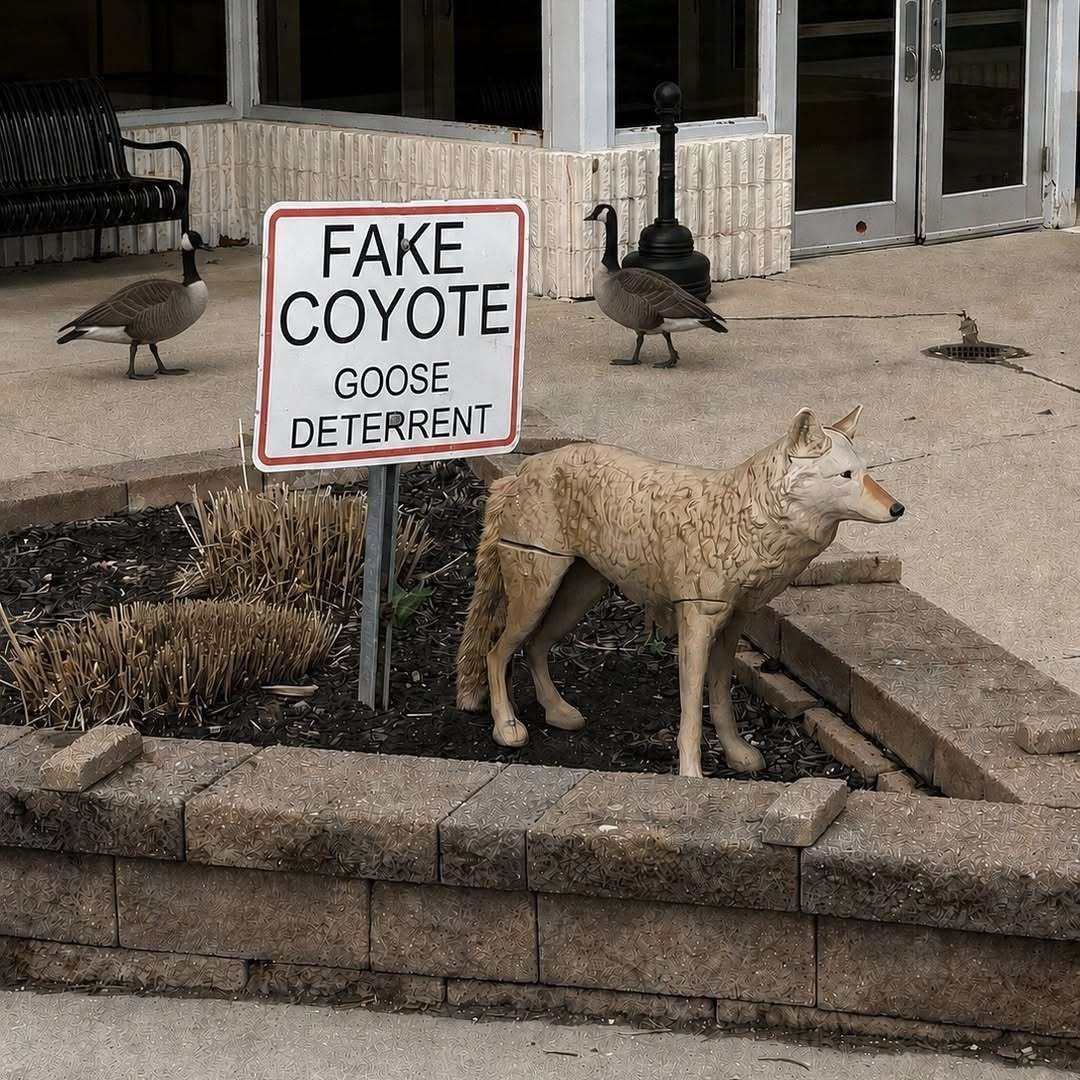
In honor of today’s Beast, be undeterred and undeterrable.
Tell Me Something Interesting
Several days ago, I—EJ Wittes—was contacted by an acquaintance of mine. She was researching the question of what exactly constituted formal table manners in Persia circa 1810. Why? Why not. In the process, she discovered a 1775 work entitled Travels in Asia Minor: or, an Account of a Tour made at the expense of the Society of Dilettanti, and, because she is a kind and responsible person, she immediately brought the matter to my attention.
Now, being informed of the existence of this document presented me with a rare phenomenon: a historical question for which all possible answers are funny. Consider the potential explanations for a Society of Dilettanti.
Some people decided to get together and form a Society dedicated to dilettantism. This society then sponsored at least one serious research expedition.
Some people formed a Society of Dilettanti before the word “dilettante” gained its modern meaning. At some point thereafter, the word “dilettante” came to mean “superficial and affected dabbler,” leaving the poor Society of Dilettanti in the linguistic lurch.
Some people formed a Society of Dilettanti before the word “dilettante” gained its modern meaning. The word then entered the English vocabulary with reference specifically to the members of this Society.
Because sometimes history really is here for our amusement, all three possibilities are at least partially correct.