


Good Morning:
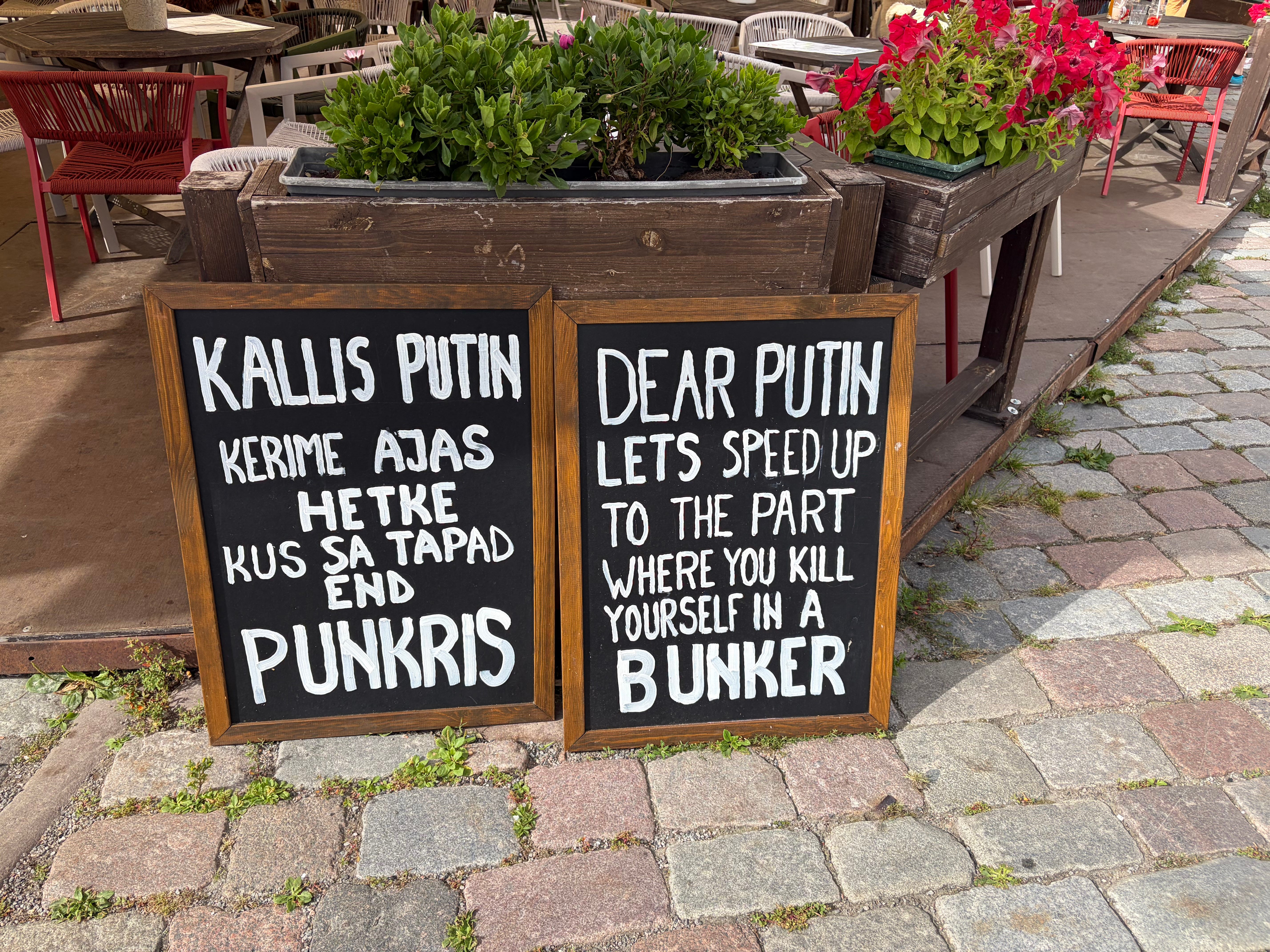
Seen in Tallinn by the most estimable Holly Berkley Fletcher.
Monday on #DogShirtTV, the estimable Eve gaumond listened to me explain my latest project:
Tuesday on #DogShirtTV, the estimable Alicia Wanless continued our discussion of Christopher Nolan’s Odyssey, and I talked about getting homework from Claude:
Yesterday on #DogShirtTV, the estimable Anastasiia Lapatina and I discussed the next few orders of business for the Greek Chorus Foundation:
Which brings me to today’s polls. As you probably know, all of the major decisions of the #GreekChorusFoundation, which you should support, are discussed on the show and then made collectively through polls on the show. So here are a few questions that we discussed yesterday.
A little bit of background before you vote on these: The #GreekChorusFoundation, which you should support, is currently raising money for #OperationTaya (have you donated yet?). We have made our first tuition payment and have a second one due at the end of the October. At the broadest strategic level, the question is whether we should focus on raising the rest of Taya’s tuition or whether should engage in other projects simultaneously. Specifically, we discussed one major idea yesterday:
The pros, in brief: We have a window before winter comes to raise and spend money to help people position themselves better. The cons, in brief: We still have a fair bit to raise on #OperationTaya (hint, hint, hint), so this could compete with that or even undermine it.
My opinion: For what it’s worth, I think we should take it on. The battery fundraiser last year was self-driving in a way that #OperationTaya was not, being a more bespoke effort to make something happen for one very worthy person. I think there is a lot of good to do in the battery department and it could get a lot more people involved.
This is an important question for two reasons: We want to be scrupulously honest with donors—and if we are going to pool funds, it’s important to be candid that some funds #OperationBattery might go to support #OperationTaya. Second, if we segregate funds, there’s a risk of orphaning #OperationTaya, because the call of keeping people in power and warm is so compelling compared to the tuition needs of one public servant. Segregating funds is also a bit of a record-keeping hassle. My own view is that we should pool funds of all the projects but also be very candid with donors that this is what we are doing.
This question is mostly self-explanatory, but a few notes: during #OperationBattery, we bought a lot of batteries and mostly just gave them away to people in Anastasiia Lapatina’s greater cinematic universe. This allowed us to make a big difference in the lives of many people, particularly people with small children. That said, some of our highest-value decisions were decisions to support small institutions that serve many people: a classroom in a public school, for example, or a small business serving women and children. For what it’s worth, I think a mix here is the right strategy but I can see the argument for focusing narrowly on either individuals or institutions.
Recently On Lawfare
Compiled by the estimable Sarah Willrich
Dispatch: Setting Up Secret Courts
Peter Beck reports from the first public hearing of the Alien Terrorist Removal Court, where Judge Joan Ericksen heard initial statements from the government and respondents about Nazira Haji Zada’s alleged connections to the Islamic State.
After this, O’Byrne specifically points to a subsection in the ATRC statute that allows the removal hearing to proceed without an unclassified summary if the judge deems that the noncitizen’s presence in the U.S. and the provision of the summary would both “likely cause serious and irreparable harm to the national security or death or serious bodily injury.” I feel lost as to how this would impact the Haji Zada’s attorneys’ access to classified discovery.
Apparently, I’m not alone. Judge Ericksen tells the Justice Department to file a brief on their argument. She says her presumption will be that the federal defender’s office will be able to review classified evidence and will need a “pretty strong reason” to change her mind.
If AI Outputs Aren’t Speech, Who Has to Prove They’re Human?
Becca Branum highlights the underappreciated consequences denying First Amendment protections to artificial intelligence (AI) outputs could have on humans. She explains that existing detection tools can flag AI-like patterns, confirm a file’s history, or verify that a real person exists, but none can establish whether a human is behind a specific piece of text, the factor that determines whether First Amendment protections apply. As a result, Branum argues, platforms and governments are likely to turn to human verification systems which impose additional burdens on users and may compromise privacy.
Suppose a state provided that only verified humans may post on a large social-media platform. Because unadopted machine output would carry no First Amendment interest, the government could cast the verification step as an incidental burden on protected speech—much as Texas defended the age gate in Paxton—even though every human user would now have to authenticate before saying anything at all. The burden on a person required to establish human attribution then appears incidental rather than as a direct restriction on speech. That classification may determine the applicable level of scrutiny.
After Chatrie, the Real Fight Over Digital Privacy Is Just Beginning
Christy Lopez argues that the Supreme Court’s decision in Chatrie v. United States, holding that the Fourth Amendment applies to geofence searches, is likely to be gradually limited by lower courts, resulting in a more modest win for digital privacy advocates. Instead of relying on courts’ interpretations, Lopez defends the need for legislation at the federal and state level to clarify when and how law enforcement can use their increasing arsenal of digital surveillance tools.
In other words, now is when things get dicey. The Supreme Court decided in Chatrie that geofence warrants trigger Fourth Amendment protection. But it will be hundreds, or even thousands, of judges presiding over criminal cases who shape the contours of that constitutional protection in coming years. And they will do so in a context that structurally discounts the importance of the constitutional protections at stake, perhaps even to the extent that the courts may create a reverse warrant legal regime that is less protective of digital privacy rights than was Google.
The Case Against the Proposed Chip Security Act in Taiwan
Dah-Wei Yih analyzes the constitutional implications of new legislative controls over semiconductor exports proposed by Taiwan’s opposition party. He explains that the proposal would allow lawmakers to review exports themselves, a task traditionally reserved for executive agencies. Yih argues that such a move threatens separation of powers and risks losing expertise in reviews.
Outbound investment review, at its core, functions as a national security screening mechanism for outward transactions. It requires applying legal standards to the concrete facts of a proposed transaction and making individualized decisions in light of case-specific circumstances. These are functions traditionally associated with the executive branch. If legislators assume both the power to enact general rules and the authority to administer them in individual cases, the result does not merely blur the distinction between legislating and administering. Rather, the legislature effectively substitutes itself for the executive in the exercise of a constitutionally assigned function, contrary to the Constitutional Court’s instruction that checks and balances do not permit one branch to substantially deprive another of its authority or simply usurp that authority.
Grokipedia Stopped Reviewing Edits in April. It Didn’t Tell Anyone.
Renée DiResta and Ronald Robertson analyze Grokipedia’s update records, finding that the site appears to have stopped considering human edits or updating the site since late April. DiResta and Robertson highlight how Grokipedia’s lack of transparency harms both the site’s reliability and ability to demonstrate the promise of an encyclopedia supported by artificial intelligence (AI).
Altogether, what we found was that the “live” change feed is gone, past decisions were retroactively reverted without explanation, new decisions are not being issued, and article text appears frozen (and, in some cases, outdated). We do not know whether xAI is preparing a major revision or has altogether abandoned active development of the project.
Immigration as a Test Case for Executive AI Governance
Camille J. Mackler explains that the executive branch is already using AI for governance in immigration enforcement where legal protections are weak and emphasizes that many of the same AI-tools and practices will likely spread beyond immigration, just as post 9/11 surveillance infrastructure did. That trajectory, Mackler argues, makes it urgent to build in transparency and oversight safeguards now, before these systems become further entrenched.
This is why it is important to embed privacy and surveillance protections from the outset in government technology. Infrastructure first developed where legal protections are weakest rarely remains confined there. The data systems supporting immigration enforcement do not neatly distinguish among noncitizens, family members, neighbors, or bystanders whose information enters the same networks; as we saw with post‑9/11 surveillance authorities built in the name of national security, tools first justified in immigration and border contexts quickly expanded to cover broader populations.
Podcasts
On Monday’s Lawfare Daily, I sit down with Peter Harrell, Eric Columbus, Anna Bower, and Roger Parloff to discuss legal challenges to President Trump’s new tariffs, recent motions by James Comey in the ‘86 47 seashell’ prosecution, developments in the Reflecting Pool prosecution, a hearing on Anthropic’s summary judgement motion challenging their supply chain risk designation, and more.
On Tuesday’s Lawfare Daily, Natalie Orpett speaks with Dara Massicot, Ariane Tabatabai, and Julia Curlee about the short war illusion that is playing out in Ukraine and Iran today and how it could manifest in a future conflict between China and Taiwan.
On Scaling Laws, DZ Kalman joins Kevin Frazier to explore what religious traditions can teach artificial intelligence (AI) governance. They discuss religious responses to AI, Jewish technoculture, kosher supervision as a model for AI certification, the limits of AI use in faith contexts, and how it all connects to debates on alignment, trust, and human dignity.
On Wednesday’s Lawfare Daily, Tyler McBrien sits down with Bernice Yeung to discuss Yeung’s recent article about the bumpy history of Big Tech’s relationship with U.S. defense contracting, how Silicon Valley has reshaped the Pentagon, and how, in turn, the Pentagon has reshaped Silicon Valley.
Today’s #BeastOfTheDay is the orca, seen here making a sunfish explode, seemingly just for the hell of it:
The research, described in Frontiers in Ethology, examined two documented cases off the coast of Mexico’s Cabo San Lucas of orcas killing sunfish, teeing up their carcasses, and torpedoing toward them at speeds great enough to blow the bulky animals to bits.
Experts say this never-before-seen behavior could make it easier for the marine mammals to make meals of sunfish, which have thick, tough skin. “Killer whales can’t chew,” notes Michael Weiss, a behavioral ecologist at the Center for Whale Research who was not involved with the work. “So regardless of what they eat, they need to make bite-sized chunks.”
It’s also possible the orcas might simply enjoy the act of turning sunfish into shrapnel. “The purpose of the behavior could be anything (or any combination of things): fun, prey processing, practice, teaching, you name it,” Weiss says.
Indeed, “Orcas are known for playing with their food,” study co-author Kathryn Ayres, a marine ecologist and research scientist with the U.S. ocean conservation nonprofit Beneath the Waves, said in a statement released by the organization.
In honor of today’s Beast, eat messily. There’s no shame in enjoying yourself.
