


Good Morning:
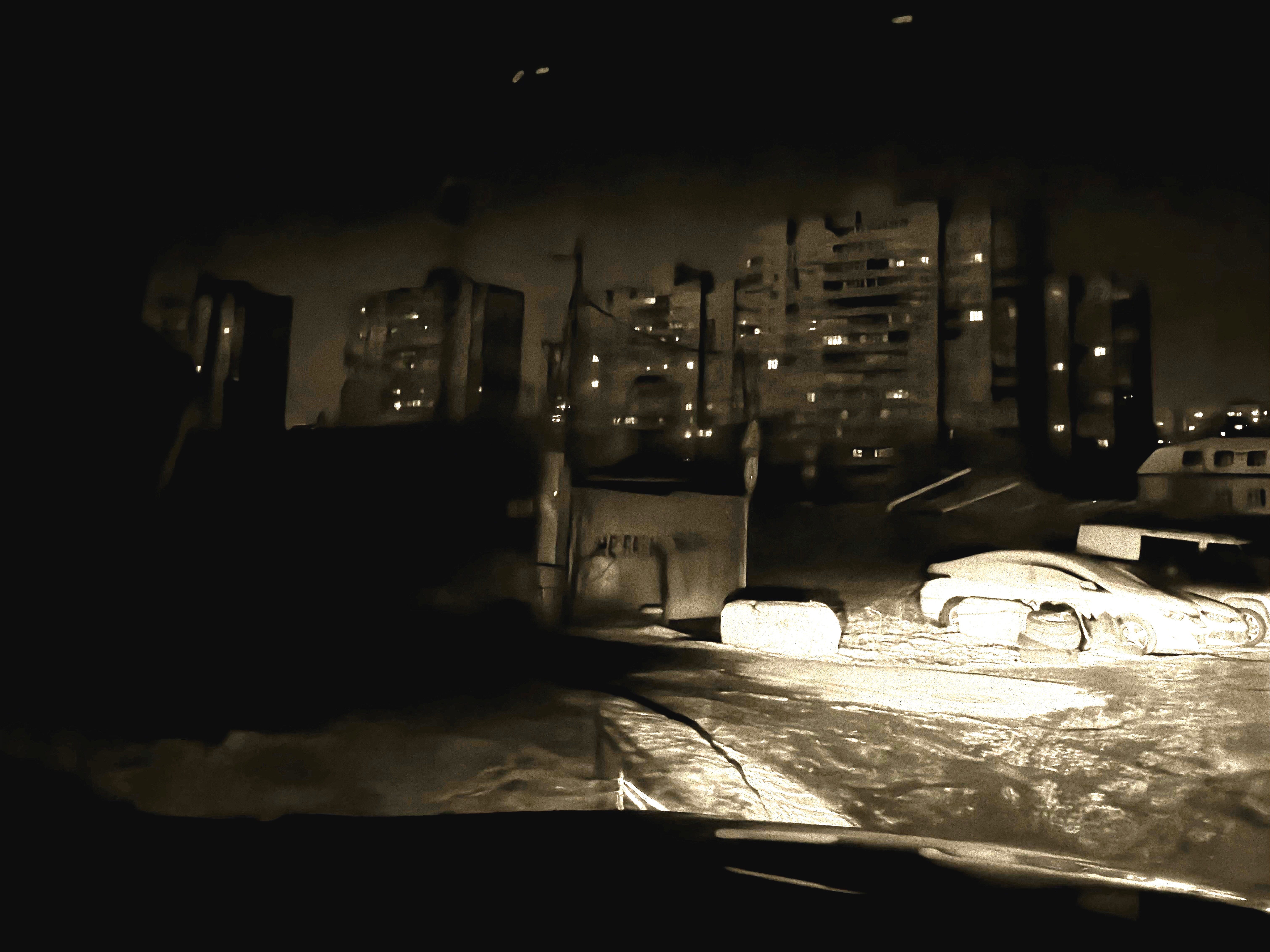
I shot this photograph last night at 8:30 pm in a Kyiv neighborhood that is almost completely blacked out. A series of cascading power failures have knocked out electricity to an enormous number of people, and because of the way heat is delivered in Ukraine—most buildings do not heat themselves; there are centralized heating plants that deliver heat to thousands of buildings—a comparable number are without heat too. Power outages and pipes freezing have meant that large numbers of people are without running water—including the estimable Anastasiia Lapatina, who texted me this morning: “Our apartment is properly freezing . . . Oh and there is no water.”
Why are there scattered lights in these buildings? Batteries.
“Properly freezing” is not hyperbole. The temperatures below are in Fahrenheit:
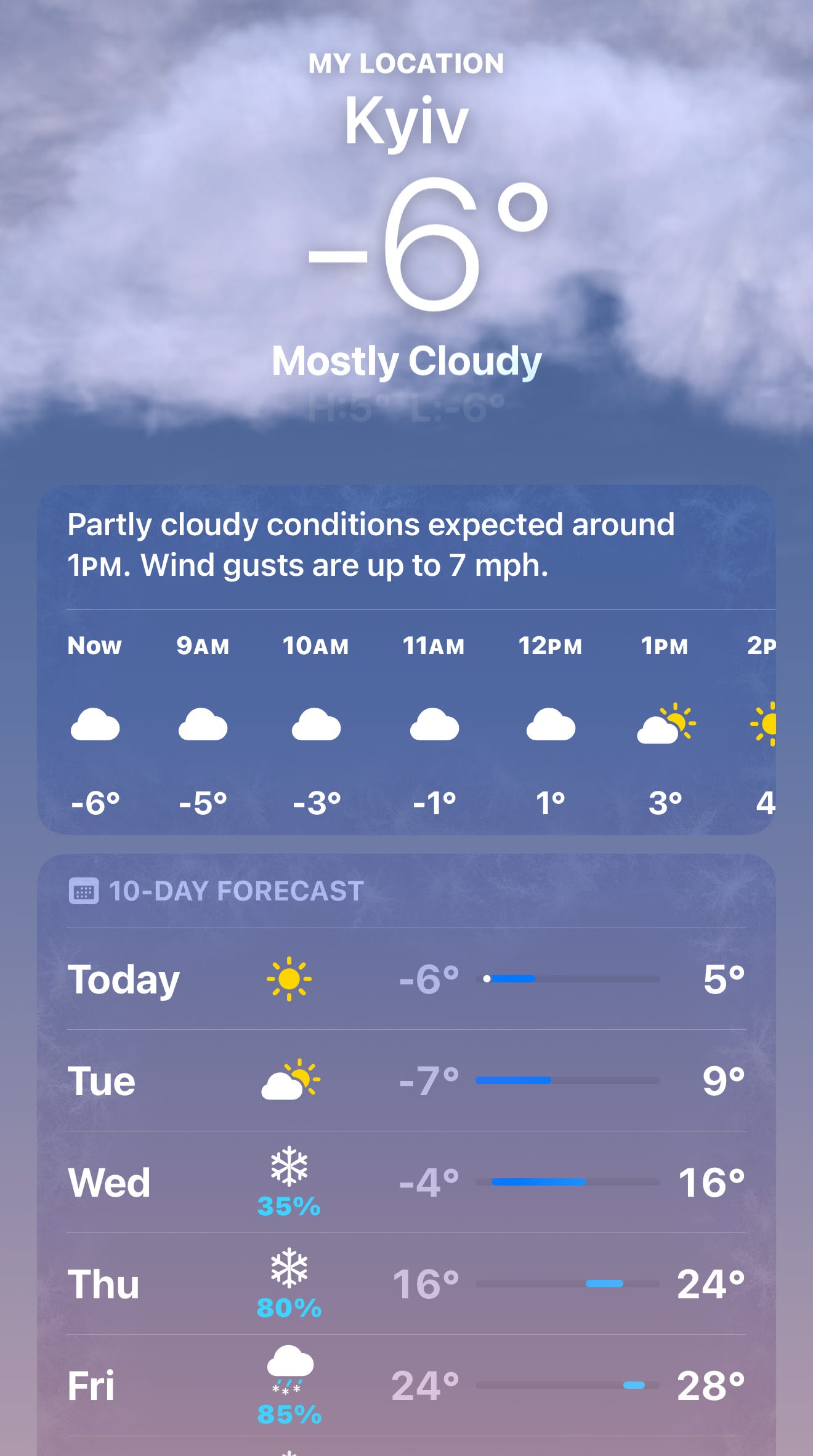
(For those who are not in the United States, I am displaying these temperatures in Fahrenheit, because the phrase “below zero” means something very different to people who think in Fahrenheit than it does to people who think in Celsius. People who think in Fahrenheit are used to Celsius temperatures making everything seem much colder than it feels to them.)
It is against this backdrop that I want to update you all on Project Batteries, about which I just brought my spreadsheet up-to-date. We haven’t been able to buy and distribute batteries the last few days, as we have been in Odesa, and we were running low on cash. Over the last few days, some new funds have come in, and I put in $5,000 of my own, so we have about $15,000 to burn over the next few days. And I think it’s fair to say that we feel a certain urgency about this—because the number of lights in those buildings is small relative to the number of dark areas, and because a battery powerful enough to light up an apartment and recharge a phone or laptop is, generally speaking, not going to remotely powerful enough to keep that apartment warm.
What we are doing is a tiny drop in the bucket. But it’s very significant for the individuals and institutions whom it helps. And we want the number of such people to be as large as possible—not because it makes a difference systemically but because it makes a difference to individual people.
I had coffee the other day with one such person for reasons having nothing to do with the battery, and she asked me how this came to start. I told her the story about how the Greek Chorus decided to buy a battery and a Starlink for Nastya, and about how Nastya then suggested we make a kind of a program out of it, how the Greek Chorus voted on this in the form of a poll and started sending me money—lots of it. She rolled up her sleeve and tapped her forearm and said (in Ukrainian), “goosebumps.”
I will be on the road again starting tomorrow morning, so Nastya will be handling acquisition and distribution—as she does anyway. I am actually quite superfluous on the Kyiv side of this operation; my job, quite frankly, is to put cash in her hands, to supervise and provide some high level guidance on priorities, to make sure we have receipts for everything we do so that people feel comfortable giving, and to try not to get in her way.
Here are the updated numbers:
Total contributions so far: $66,115.80
Number of individual contributions so far: 376
Median contribution: $96.12
Average contribution: $175.84
Largest individual contribution: $5,000 (I think it’s important that I have visible skin in this game)
Largest individual contribution not from me: $3,500
Total tax deduction achieved by any of 376 people in exchange for their generosity: $0
Batteries purchased: 14
Batteries delivered to families: 13
Batteries delivered to institutions: 1
Current wait-list of families and institutions: 4
Cash on hand to spend: Roughly $15,000
Current temperature in Kyiv: -6 degrees Fahrenheit
Thanks to everyone who has contributed and continues to contribute.


Friday on #DogShirtTV, there wasn’t a show. Shows this week will continue to be erratic. Today’s show will take place at the normal time. Tomorrow and Wednesday I will be traveling, and the show will not take place at the regular time. I will try on either or both days to do a show in the late evening here before I go to sleep. This will depend on exhaustion on my part and internet availability/stability. If I am able to do them, I will stream them to Substack Live so that folks will get a notice when they start—as I won’t be able to announce them much in advance. No promises, but I’ll do what I can.
Thursday there will be show at all. We should be back to normal schedule on Friday, when I will be in a more permissive environment.
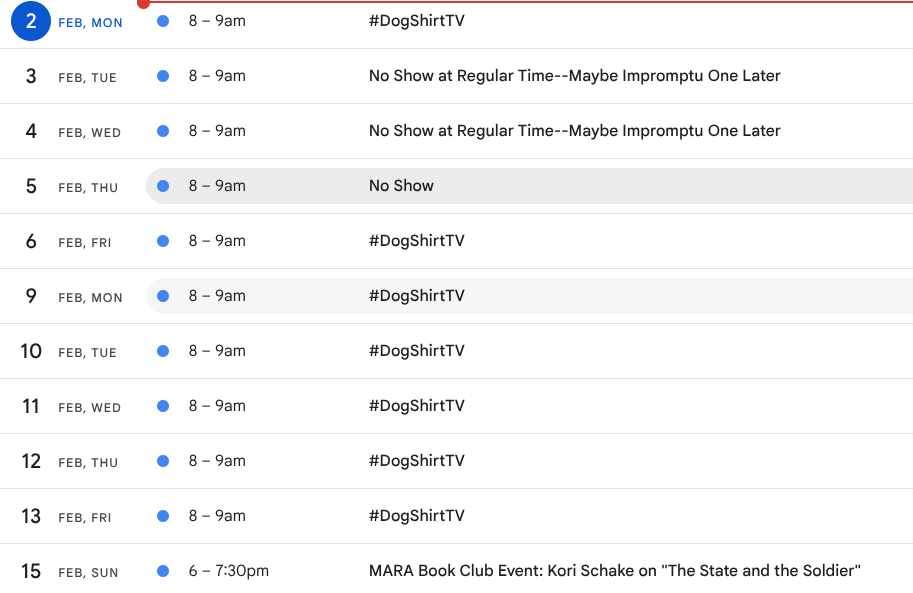
A reminder as well that the next meeting of the MARA Book Club, featuring the most estimable Kori Schake, will take place on Sunday, Feb. 15. See the calendar entry for all the details.
The Situation
The Situation on Wednesday took a look at The Situation from the vantage point of a city facing a less self-inflicted situation.
One funny thing about watching The Situation from abroad is that it seems to speed up. I have spent the last several days in Ukraine in an intensive series of meetings with a diverse array of people all focused—in very different ways—on the war here. The Situation shows up in these conversations not infrequently, because people want to understand where the United States stands and where it is likely to stand over the coming weeks, months, and years. But it is never the focus. It is not even the background. It is one of several backgrounds.
When you go abroad and you focus intensively on the security problems of another country, you dramatically reduce the number of hours per day that you dwell on The Situation. You read many fewer news stories. You don’t read legal briefs or court opinions. You may miss presidential statements. And the result is that the number of Situation frames per second decreases, making The Situation’s movements jerkier. The picture hops from image to image. You glance over at it and it looks different. You miss things.
And so you learn things in funny ways:
I received a text Thursday that read, “DNI Tulsi Gabbard overseeing FBI raid at Fulton County elections board is terrifying. They are calming the ICE stuff but going full tilt on other awful things.” This was how I learned, a day late, that there had been an FBI search warrant at the Fulton County elections board in the first place, much less that Gabbard had been present for it. And it was the first indication I had that the “ICE stuff” might be calming.
Even as I am writing these words, I received a text that reads, “I am procrastinating from writing about Don Lemon. #jesuislemon.” I paused before responding, “What’s up with Don Lemon? Why #jesuislemon?” I kind of knew what the answer would be: “DOJ arrested him.” And so I learned about Lemon’s arrest.
There is emotional health in watching The Situation in jerky fast motion while focusing on other things—though there are probably healthier ways of disengaging from The Situation than going to a war zone in a time of pretty desperate cold. One doesn’t actually need to learn about every outrage in real time. There is value in forcing oneself to study something serious, rather than wallowing endlessly in the self-destructive inanity of American executive governance.
But there is also a certain stress associated with not keeping up. The Situation is a jealous mistress. She wants all of your attention all of the time. She wants you to believe that the fate of democracy rests on your knowing that Lemon was arrested the moment that fact broke via some news alert or on social media. She wants you to experience distress if you get a text that you can’t quite parse about Tulsi Gabbard, ICE, the FBI, Fulton County, and some search warrant. The Situation does not want Lawfare to write about other security issues. It does not want me to think about Ukraine—except, of course, when I write about Ukraine as an expression of The Situation. The Situation wants to absorb you completely and it will stress you out when you resist absorption.
It works. This weekend finds me in Odesa, a city almost completely without power and under regular bombardment by Russian forces. It is quiet here right now because of an eerie pause in Russian attacks on Ukrainian power infrastructure—a pause requested both by President Trump and by Ukrainian negotiators at peace talks. As the New York Times describes the matter:
An adviser to the Ukrainian president’s office said that Ukraine had asked for a pause in strikes in a meeting with Russian negotiators last weekend, and that the Russian side had agreed, but not in writing. In Russia, reports of an order to hold fire temporarily on Kyiv and Ukrainian energy targets surfaced early Thursday on the Telegram accounts of pro-war bloggers close to the Russian military.
The pause is scheduled to last only until Feb. 1, when it is also forecast to grow dangerously cold once again all over Ukraine.
The press in the United States—understandably absorbed by The Situation and its latest abominations in Minnesota and elsewhere—has dramatically undercovered the power crisis here. Millions of people have no electricity and heat at a time when temperatures are headed below zero and the capacity to repair infrastructure is gravely impaired. I understand, really. Even being here, absorbed 24-7 in thinking about this country’s overwhelming security difficulties, I feel a little bit guilty every time I get one of these texts that reminds me that The Situation is jealous of my attention. I have looked away, because I am a bad citizen. I have looked away because I don’t care enough about my own community. I have looked away because I am unfaithful.
I know this is nonsense. The fight to preserve democracy takes place worldwide. One front is in Minnesota. And it is well-covered. And another front is here—where actual bombs fall every day, and where people don’t have electricity or heat, and where the temperatures will be below zero shortly. And there is a real danger that this front gets ignored because of The Situation’s jealousy for our attention, because The Situation is our situation, because going out and defending our own democracy is hard enough—but what can we really do to help people in Kyiv who live on the 16th floor of a Soviet-era apartment building which has no electricity or heat except in a single elevator it is dangerous to get into? So my job is to think about this while it is hard for others to do so, because it is hard for others to do so—to remind people that there is a profound connection between stopping ICE violence in the streets in Minneapolis and the larger struggle by free peoples to avoid domination by authoritarianism, that there is a seamless web binding together disparate components of the fight against despotism. And my job, sometimes, is to make visible the often-invisible threads of that web, even if that means sometimes missing the details of The Situation. I believe this very deeply.
But I don’t always feel it. So every time I get a text that reflects that The Situation is changing faster than I can follow from here, I feel a pang of guilt—and a pang of fear as well, because how on Earth am I going to catch up? And I tell myself that The Situation doesn’t own me. And I tell myself all the things that appear in the paragraphs above, which I really do believe. And I tell myself that The Situation will be there waiting for me when I get home. And sometimes, as I felt compelled to do with the Fulton County FBI raid and Gabbard—I actually dive in and do a crash course and help write something. But that guilt for cheating on The Situation never really goes away.
That’s the thing about all-consuming political environments: They are all-consuming even when you venture to other all-consuming political environments.
Which is one reason why The Situation continues tomorrow—even if I miss details.
Friday on Lawfare
Compiled by the estimable Marissa Wang
We Have Questions About the FBI’s Fulton County Search
Anna Bower, Eric Columbus, L.T. Edwards, Michael Feinberg, Molly Roberts, and I raise and answer questions related to the Federal Bureau of Investigation’s (FBI) search of the Fulton County, Georgia election hub as part of an investigation seemingly tied to revived 2020 election fraud claims, despite years of courts finding no evidence of wrongdoing in Georgia’s vote count. Our queries cover topics such as the legal basis for the warrant, the statute of limitations, and the unusual involvement of Director of National Intelligence (DNI) Tulsi Gabbard.
The FBI executed a search warrant on Wednesday at the Fulton County Election Hub and Operation Center outside Atlanta, Georgia. The Justice Department, through the FBI, stated that it was conducting a “court authorized law enforcement action.” A few hours later, Trump posted a flurry of conspiracy theories on TruthSocial, including sharing a post from an anonymous account that accused Italian hackers, the CIA, the FBI, and China of conspiring to rig the 2020 election.
You may remember the 2020 election fracas in Georgia.
AI Will Automate Compliance. How Can AI Policy Capitalize?
Cullen O’Keefe and Kevin Frazier delve into the future of regulatory compliance with artificial intelligence (AI) at the helm. O’Keefe and Frazier propose that policymakers should implement automatability triggers that preserve a balance between innovation and regulation.
Automated compliance is the future. But it’s more difficult to predict when it will arrive, or how quickly compliance costs are likely to fall in the interim. This means that, for now, difficult trade-offs in AI policy remain: In some cases, premature or overly burdensome regulation could stifle desirable forms of AI innovation. This not only would be a high cost in itself but also would postpone the arrival of compliance- automating AI systems, potentially trapping us in the current trade-off between regulation and innovation. How, then, should policymakers respond?
Minnesota’s Compelling 10th Amendment Case Against Trump’s ICE Surge
Ilya Somin explains the state of Minnesota’s 10th Amendment anti-commandeering argument in its lawsuit against the Department of Homeland Security’s deployment of thousands of federal agents to Minneapolis and St. Paul as part of Operation Metro Surge. Drawing on precedent and the Trump administration’s statements, Somin warns that if courts permit the federal deployment to continue, it would set a dangerous precedent that allows the executive to strong-arm states using force, disruption, and threats.
The administration’s current actions are more egregious than those struck down in previous anti-commandeering rulings. Here, there is no congressional authorization for federal coercion of states; the president is acting on his own. And the direct use of force is even more blatantly coercive than illegally withholding federal grants. If the federal government cannot coerce states by enacting commandeering laws and imposing grant conditions, surely it cannot do so at the literal point of a gun.
The National Security Strategy and the Maduro Operation: A Coherent Mess
Gabor Rona examines how the Trump administration’s National Security Strategy (NSS) and its military operations in Venezuela reflect a rejection of the rules of international order in favor of regional dominance and power. Rona posits that by replacing legal justification with a Monroe Doctrine-style logic, the strategy erodes U.S. legitimacy, weakens alliances, and undermines the civic, pluralist foundations of American leadership.
The Trump administration’s NSS is a radical departure from previous such statements of U.S. policy. It doesn’t attempt to justify departures from the rule of law. Instead, it refuses to render homage by simply ignoring the international legal order. By ceasing to argue within the law’s categories and instead appealing to civilizational identity, regional prerogative, and unvarnished power interests, the administration challenges the premise that international law organizes legitimate state action at all. That rejection—of the law’s authority, not merely its constraints—is the big deal.
Punish the Wicked, Reward the Righteous
In the latest edition of the Seriously Risky Business Cybersecurity Newsletter, Tom Uren explores efforts to curb abusive commercial spyware through the Pall Mall Process, the effectiveness of U.S. and U.K. telecommunications regulations against Chinese hacking operations, and more.
The overall goal of the Pall Mall Process is to shape the commercial cyber intrusion market and ensure that its products are used only for legitimate uses, such as assisting law enforcement.
It’s nice that industry stakeholders are invited to participate, but we think any actual success will come down to government action. It is our cynical view that voluntary industry standards take a lot of time to develop and rarely do much to shape the industry. But the canapes are great.
Podcasts
On Lawfare Daily, Kyle Cheney joins Roger Parloff to discuss the thousands of habeas corpus cases that challenge the Trump administration’s policy requiring mandatory detention of undocumented immigrants. The pair parse through how judges have ruled, how those rulings mesh with political expectations, and the potential for appeal.
Videos
On Lawfare Live, Parloff, Bower, Roberts, and Columbus sit down to discuss the Federal Bureau of Investigation search of an election office in Fulton County, Georgia, the arrest of protestors in Minnesota, and more.
In honor of Kleio the dog—who had to go to the vet yesterday because she cut her paw and now has two weeks of drugs and the cone of shame—I am waving the normal rules of dog eligibility for #BeastOfTheDay status.
Hey dude, my site, my rules. I maketh the rules. I breaketh the rules. I restoreth the rules.
The #BeastOfTheDay is Kleio the dog, who would normally not be eligible for such an honor:

And now the rules are restored to their usual domestic-dogs-cannot-be-beasts-of-the-day-without-performing-an-act-of-valor status quo.
