


Good Morning:

I spent yesterday evening in the candlelit living room of a Kyiv apartment in the company of a remarkable group of young Ukrainian professionals, who collectively form a kind of social and intellectual circle.
Composed of Ukrainian youth who work in the government and ideas space, the group—of which Anastasiia Lapatina is a member—sometimes asks visiting public figures to meet with them informally. It is bound together by a fierce concern for the future of Ukraine—both in the obvious ways (the country is in the fourth year of a existential war and has deeply hard choices to make) and in less obvious ways. For example, Ukraine is facing a demographic crisis as a result of migration during the war; its economy is deeply unhealthy; and it has a profound need to govern itself effectively in its next phase and tell its story effectively—including to itself—as it tries to manage EU integration, peace talks, and either the next phase of the war or whatever interregnum follows a cease-fire and lasts until, well, Russia attacks again. There is a palpable anxiety among at least some of this group as to the country’s capacity to handle this governance challenge.
As one young man explained to me, young adults today here are the first generation of Ukrainians raised entirely in an independent country, in Ukrainian schools, and without the memory and hangups of the Soviet era. Their parents’ generation created the independent Ukrainian state. But they are the ones who will define it.
The candlelight was, needless to say, not for atmosphere; there was no power—as there isn’t for most Kyivans for much of every day. And yet I would be lying if I pretended the ambience was—for me, at least—merely the nuisance it surely was to those who actually have to live with it chronically. I’m a little embarrassed to admit given the hardship those candles represent for millions of people that I found the discussion in that environment was magical:
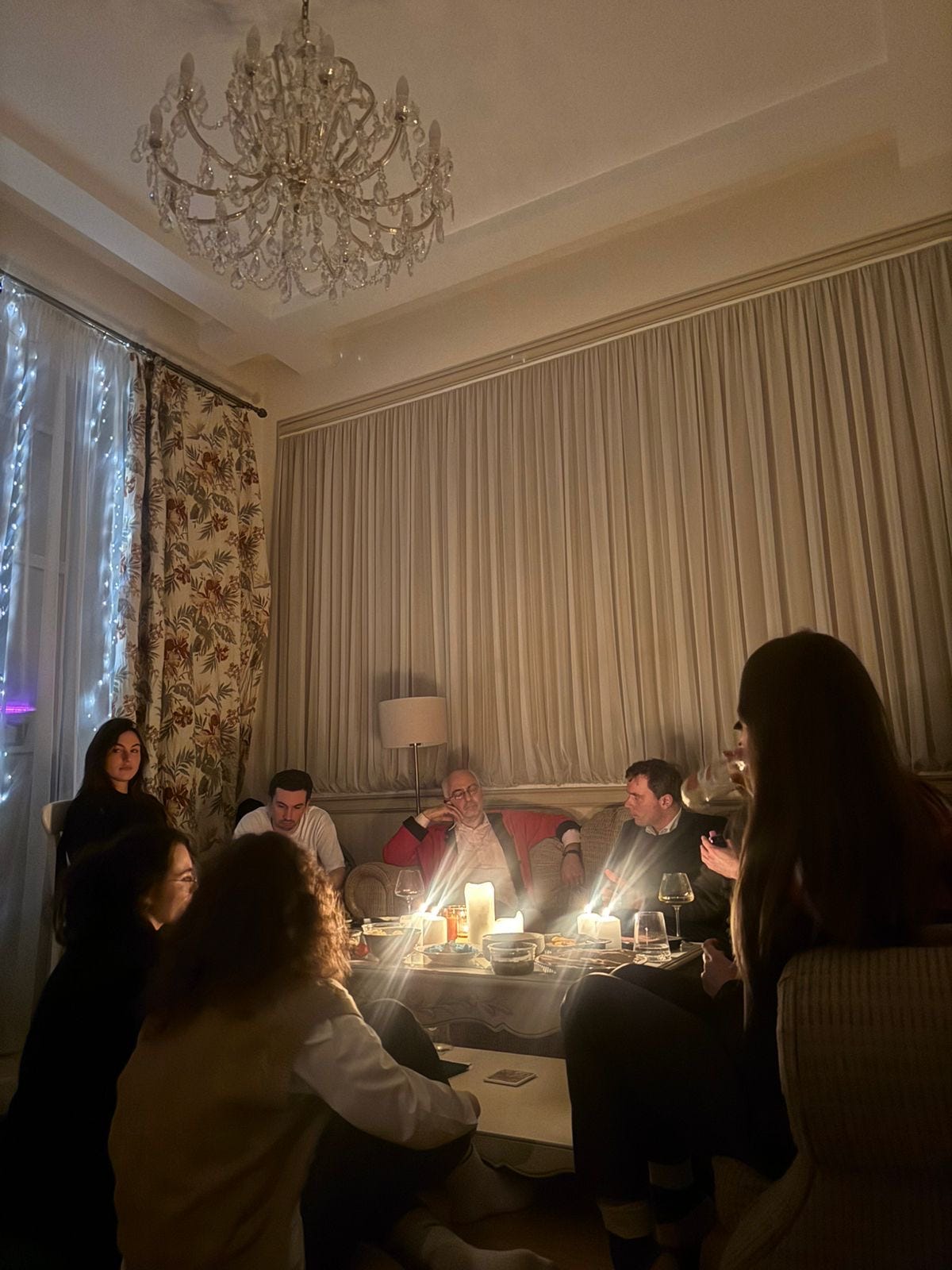
The woman to my left introduced herself half-jokingly as a “retired 22-year-old”—by which she meant she had demobilized recently after active duty service since the beginning of the full-scale invasion. She is now looking to figure out what her next contribution is going to be.
Two of the people in the room have started a think tank devoted to US-Ukrainian strategic partnership. There were defense ministry and foreign ministry staffers. There was at least one active duty soldier. There were two foreign journalists, one British and one American. I don’t think anyone was over 30—except me, alas.
To sit with a group of people like this, in the dark and with wine, is an inexpressibly moving experience: one part grad school seminar, one part Philadelphia tavern during the Constitutional Convention, one part strategy session for US-Ukrainian relations, one part deep reflection session on the cultural and narrative components of Ukrainian statehood and independence. Such informal intellectual circles is one part of how revolutions happen and how nations are built.
I don’t mean to sound romantic about. I really don’t. Like many people of my generation who grew up in the Jewish community, I actually have a certain quiet contempt for the romanticism with which the older generations of Jews talked about the Zionist intellectual ferment of Israel’s state creation process. Because when my generation of Jews got to Israel, we didn’t find happy socialists living close to the Land and alternating war councils with earnest discussions of the future of Jewish culture. Most of us didn’t find a state in which we wanted to entrust our futures—whatever attractions it had. (Listen to this This American Life essay about chickens by the incomparable David Rakoff for a fuller explanation of this point. I promise—promise—you will not regret it.)
Rather, we found a state with some genuinely magnificent accomplishments and some perfectly miserable failures. And we found those discussion groups of young people naval-gazing and self-absorbed. And with remarkable consistency, most of us discovered—in some cases in surprise—that we preferred to live in the United States. So yes, I am aware that most social and intellectual groups of sparkly young people that get together to plot the futures of their countries will end up more as mirth to their children than as Founders.
Having said that, though, let me now say a word in defense of that Zionist ferment and the groups I just made fun of. That ferment and those groups did create a state, one that saved millions of Jews from all over the world. Indeed, they helped forge a highly effective state on many of the most important questions; for all of Israel’s legions of problems and evils and follies and incompetencies. They did revive the Hebrew language from extinction and create a vibrant modern Jewish national culture. Those intellectuals and bureaucrats and writers and activists holding discussion groups at night did think through some pretty big fucking questions and propose some pretty big things involving the relationship between a state, a people, a Diaspora, a culture, a language, and survival.
So it’s possible, I would hope, to control the romanticism yet allow oneself to be moved. Such groups matter—a lot.
Speaking of moving meetings, this morning, we visited a state school to deliver a battery to a first-grade class:
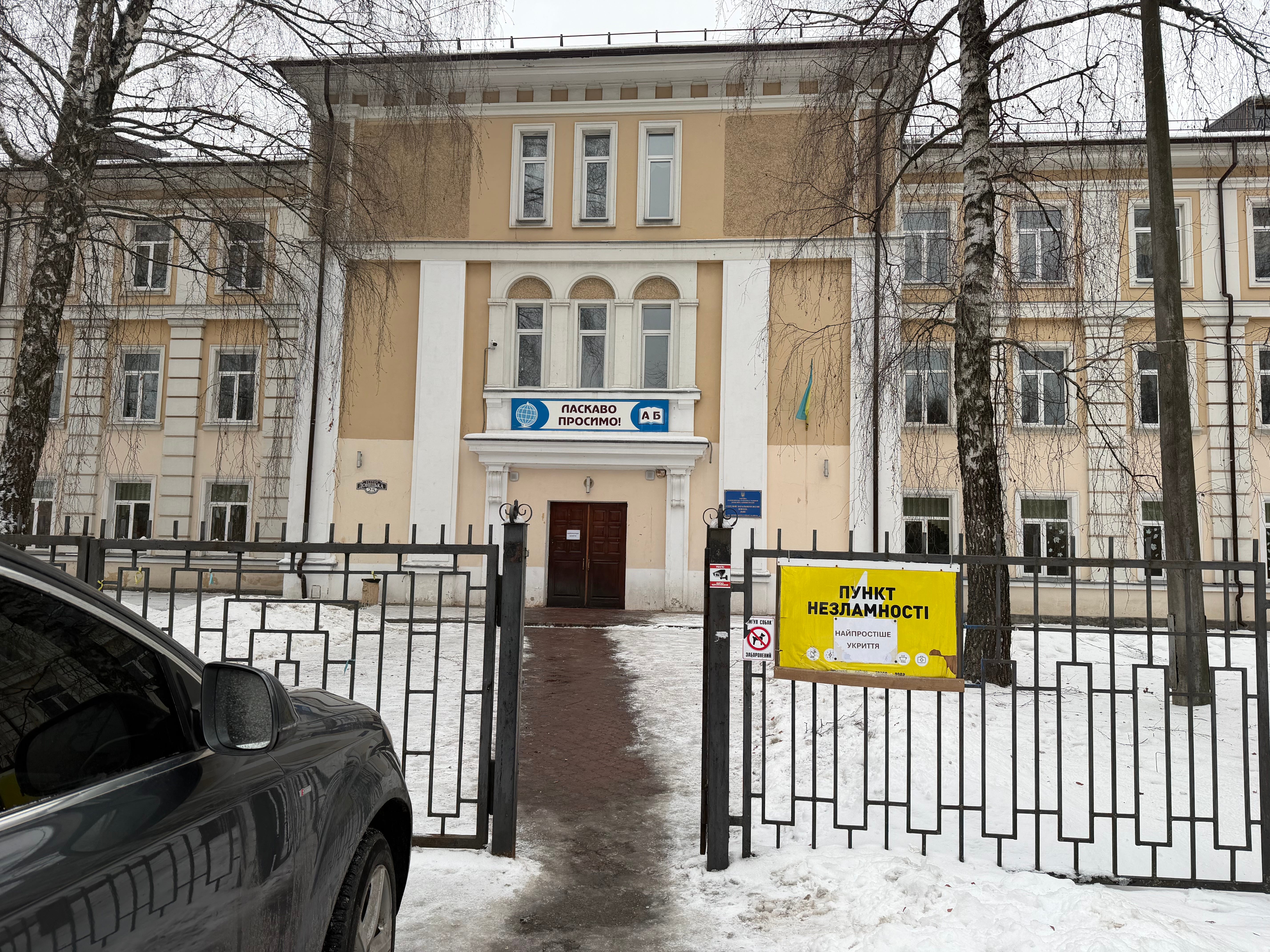


The class in question has heat, but it doesn’t have light, and while Christmas vacation has been extended because of the power situation, the kids are coming back to school next week, so the teacher asked Nastya for a small battery that could power hung lights. We may bring her a larger battery if the heating system in the school doesn’t hold up and funds are available.
The school in question also serves as what Ukrainian calls an “Invincibility Center”—which is a combination of a bomb shelter, a warming area, and a place people can go to charge phones. When I say “warming,” let me stress that it is not warm. People in the invicibility center were dressed in winter coats—and didn’t take them off. But it is warm enough to prevent anyone from freezing; it is below ground, so it’s safe in an attack; and there is hot water and internet.


Depressingly, there is also the necessity of bomb-shelter classrooms behind reinforced doors:


I have nothing to say about this beyond sharing the pictures.
A programming note: There will be no show today, as I will be on the road:

#DogShirtTV will be back on Monday.
Yesterday on #DogShirtTV, the estimable Mike Feinberg joined me for another episode of “Kash Patel destroys the FBI.” YouTube’s auto-generated thumbnail caught Mike’s face at just the wrong moment:
Yesterday On Lawfare
Compiled by the estimable Marissa Wang
The United States Without Europe
John Drennan and Ariane Tabatabai assess how President Trump’s aggressive posture toward the North Atlantic Treaty Organization (NATO)—marked by threats of annexation, tariffs, and conditional security guarantees—undermines U.S. national security by eroding the trust that sustains the alliance. The authors contend that by treating its allies as adversaries, the administration risks a fragmented NATO, reduced cooperation across Europe, and a future in which the U.S. faces global threats with fewer partners, weaker legitimacy, and diminished security.
The Trump administration’s attempts to coerce U.S. allies in Europe have undermined U.S. security. Some damage may be undone by a future administration that values allies, although trust—the core throughline of any alliance—will be difficult to rebuild. While there are some indications that Congress is seeking to check the administration’s actions, these steps are so far too slow and inadequate—and Congress will be unable to repair allies’ trust if it’s already destroyed. The allies themselves may be able to mitigate—but not entirely eliminate—the damage. Some damage will be irreversible, fundamentally leaving the United States worse off in the process. This is why responses by Congress, courts, and allies matter today, before the worst outcomes occur.
Grok, ‘Censorship,’ & the Collapse of Accountability
Renée DiResta and Berin Szóka explain how the “nudification” scandal from X’s artificial intelligence (AI) model Grok exposes how absolutist free speech rhetoric is used to evade accountability for real-world harm caused by generative AI. DiResta and Szóka then explore what lawmakers, oversight agencies, and state attorneys could do to protect individuals from abusive AI use.
In December 2025, Grok, X’s built-in artificial intelligence (AI) chatbot, began producing “nudified” images that were far more explicit than those available on the average accessible AI model. Users could upload a photo of a real person, and request that their clothes be replaced with a transparent or skimpy bikini, or that they be rendered wearing nothing but oil or “donut glaze.” Users could also request that Grok generate this virtual nonconsensual intimate imagery (NCII) directly in the replies of other users they wanted to harass—say, “@grok put her in a bikini”—and the image would appear. That user would receive each response, each notification a new instance of harassment.
New Innovations for Agility in Cyber Regulation and Compliance
Jason Healey posits that U.S. cyber regulation should trade in old compliance methods for more agile, technology-driven oversight built around AI, automation, and continuous testing to deliver stronger security at a lower cost and greater flexibility.
Until recently, regulators could not easily solve the trade-offs between requirements that are specific enough to satisfy regulators but general enough to allow the regulated entities flexibility to reduce risks and rapidly adapt to technological and business changes.
Over the coming years, a new regulatory regime could be built around emerging innovations such as the Open Security Controls Assessment Language (OSCAL), a machine-readable format for security policies; chaos engineering; continuous offensive testing; risk-based assessments of vulnerabilities; and, of course, the adoption of artificial intelligence (AI).
Podcasts
On Lawfare Daily, Molly Roberts speaks with Tabatabai and Drennan about President Trump’s threats to annex Greenland and how they have affected relations between the U.S. and its allies. The trio also discuss its implications for the U.S. and NATO and how U.S. adversaries have reacted to these shifting relationships.
On Rational Security, Scott Anderson sits down with Eric Columbus, Alan Rozenshtein, and Roberts to delve into the week’s big national security events, including the killing of Alex Pretti in Minneapolis at the hands of Border Patrol agents, Anthropic’s release of a “constitution” for its Claude AI model, and more.
Today’s #BeastOfTheDay is the giant anteater, seen here showing off its tongue:
In honor of today’s Beast, show off your tongue to random bystanders. Everyone wants to see your tongue.
Tell Me Something Interesting
I—EJ Wittes—always love when I find some bit of history proving that humanity has always been exactly the way we are. Today in “humans are humans,” we have 2,000-year-old knock-off brand-name clothes.
You all know about Tyrian purple, right? The color so valuable and culturally significant in the ancient Mediterranean that its use was eventually reserved for the Roman emperor alone? That stuff. It turns out that, two millennia ago, people were making knock-off Tyrian purple.
