


Good Morning.
The answer to the question in the headline is that it looks something like this:

And this:


And this:
And once you have seen them, the question of any anyone would do it kind of answers itself. Photo and video credits: The estimable Mariia Hlyten (aka Marichka).
Wednesday on #DogShirtTV, the estimable Andrew Steele came on to discuss the indictment of the Southern Poverty Law Center, and the estimable Jonathan Rauch had some thoughts on Kash Patel:
Yesteday on #DogShirtTV, some discussion of two abrasive, talented men with very little else in common:
Recently On Lawfare
Compiled by the estimable Marissa Wang
Designating Cartels as Terrorists Has Sweeping Legal Consequences
Poorvika Mehra and Katherine Tomaszewski argue that the Trump administration’s expansive application of the terrorist group designation to drug cartels and gangs opens the door for an overbroad use of executive power, enables militarized responses and legal overreach, and undermines the rule of law in counterterrorism frameworks.
In other words, while a designation is not itself a war authorization, it can supply the legal and political predicate through which other authorities are mobilized. Cartels, gangs, and criminal syndicates, once dealt with through law enforcement cooperation and anti-narcotics strategies, are now being reclassified as transnational terrorist threats to be terminated by state-sanctioned armed force. Furthermore, the broad power that the U.S. national security framework vests in the administration is being weaponized to justify imperialist motives in Venezuela, with Trump publicly stating the U.S. “will run” Venezuela—likely due to its large oil reserves—instead of backing the current opposition leader in the country. This rapid expansion of the counterterrorism framework demonstrates the broad and dangerous power that terrorism laws can enable within the administration.
Cruel and Unusual: Israel’s “Death Penalty for Terrorists” Law
Amichai Cohen and Yuval Shany unpack the context and provisions of Israel’s new law that extends the application of the death penalty to people convicted of murder carried out with the goal of denying the existence of the state of Israel. Cohen and Shany explain how the law represents a major break from Israel’s longstanding near-abolitionist practice by not only expanding capital punishment, but also weakening due process protections in potentially discriminatory ways.
On March 30, the Knesset, Israel’s parliament, passed on third and final reading the “Death Penalty for Terrorists” law. The law marks a radical shift in Israel’s policies on the death penalty: The country has only ever carried out two executions in its history (the last of which was in 1962), rendering it a de facto abolitionist state. The terms of the new law add further grounds for concern by removing important due process protections and appearing to apply discriminatory legal criteria. This law and another bill regarding the Oct. 7 trials—which is still pending before the Knesset—have the potential to significantly expand the use of the death penalty in Israel, raising serious concerns under both international and domestic law.
On a deeper level, the law seems to signal a legal-cultural move in Israel away from Western liberal traditions—which largely reject capital punishment and enshrine values of due process and equality—to a more populist and vindictive political system that uses the law in overtly politicized and discriminatory ways. In response, petitions have already been filed with the Israeli Supreme Court (see here, here and here), calling on it to intervene by striking down key provisions of the law. How the court will respond remains to be seen.
Blame the Pentagon, Not AI, for Preventable Targeting Mistakes
Rebecca Crootof argues that recent civilian casualties from U.S. strikes are primarily the result of flawed Pentagon decision-making processes, rather than the use of artificial intelligence (AI) tools. Crootof contends that the real failure lies in the Department of Defense’s abandonment of prior civilian harm mitigation policies, its resistance to external accountability, and a broader cultural shift prioritizing efficiency and lethality.
Children and other civilians were killed, needlessly, in a mistaken attack. But the problem is not whether AI was incorporated in the targeting kill chain. Rather, it’s that the Defense Department employed—and is likely still employing—a deeply flawed decision-making process for target selection.
The U.S. military already has the tools it needs to deploy AI responsibly and reduce civilian harm. It just needs an institutional commitment to doing so.
Absent that, there will be more preventable tragedies.
Implementing Cybercom 2.0 Should Not Postpone Establishing a Cyber Force
Erica D. Lonergan and Mark Montgomery explain why the Pentagon’s “Cybercom 2.0” initiative, which is aimed at improving cyber force generation through new authorities and organizations, cannot fully solve the military’s cyber readiness and talent problems. Instead, the duo write the initiative should serve as a foundation—rather than a substitute—for establishing an independent cyber force.
In recent remarks, Rep. Pat Fallon (R-Texas) reflected on the dire state of the U.S. military’s readiness in the cyber domain. Fallon lamented that, despite the military having had two decades to build a cadre of cyber leadership, “of the 13 or so general and flag officers assigned to Cyber Command, there is only one single one-star [general] with a cyber background.” This is not an outlier perspective. Indeed, there is a broad consensus that the U.S. military’s current force generation model for the cyber domain—how the military organizes, trains, and equips forces—is broken. The Pentagon acknowledged in 2025 that the status quo approach to building cyber talent “is not keeping pace with the rapidly evolving and increasingly contested cyberspace domain.”
Experts have coalesced around two paths forward. The first is to provide U.S. Cyber Command, the unified combatant command responsible for the military’s cyber operations, with greater budgetary control and acquisition authorities, an initiative dubbed “Cybercom 2.0.” The second is to establish a new branch of the armed forces, a Cyber Force, with the primary responsibility for force generation for the cyber domain. The policy debate falsely presents these as mutually exclusive options. Meanwhile, too many experts who support Cybercom 2.0 portray it as a faster, more efficient solution, overlooking its flaws.
Documents
Marissa Wang shares the indictment of the Southern Poverty Law Center, which accuses the prominent civil rights non-profit of engaging in a nine years’ long fraud operation and paying over $3 million in donations to informants inside violent extremist groups.
Podcasts
Lawfare Daily: ‘The Criminal State’ with Lawrence Douglas: Tyler McBrien sits down with Lawrence Douglas to discuss the latter’s new book, “The Criminal State: War, Atrocity, and the Dream of International Justice,” and unpack how and why international criminal justice shifted from a focus on the crime of aggression to an “atrocity paradigm.”
Lawfare Daily: Breaking Down the Lebanon Ceasefire: Scott R. Anderson sits down with Joel Braunold, Daniel Byman, and Mona Yacoubian to break down the recent ceasefire between Lebanon and Israel and what it may mean for their ongoing conflict, and the broader conflict with Iran.
Today’s #BeastOfTheDay is the chimpanzee, currently engaged in civil war. A new paper in Science reports:
In this work, we report a clear and extensively documented permanent fission of a chimpanzee group and the lethal aggression that followed. We analyzed 24 years of social networks, 10 years of GPS-based ranging, and 30 years of demographic data from the Ngogo chimpanzees in Kibale National Park, Uganda. We identified three key stages: (i) an abrupt shift from cohesion to polarization, defined as the consolidation of relationships into two cohesive clusters with reduced cross-cluster interaction; (ii) 2 years of increasing avoidance that led to the formation of two groups; and (iii) lethal aggression between former group members. These findings provide evidence that shifting relationships, independent of cultural markers, can fracture a community and catalyze collective violence.
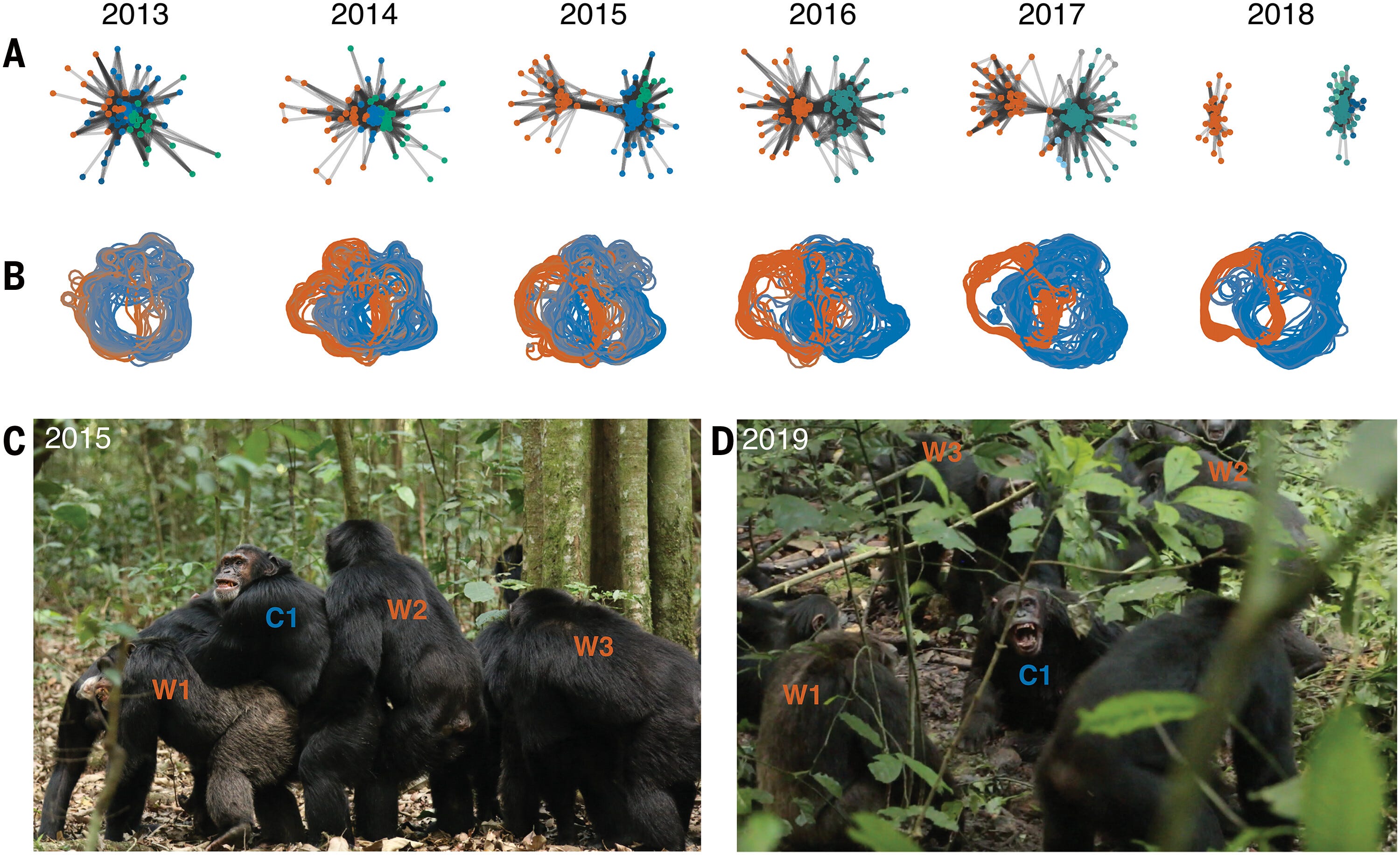
In honor of today’s Beast, read the whole paper. Seriously, it’s very neat.