


Good Morning:
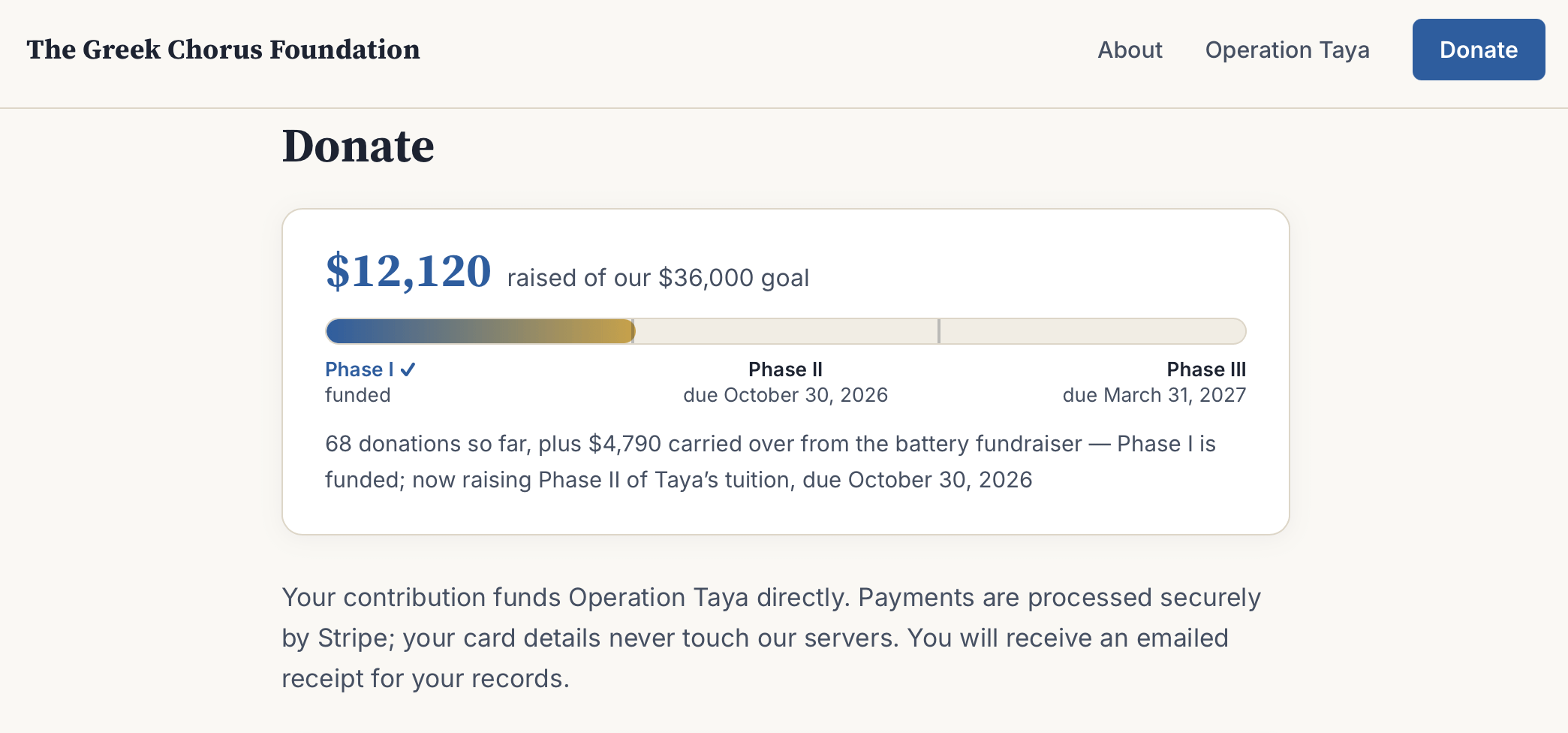
And we did it! Phase I of #OperationTaya is now complete. I will go to the bank and wire the first payment of her tuition to the College of Europe on Monday. Thanks to the dozens of you who contributed. I think we have proof of concept.

Yes, it can. And no, it doesn’t need to.

No.

Getting older. Becoming middle aged protesters.

No. Everything is bad for you. Even not drinking any alcohol is bad for you, because you’ll be drinking something else that will be bad for you. There’s no winning. It’s all bad for you for in the end.

No. It’s turned you into something even more annoying: which is a person who ruminates about whether he’s a sports guy. Watch sports. Don’t watch sports. Enjoy sports. Think watching other people you don’t know play sports is dumb. Whatever. Nobody needs your psychodrama about it.

Lift heavy things over and over again. Do wall squats. Do pilates.

No, I want to bet on your marriage, which won’t last.
Wednesday on #DogShirtTV, the estimable Eve gaumond had various questions, to which the estimable Holly Berkley Fletcher and I attempted to provide answers:
Yesterday on #DogShirtTV, the estimable Mike Feinberg and I talked AI and quantum computers:
Recently On Lawfare
Compiled by the estimable Sarah Willrich
When Commercial Satellites Become Wartime Intelligence
Joshua Villanueva explains the difficulty of categorizing commercial satellites under international law given the overlap between civilian and military uses. Villanueva argues that military utility alone is insufficient to deem satellites a valid wartime target, proposing instead a six-factor framework in which operational integration into military activity is the most significant element.
One state may view commercial remote sensing as part of the standard information infrastructure, while an adversary may consider it an intelligence asset supporting enemy operations. Russian officials have warned that Western commercial satellites could become targets if used to aid Ukraine, and the United States has stated that attacks on U.S. infrastructure would trigger a response. The legal status of commercial space infrastructure can become contested in real time, with serious implications for crisis stability.
The Next Mythos Moments
Anton Leicht and Alasdair Phillips-Robins warn that U.S. policy is unprepared to respond to future novel threats posed by leaps in artificial intelligence (AI) development. They argue that without preemptive action—primarily by the executive branch, with Congress eventually following through with legislation—the U.S. response will struggle to balance the risks of governmental overreach against the danger of moving too slowly to address vulnerabilities.
Spur-of-the-moment decisions are also more likely to be based on thin evidence and political happenstance. The risk is governance by streetlight: Whatever the administration becomes aware of receives attention, and whatever the developers successfully conceal remains unregulated. Given that precedent, if an AI developer were to spot dangerous biological capabilities in its next model and no mechanism existed to compel the company to inform the government, executives might think twice about approaching the administration, and policymakers would miss out on an important window to prepare defenses.
The Monroe Doctrine Was Never a Blank Check for Presidential War
Katherine Yon Ebright argues that those who encourage the return of the Monroe Doctrine, and its detractors, misunderstand its original intentions. Yon Ebright explains that the Monroe Doctrine was originally interpreted as supporting anti-imperialism and constitutional limitations on the president’s war powers, and that this conception only began changing later, in the 20th century.
Those who seek to aggrandize presidential power or to critique the Monroe Doctrine often note that the message does not foreclose U.S. intervention, as opposed to European intervention, in Latin America. But this glosses over the message’s disavowal of U.S. adventurism and its recognition of Latin American independence based “on just principles.” It also overlooks the well-established position of Monroe’s secretary of state and the architect of the Monroe Doctrine, John Quincy Adams. Two years earlier, Adams had famously proclaimed that the United States “goes not abroad in search of monsters to destroy.” He lauded the U.S. policy of nonintervention, crediting it with keeping the nation out of wars that would “usurp the standard of freedom,” “insensibly change [U.S. policy] from liberty to force,” and transform America into “the dictatress of the world.”
Why U.S. Technology Controls Keep Faltering, and How to Save Them
Doni Bloomfield and Jeff Gordon consider the inconsistencies of the Trump administration’s export controls policy, arguing that the oscillation between stringent limitations on sales and permissiveness harms U.S. companies’ ability to generate revenue from sales to China, in turn limiting their capacity for the long-term research and development that maintains the U.S.’s technological edge. To rectify this, Bloomfield and Gordon propose tightening export controls while providing a tax credit to offset the revenue loss.
The administration’s seesawing risks becoming the worst of both worlds: giving China intermittent legal access to advanced U.S. technology while undercutting U.S. companies’ stable incentive to invest in R&D. The tax on U.S. companies is sizable. Researchers at the Federal Reserve have found that export controls on chips led U.S. companies’ market cap to fall by more than $150 billion, and that Chinese firms turn to non-U.S. suppliers, including those in China, to fill in gaps. And a mountain of economic evidence shows that how much companies invest in R&D depends in large part on the size of the market they can sell to. When the U.S. restricts sales to China—and all the more when it restricts sales entirely—it burdens the very firms it relies on to maintain its technological lead.
Podcasts
Lawfare Daily: Inside Zelensky’s Disastrous Decision to Fire Ukraine’s Minister of Defense: Anastasiia Lapatina sits down with Francis Farrell to discuss the Ukrainian president’s decision to replace the country’s minister of defense, the mass protests that happened as a result of his firing, and how the decision will impact the course of the war.
Lawfare Daily: Can State Laws Protect Against Misuse of the National Guard?: Natalie Orpett sits down with Elizabeth Goitein, Joseph Nunn, and Loren Voss to discuss the state laws governing the National Guard and what they mean for domestic deployments in the United States.
Rational Security: The “(Deep State) Friends We Make Along the Way” Edition: Scott Anderson sits down with Eric Columbus, Julia Curlee, and Molly Roberts to talk through the week’s big national security news stories, including President Trump’s election speech and document release, the Justice Department’s issuance of subpoenas to reporters from The New York Times, and the confirmation hearings of Jay Clayton and Todd Blanche.
Today’s #BeastOfTheDay is the likweli, a newly discovered monkey with a face that looks like a plastic surgeon’s error:

Congratulations to the likweli on being officially documented as a species! In honor of today’s Beast, check out the paper announcing the discovery. Alternatively, you can honor today’s Beast by wearing way too much orange lipstick.