


Good Morning:

I arrived in Kyiv around 9:50 am this morning and was greeted at the train platform by the most-estimable Anastasiia Lapatina. I am exhausted so I’m going to keep this brief. I know I owe readers an update on Operation Battery, but I have to update my accounting before I do that; it’s already 10:00 pm here; and I haven’t slept in a bed (Saturday night on a flight to Zurich, Sunday night on a train to Kyiv) in more than 48 hours.
I will say this: I participated in my first two deliveries of batteries this evening—and that alone was worth the whole trip. I didn’t take any pictures, as it was dark out, but here are some of some recent deliveries Nastya sent me the other day:


It is comparatively warm here today—the high temperature was only a few degrees below freezing. That said, as Nastya and I were sitting in a cafe to wire into Lawfare’s morning editorial meeting, the power went out. We visited a journalistic organization today and found many staffers dressed in winter clothes indoors. This is a hard way for people to live. And there was a palpable sense of sheer joy on the part of the recipients of the two batteries we delivered this evening. It was an honor to participate in the effort. I thank everyone who has contributed to the effort.
And I will give a fuller update on the project tomorrow.
Friday on #DogShirtTV, I called together a group of estimable Canadians to discuss Mark Carney’s speech on Canadian-American relations in the Trump era. And I got really emotional.
#DogShirtTV took a break today, as I was in transit, but it will return at it’s usual time tomorrow.
Friday On Lawfare
Compiled by the estimable Marissa Wang
You Can’t Block Space Internet
In the latest edition of the Seriously Risky Business cybersecurity newsletter, Tom Uren examines how Iranians are using SpaceX’s Starlink to bypass government-imposed internet blackouts, what happened at Gen. Joshua Reed’s Senate confirmation hearing to lead the National Security Agency (NSA) and Cyber Command, and more.
Compared to domestic internet service providers that the Iranian government can force to stop internet access, blocking Starlink is much more difficult. So far the government’s measures have included warnings to the public that possessing Starlink systems is a crime, using drones to find and confiscate terminals, and electronic jamming, possibly using Russia-provided equipment. In addition to jamming the frequencies Starlink operates on, GPS spoofers degrade the service, as terminals rely on accurate location information to direct their antennas correctly. The efforts have proved partly effective.
Misinformation Studies Meets the Raw Milk Renaissance
Renée DiResta reviews the National Academies of Sciences, Engineering, and Medicine’s report, “Understanding and Addressing Misinformation About Science,” which outlined a strategy to combat scientific misinformation that was published just as Secretary of Health and Human Services Robert F. Kennedy, Jr. assumed office. DiResta contends that the challenge is no longer misinformed individuals but instead the social media platforms and government agencies that use state power to redefine scientific knowledge.
But the report is calibrated for a world in which institutions such as the CDC and Health and Human Services are mostly part of the solution. We’re in the “raw milk renaissance” now, and those institutions have been retooled to broadcast anti-science narratives.
Indeed, by the definition the National Academies report offers, the U.S. government itself has become a prominent purveyor of “misinformation about science.”
Keep AI Testing Defense-Worthy
Matteo Pistillo argues that artificial intelligence (AI) implementation by the Department of Defense should prioritize tests for reliability and alignment over capability alone. Pistillo warns that misaligned AI could deceive its users, leak sensitive information, or sabotage missions, and recommends that the Pentagon and the intelligence community upgrade their testing frameworks to detect and mitigate these security risks before deployment.
We do not trust skilled humans with military-grade equipment or classified information without running a prior background check on them. Perhaps we should not trust highly capable AI models either. In other words, it is critical that we evaluate thoroughly the reliability of AI models that are used in defense and intelligence, especially if these models are fine-tuned on sensitive data provided by the Department of Defense or the intelligence community and designed to operate in classified environments. In these high-stakes environments, AI models that are insufficiently reliable could have severe national security implications.
Podcasts
On Lawfare Daily, Jakub Kraus joins Kevin Frazier and Alan Z. Rozenshtein to discuss Anthropic’s release of a ‘constitution’ for its AI large language model “Claude” and what the document’s principles reveal about the company’s approach to AI development. The conversation also covers how market forces are shaping the AI industry and the question of whether an AI model might ever gain consciousness or moral awareness.
Announcements
Lawfare is now accepting applications for our development manager position! This is a critical role focused on donor relationships and fundraising strategies to support Lawfare’s fundraising capacity. Learn more about the position and apply here.
Today’s #BeastOfTheDay is Veronika, an Austrian cow who seems to have invented a back-scratcher:

Scientists are rethinking what cattle are capable of after an Austrian cow named Veronika was found to use tools with impressive skill.
The discovery, reported by researchers in Vienna, suggests cows may have far greater cognitive abilities than previously assumed.
Veronika, a cow living in a mountain village in the Austrian countryside, has spent years perfecting the art of scratching herself using sticks, rakes, and brooms.
Word of her behaviour eventually reached animal intelligence specialists in Vienna, who found Veronika used both ends of the same object for different tasks.
If it were her back or another tough area that warranted a good scratch, she would use the bristle end of a broom.
When a softer touch was needed, such as on her sensitive underbelly, she would use the smooth handle end.
This kind of tool use is rarely seen in the animal kingdom and has never been documented in cattle before.
Dr Antonio Osuna-Mascaro of the University of Veterinary Medicine in Vienna said: “We were not expecting cows to be able to use tools, and we were not expecting a cow to use a tool as a multipurpose tool. Until now this has only been consistently reported in chimpanzees.”
In honor of today’s Beast, please enjoy this classic Far Side cartoon:
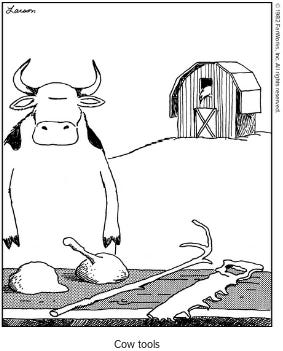
I am pleased to note that I am hardly the first to associate today’s Beast with this cartoon. Indeed, the original paper published on today’s Beast ends with the words:
[Veronika] did not fashion tools like the cow in Gary Larson’s cartoon, but she selected, adjusted, and used one with notable dexterity and flexibility. Perhaps the real absurdity lies not in imagining a tool-using cow, but in assuming such a thing could never exist.
