


Good Morning:

IMPORTANT PRELIMINARY ANNOUNCEMENT
Tomorrow’s show will take place not at the usual time but at 11:30 am Eastern time to accommodate our special guest, who is on the West Coast. You’re welcome to join the show at the regular time, but I won’t be there. The estimable Holly Berkley Fletcher won’t be there. Our very estimable and very special guest won’t be there. And you’ll be bored.
Upcoming MARA (Make America Read Again) Book Club Events
I haven’t quite pinned down all of the dates yet, but the following will be the next meetings of the MARA Book Club, which—as a reminder—are for paid subscribers only.
I promised we would have filmmaker Ari Ali back to discuss her film, “Ben Between Africa,” when there was an opportunity for club members actually to watch the movie. That time is now. There are four online screenings scheduled between now and the end of the year. You can sign up for any of them here with a $15 ticket that helps defray costs of the film. Here is Holly and my earlier conversation with Ali, who has agreed to come back on the show in early January for a discussion with the book club.
We are still pinning down a precise date, and I will announce the date and time as soon as we nail them down. I wanted to announce the event, however, as the screenings are happening now, and I want to make sure people have the opportunity to make one of them.
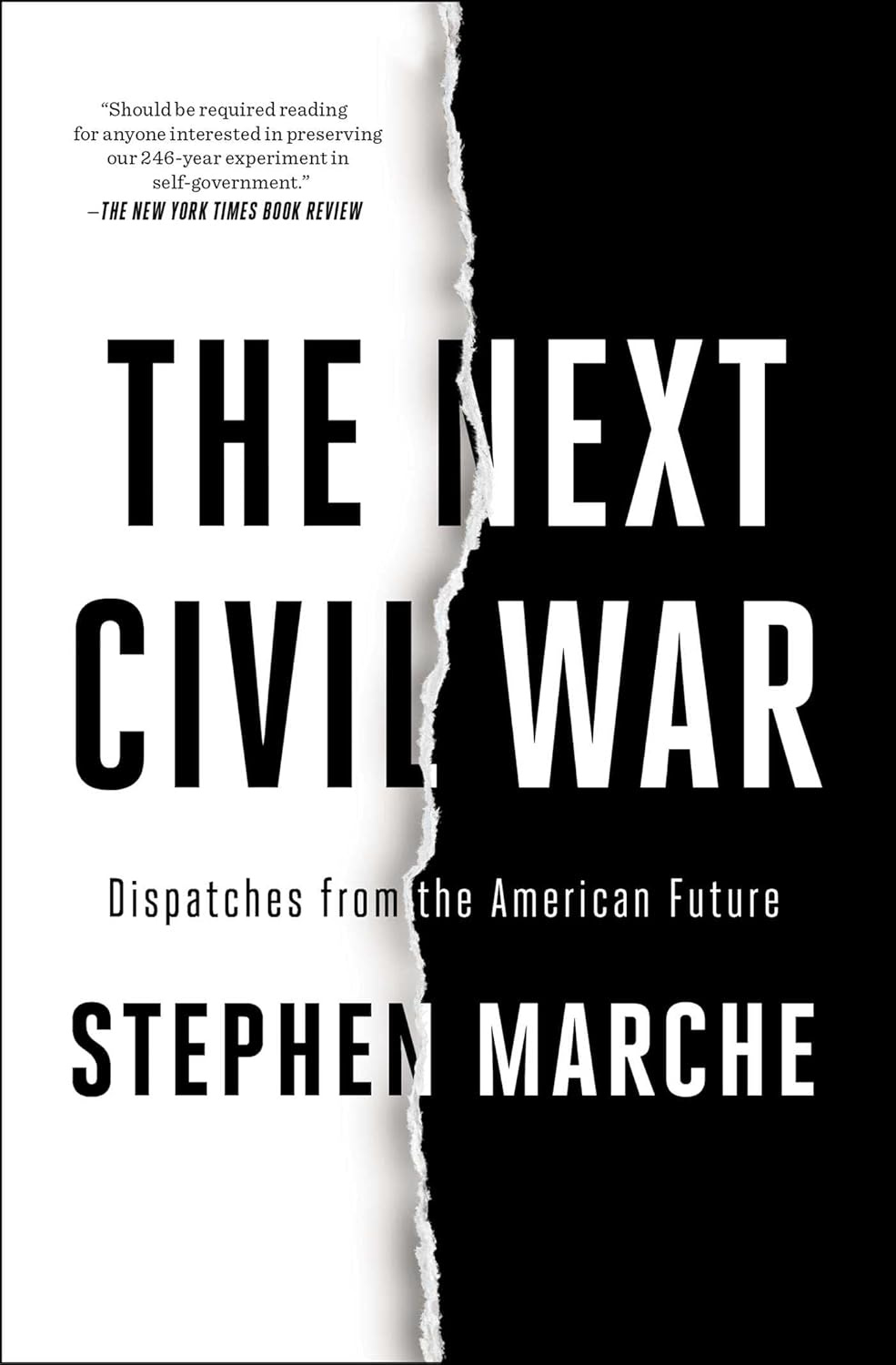
Ditto Stephen Marche, the author of “The Next Civil War,” which was the subject of a somewhat contentious conversation recently on the show:
I had not yet read the book when this conversation took place, so Marche agreed to return after the audience (and I) had a chance to do so. That will also be in January, so get your copy and start reading now. As this book is partly fictional, it is its own fiction wine pairing. Again, I will announce the date and time as soon as we have it written in stone:
February’s guest will be the very estimable Kori Schake, author of the new book, The “State and the Soldier: A History of Civil-Military Relations in the United States.” This event will take place on February 15, 2026 at 6:00 pm.

Schake has named has her fiction wine pairing Phil Klay’s book, “Redeployment.”

Again, MARA Book Club events are for paid subscribers only. They are opportunities for readers to engage directly with authors in an intimate and fun setting. Further details on dates and times will follow shortly.
Operation Brahms
Today’s installment, Opus 20, is an admittedly minor work—a set of three duets for soprano and alto. It is, to be honest, not great Brahms. But again, not all the children can be above average. They are very pretty, though not deep works.
Thursday on #DogShirtTV, the mysterious Albert Craig appeared on the show claiming to be the estimable Eve gaumond. We talked about writing a dissertation, being a slumlord, and the surprising excellence of the city of Ottawa:
Friday on #DogShirtTV, the estimable Minna Ålander came by to tell us about all the goings on in Danish foreign policy this week, of which there were many.
The Situation
In Friday’s “The Situation” column, I explore whether any rules formally limit Lindsey Halligan’s capacity to appear before an infinite number of grand juries seeking an indictment of Letitia James.
Well, now we face the question pretty squarely. Halligan and a lawyer she imported from Missouri when none of the Eastern District professionals would work the James case have now brought this case before three separate grand juries. The first time, Halligan obtained an indictment, only to have it thrown out, because, well, she’s not actually lawfully in office at all. To stick with our baseball metaphor, you might say she wasn’t even supposed to be at bat—or on the team at all. The second two times, grand juries rejected her bids for redos. Does she get an infinite number of shots at James before an infinite number of grand juries?
The legal answer to this question is apparently that she does. But the assumptions behind that toleration all seem pretty flawed in the current context.
Recently On Lawfare
Compiled by the estimable Isabel Arroyo
How the FCC Chair Unplugged Jimmy Kimmel—and Why It Didn’t Last
Eric Columbus examines how Federal Communications Commission (FCC) Chair Brendan Carr has successfully pressured a range of media outlets into changing or removing coverage, then explained how backlash from viewers and legislators alike forced Disney to stand up to that pressure in the case of Jimmy Kimmel. Columbus discusses the lessons that this instance of successful resistance holds for civil society.
Why did ABC take its own talent off the air? Because its owner, Disney, is a massive conglomerate with lots of business before the FCC. As noted above, ABC owns FCC-licensed television stations in lucrative media markets. Disney is well aware of the hoops that Carr made Paramount, the owner of CBS, jump through when it sought FCC approval of its merger with Skydance, which resulted in the transfer of dozens of CBS-owned station licenses to the new entity. And Disney has strong incentives to stay in the administration’s good graces for reasons beyond the FCC. For example, at the time it pulled Kimmel it was awaiting Department of Justice approval for two pending deals: to acquire a controlling stake in Fubo TV and to acquire the NFL Network and other NFL media assets in exchange for the NFL acquiring a 10 percent stake in ESPN. (The Department of Justice signed off on the Fubo TV deal at the end of October.)
That Carr was plainly wrong on the law was beside the point. The realistic risk to Disney was not that Carr would revoke, or deny a renewal of, a license based on a finding that Kimmel engaged in news distortion or violated the broadcast hoax rule. Rather, Disney feared that Carr would find other ways to get back at the company, in a manner that would be harder to prove or contest. The law was on Disney’s side; the power was on Carr’s.
Digital Freedom Depends on Access Rights
Matt Boulos argues that tech companies cannot be allowed to block personal artificial intelligence (AI) agents from platforms, suggesting that these agents offer a rare opportunity for consumers to push back against predatory, data-backed algorithms designed to exploit them.
Consider these competing visions. A social media feed is an AI system trained to addict you; an airline’s pricing algorithm is often an AI system that dynamically changes fares to maximize your spending. They give power to platforms. A loyal AI agent does the opposite: It filters your social media feed as you prefer or shops flights across times and airlines to tilt the negotiating balance back in your favor. Without AI agents pushing back in this way, predatory AI systems will deepen their entrenchment of the former picture.
A specific category of AI agents called coding agents create software (instead of acting directly on a user’s behalf). In a few years’ time, most people will be able to quickly and cheaply generate custom software for themselves and others. But useful software depends on interactions with other systems and your data. The current rules, as set by the platforms, mean that this access will be capricious at best.
Students, Spies, and Self-Inflicted Wounds
Michael Feinberg explains how restricting visas for Chinese students inhibits U.S. intelligence agencies’ capacity to recruit and cultivate sources in China long-term. Feinberg emphasizes the need for lawmakers to carefully balance that forfeiture—alongside losses in research and tuition—against the espionage risk some Chinese students might pose.
There’s just one problem with the administration’s proposal: It’s completely unresponsive to the actual problem posed by Chinese academics in the United States. For one thing, the overwhelming majority of the offenders in this regard are not here on F visas. Most are postdoctoral fellows in the country on J visas, a status that would be unaffected by the proposed change. Ironically, the main effect of the proposed actions placing new limits on the F visa program, rather, will be an unintended blow to American counterintelligence efforts.
That is, it will create a huge obstacle in terms of the ability of the United States to recruit future spies against China.
Why Zelensky Can’t Hold Elections Yet
The estimable Anastasiia Lapatina—in response to President Trump’s comments that Ukrainian President Volodymyr Zelensky is “using the war” to hold onto power—parses the massive legal, logistical, and combat-related risks of holding elections for a new Ukrainian president while still at war with Russia.
In a recent Politico interview released on Dec. 9, President Trump claimed Zelensky was “using the war” not to hold an election. “[The Ukrainians] talk about a democracy, but it gets to a point where it’s not a democracy anymore,” Trump said, arguing it was time for Ukrainians to head to the polls. The comments echoed the Kremlin’s own call for elections in Ukraine and its portrayal of Zelensky as an illegitimate leader who can’t be negotiated with.
In response to Trump’s comments, Zelensky told reporters he personally was “ready” to hold elections, but only if Ukraine’s allies agreed to ensure the country’s security.
The Ukrainian president was likely trying to avoid Trump’s ire amid high-stakes negotiations, agreeing to an election in principle, but shifting the responsibility to allies to make it happen. Zelensky’s careful response was rooted in the reality that holding elections during an active phase of war is an insurmountable task for Ukraine alone. Here’s why.
The Bondi Memo’s Quiet Rewriting of Domestic Terrorism Rules
Thomas E. Brzozowski analyzes Attorney General Pam Bondi’s memo directing intelligence personnel to focus on the threat of Antifa, arguing that the memo hollows out protections against investigating and prosecuting ideas and beliefs rather than conduct tied to crime or violence. Brzozowski explains how the directives outlined in the memo will drive investigations into protestors, philanthropic organizations, and more.
Domestic terrorism investigations and prosecutions are inherently fraught. The line between protected speech and association as well as true threats and acts of violence is vanishingly thin, so every step carries real civil liberties risks. The system functioned, roughly, because the government had rails to run on: the Attorney General Guidelines, the Domestic Investigations and Operations Guide, FISA, the Privacy Act, and lessons taken from the Church Committee. Those guardrails stood for a simple proposition: investigate and prosecute conduct tied to crime or violence, not ideas and beliefs.
The Bondi memo takes that settlement and bends it.
How to Tell a National Security Story
Sean Case reviews Peter Roady’s “The Contest Over National Security” and Andrew Preston’s Andrew Preston, “Total Defense,” two historical accounts of how the term “national security” has developed since its popularization by President Franklin D. Roosevelt. Case compares the two authors’ approaches to telling this story and argues that the Trump administration’s refusal to attend this year’s Aspen Security Forum epitomizes a new turn in the meaning of “national security.”
Historians Peter Roady and Andrew Preston bring crucial contributions to our understanding of how the concept and rhetorical tool of “national security” has changed over time. Roady and Preston both find fault with our current understanding of national security, and both trace the source of those faults to political debates during the New Deal. But they tell quite different tales and thus focus on different sets of key actors. For Roady, the central thread is a conservative counterrevolution that succeeded in defeating the New Deal’s promise of including economic security for all Americans as an essential component of national security. For Preston, the fault lies instead with the New Deal’s liberalism and its attachment to securing the United States from fear itself. While Roady provides a policy prescription to return to the push for nationwide economic security, Preston offers the broader and deeper proposal on how to redefine national security to meet the challenges of climate change.
Documents
Isabel Arroyo shares the White House’s executive order aimed at preempting state artificial intelligence (AI) regulation.
Jakub Kraus shares the Office of Management and Budget’s memo providing guidance on compliance with President Trump’s Jan. 23 executive order on blocking ‘woke AI.’
Podcasts
On Thursday’s Lawfare Daily, Natalie Orpett sits down with Frank Rosenblatt and Colby Vokey to discuss the duty to disobey unlawful orders within the military, the complexity of choosing to do so, and what that duty means for the future of U.S. operations.
On Friday’s Lawfare Daily, I sit down with Scott R. Anderson, Daniel Byman, and Kori Schake to discuss the Trump administration’s 2025 National Security Strategy, its emphasis on immigration as a national security threat, and its implications for U.S. foreign policy.
Videos
On Lawfare Live, Anna Bower, Eric Columbus, Molly Roberts, and Loren Voss join me to discuss the Supreme Court oral arguments in Slaughter v. Trump, Judge Paula Xinis’s order that Kilmar Abrego Garcia be released from Immigration and Customs Enforcement custody, and more.
Today’s #BeastOfTheDay is the cow, as described by a ten-year-old who had never seen one before. On February 20, 1942, the Virginia Chronicle reported:
How London Boy Learned Where Milk Comes From
LONDON.—Ernest Brown, minister of health, read the following essay he received from a 10-year-old London East End boy who had been evacuated to the country:
“The cow is a mammal. It has six sides, right and left and upper and below. At the back it has a tail on which hangs a brush. With this he sends flies away so they don’t fall into the milk. The head is for the purpose of growing horns and so his mouth can be somewhere. The horns are to butt with and the mouth is to moo with. Under the cow hangs milk. It is arranged for milking. When people milk, milk comes and there never is an end to the supply. How the cow does it I have not yet realized but it makes more and more. The cow has a fine sense of smell and one can smell it far away. This is the reason for fresh air in the country.
“A man cow is called an ox. The cow does not eat much but what it eats it eats twice so that it gets enough. When it is hungry it moos and when it says nothing at all it is because its insides are full up with grass.”
In honor of today’s Beast, find something you’ve never seen before and observe it. Come to conclusions. Those conclusions will likely be wrong, but the exercise is good for your brain.
Tell Me Something Interesting
Last week, at the urgent request of the estimable Holly Berkley Fletcher, I—EJ Wittes—investigated why so many countries are called Guinea. In the process, I found myself bedeviled by another equally vital problem. Why is the guinea pig called a “guinea pig,” given that it is not from any location known as Guinea? As I said in my previous piece,
On the matter of the guinea pig, I have no answer for you. No one knows why they’re called that. The world is full of mysteries.
But that answer has not satisfied me. I have spent several days investigating the origins of the term “guinea pig.” And while I find myself still without a definitive answer, I have found a profusion of theories.