


Good Evening:


I took some better images of this evening’s projection and sunflower planting, but I haven’t retrieved them from my cameras yet, so tonight you get what’s on my phone.
It was a lovely evening. A large group turned out to plant sunflowers for the fifth year in a row, and we capped it off with a back-to-basic projection of a Ukrainian flag and map of Ukraine by artist Nikita Titov.
As always, the Russians turned their own “Z” and “V” spotlights on their own walls.
All in all, a grand evening. I’ll share the better images tomorrow.
Thursday on #DogShirtTV, the estimable Holly Berkley Fletcher had some things to get off her chest:
And Friday on #DogShirtTV, Holly’s prior rant was vindicated:
Recently On Lawfare
Compiled by the estimable Marissa Wang
Diamond Hands, War Plans
Timothy Minter argues that the expansion of prediction markets into geopolitical and military events has created significant national security risks. Using the prosecution of U.S. Special Forces Master Sgt. Gannon Ken Van Dyke as a case study—in which the government alleges that Van Dyke illicitly bet on the covert operation against Venezuelan President Nicolás Maduro—Minter describes how existing frameworks are ill-suited to regulate the exploitation of classified information on prediction markets.
In the predawn hours of Jan. 3, U.S. Special Operations Forces captured Venezuelan President Nicolás Maduro in Caracas. Hours later, Gannon Ken Van Dyke withdrew $409,881 from his Polymarket account, converting a $33,034 marker placed over the preceding week into a 12-fold return. He had repeatedly bet that Maduro would be out of power by Jan. 31.
According to a federal indictment unsealed in April 2026, Van Dyke knew why. He was a Special Forces Master Sgt. assigned to U.S. Army Special Operations Command at Fort Bragg, involved in planning and executing Operation Absolute Resolve—the very operation he spent the week of Dec. 27, 2025, betting on. His last trades came the evening of Jan. 2. The raid began before dawn the next morning. He is reportedly the first U.S. service member prosecuted for using classified information to trade on a prediction market.
Cyber Offense: How Far Can Private Organizations Go?
Rajeev Raghavan, Jared Engelking, and Grace Tang explain that as cyber threats intensify and artificial intelligence (AI) accelerates offensive and defensive capabilities, the line between cyber defense and offense has increasingly blurred for private corporations. The authors warn that the absence of a clearer legal framework for private-sector cyber operations leaves these organizations vulnerable in an era of escalating cyber conflict.
A criminal hacking group is conducting phishing attacks, masquerading as an email company to steal user data and launch ransomware. The email company’s security team has mapped the hackers’ infrastructure. The hackers have identified the command-and-control servers and a flaw in the ransomware deployment tools that could send decryption keys to victims. The company wants to launch a technical attack and take down the threat actors’ network. But there is a problem: Doing so could land the company’s employees in federal prison. That tension—between what the private sector can technically achieve and what it is legally permitted to do—sits at the heart of a growing cybersecurity policy debate.
The Justice Department Erases History; Lawfare Restores It
Tyler McBrien, Michael Feinberg, and I share a new Lawfare archive of the Department of Justice’s press releases and materials related to the Jan. 6 attack on the U.S. Capitol, which the Justice Department has been removing from its website since May 2026 as part of an effort to remove “partisan propaganda” created by “the DOJ’s weaponization under the Biden administration.” The archive recovers 5,769 pages of press releases from the U.S. Attorney’s Office in D.C., the Justice Department, the FBI, and more.
Any effort to erase history and replace it with lies warrants concerted pushback. In this case, the department has deleted a large repository of accessible public information about the storming of the Capitol and the individuals who did it. That data, unlike the court documents that lay beneath them, are in lay language. They are easily digestible by anyone interested. And they contain fair-minded summaries of evidence that—in the overwhelming majority of cases—was either proven in court beyond a reasonable doubt or pleaded to by defendants who ultimately conceded their truth.
There’s a broad principle here, and we want to state it very clearly: If the administration purges rule-of-law-sensitive materials from government websites, we will do everything in our power to restore them on Lawfare. The principle, as we instructed Anthropic’s Claude in building the programs that recovered these statements, is that “net loss of information to the public should be zero.”
The U.S.-Iran War: Fighting From ‘Neutral’ Territory
Bertina Kudrin examines how the U.S.-Iran War has exposed major tensions in international neutrality law, as Gulf states hosting permanent U.S. military bases attempt to claim neutrality while simultaneously enabling U.S. operations from their territory. Kudrin explain that modern overseas basing networks leave host states vulnerable to attack and create legal gray zones over when belligerents may lawfully strike foreign-operated bases located in “neutral” territory.
On March 9, Reuters reported Iranian missile strikes on the U.S.-operated Al Udeid base in Qatar and drone attacks aimed at Al Dhafra in the United Arab Emirates (UAE) and Juffair in Bahrain. Qatar condemned the strikes as attacking its territory even as it continued to deepen its defense relationship with the United States. At the same time, the UAE, Saudi Arabia, and Kuwait all claimed they were not parties to the U.S.-Iran conflict. The UAE “reaffirmed [its] commitment to not allowing its airspace, territory, or waters to be used in any hostile military actions against Iran, and to not providing any logistical support in this regard.” Saudi Arabia told Iran a month before the war began that it would not allow its airspace or territory to be used for military actions against Iran. And Kuwait similarly said that it was not a party to any regional conflict and would not allow its territory to be used for launching attacks.
These statements may or may not be sincere. But perhaps more urgently, the pertinent question is whether they are legally sustainable when foreign bases on a state’s soil are being used to support a belligerent’s attacks in a war.
Assassination and the Making of the Modern World
Jacob Ware reviews Simon Ball’s new book that delves into the historical use of assassinations as a political instrument, entitled “Death to Order: A Modern History of Assassination.” Ware unpacks how assassination has shaped the modern world (used by states and non-state actors from Sarajevo to contemporary counterterrorism campaigns) and what lessons should be gleaned from two high-profile U.S. assassinations in 2025.
Yet these recent assassination attempts, some successful, should not have taken us by surprise. In “Death to Order: A Modern History of Assassination,” Simon Ball issues a simple and ominous warning: assassinations are not historical aberrations, but in fact a ubiquitous and tragic thorn in the modern world’s side. Ball, a historian at the University of Leeds, is the author of several prior books, most of which focus on the history of war and conflict. In his own telling, this new study emerged from “curiosity-driven research” into the history of firearms control. Ball reaches two key conclusions: First, assassination has long served as a political instrument by both state and non-state actors. Second, the success or failure of attempted assassinations often turns as much on the target state’s response as on the attacker’s skill.
Podcasts
Lawfare Daily: Russia’s ‘Tradecraft, Tactics, and Dirty Tricks,’ with Sean Wiswesser: Justin Sherman sits down with Sean Wiswesser to discuss Wiswesser’s new book, “Tradecraft, Tactics, and Dirty Tricks: Russian Intelligence and Putin’s Secret War,” on the functions of major Russian security apparatuses.
Rational Security: The “Potty Like It’s 1999” Edition: Scott R. Anderson sits down with Anna Bower, Eric Columbus, and Molly E. Reynolds to unpack the Trump administration’s creation of the nearly $1.8 billion “Anti-Weaponization Fund,” the benefits and costs of President Trump’s involvement in the congressional primaries, and more.
Lawfare Daily: How Ukraine Is Winning the Drone War: Jimmy Rushton joins Anastasiia Lapatina to discuss how the balance of drone power in the Russia-Ukraine War seems to have shifted in Ukraine’s favor.
Scaling Laws: Inside the Fight to Detect and Govern Synthetic Abuse with Melissa Hutchins of Certifi AI: Kevin Frazier sits down with Melissa Hutchins to unpack the rise of deepfakes, non-consensual sexually explicit imagery, and the growing policy fight over online harms generated by artificial intelligence (AI).
Videos
At 4 pm ET on May 29, I sat down with Anna Bower, Eric Columbus, Roger Parloff, and Molly Roberts to discuss the Department of Justice’s newly opened inquiry into E. Jean Carroll, developments in the “Broadview Six” case after its dismissal on May 21, three legal challenges to the “Anti-Weaponization Fund,” and more.
Today’s #BeastOfTheDay is the African spurred tortoise, which we are recognizing for its skill as an engineer.
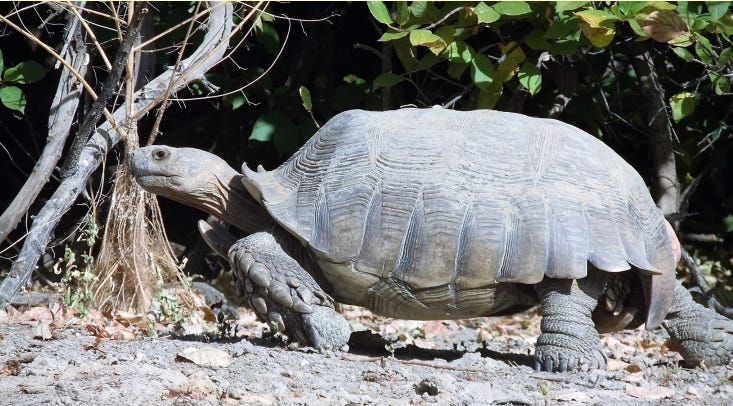
The Indian Defense Review reports:
The soil across much of the Sahel bakes into a crust. Daytime temperatures climb past 60 degrees Celsius. At night, the air cools sharply. That hardened surface blocks rainwater from seeping downward. Moisture evaporates almost immediately. Seeds sit locked in place, unable to germinate.
In 2021, researchers released 500 African spurred tortoises into a stripped-down landscape along the southern edge of the Sahara. The animals belong to a species, Centrochelys sulcata, that evolved to handle exactly these conditions. Five years later, satellite images captured scattered green patches pushing up through the sand…
To escape lethal ground temperatures, spurred tortoises carve burrows 10 to 15 meters below the surface, according to research compiled by the IUCN Tortoise and Freshwater Turtle Specialist Group. Each tunnel lets the tortoise survive the midday heat and the cold nights. It also punches through the sealed soil crust.
Once that crust breaks open, rainwater finds a path downward instead of sheeting off the surface. The surrounding soil gains water retention capacity. Moisture stays in the ground longer after each rainfall…
The mechanism that follows is more physical than biological. A burrow entrance and the loosened soil around it create a pocket of stable microclimate. The tortoise does not carry or spread seeds deliberately. But seeds already lying dormant on the hardened surface, or seeds carried in by wind, find just enough moisture and shelter near the burrow to germinate.
Insects and microorganisms move into the loosened soil next. From there, the ecological chain builds outward. Over time, vegetation thickens around the digging zones. The green patches that appeared on satellite imagery were not forest canopies. They were clusters of plant life anchored to the spots where tortoises had been working…
What followed was gradual vegetation recovery on ground that had previously shown bare sand. What returned was not forest in the everyday sense. It was visible biodiversity, with birds and small vertebrates arriving once plant cover began to spread…
The process echoes what farmers across the Sahel do by hand when they dig small water-harvesting basins to trap rainfall and concentrate organic matter. The scale and the persistence differ. A tortoise digs because its body demands it, and it keeps digging across its whole life…
The tortoise experiment is “neither a magic bullet nor a universal solution.” Restoration success depends on rainfall, grazing control, and how the land is managed over time. What the project provides is a clear look at how a keystone species can restart dormant ecological machinery without heavy engineering.
In honor of today’s Beast, check out this report on conservation efforts for today’s Beast. Also, dig a hole in the ground.