


Good Morning:
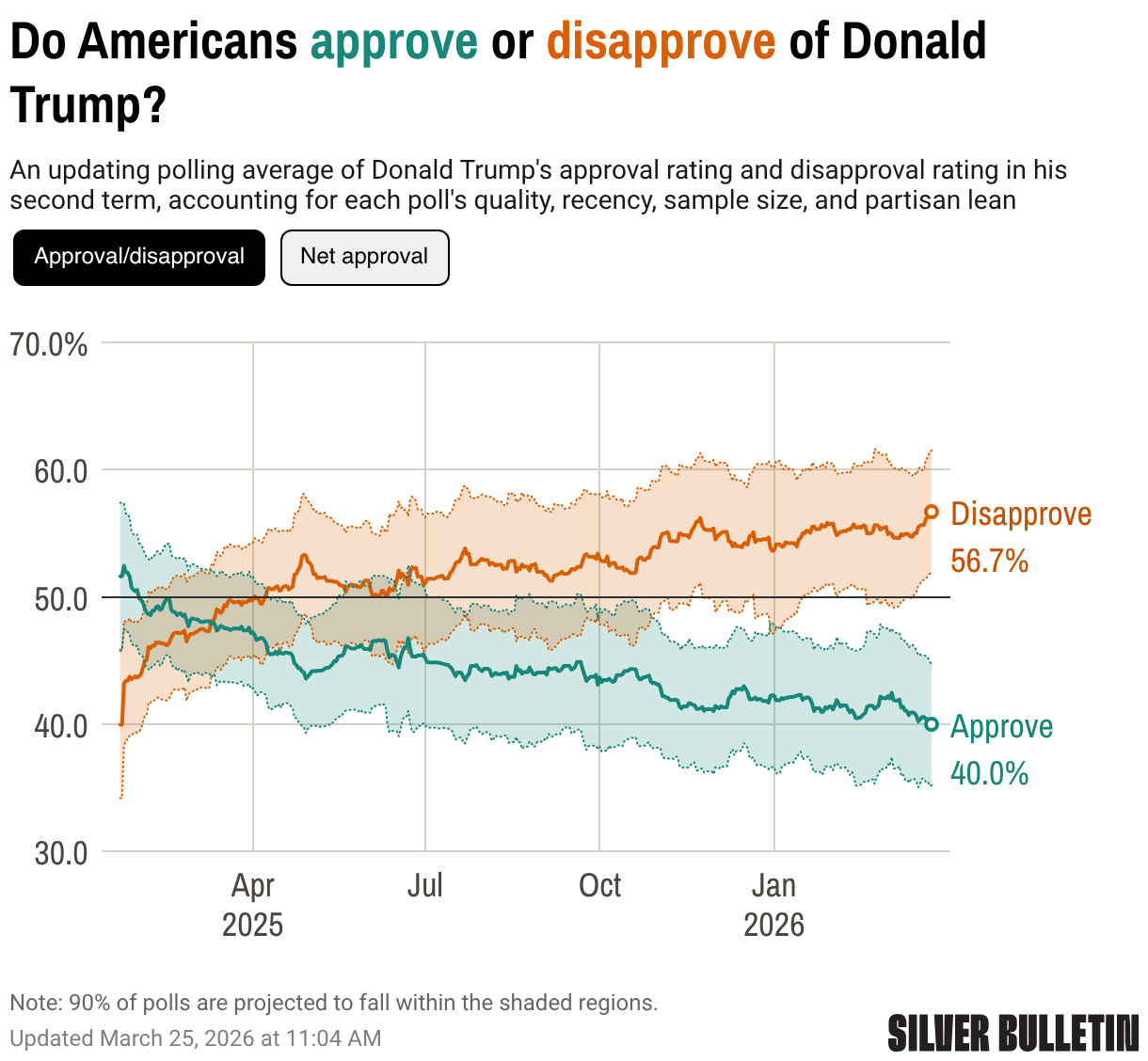
I believe this is the lowest Trump’s approval has ever been in the second term in the Nate Silver average.
Monday on #DogShirtTV, the estimable Holly Berkley Fletcher talked Reconstruction, the Greek Chorus discussed Cesar Chavez, and I gave a eulogy for Bob Mueller:
Yesterday on #DogShirtTV, we had an unusually aimless and nonsensical show. The estimable Mike Feinberg got stabbed by pirates—or perhaps a piratical cactus:
The Situation
The Situation on Sunday considered the fact that things would suck right now even without The Situation.
Also over the weekend came the announcement that Bob Mueller died.
Mueller’s death was the occasion—inevitably and of course—for unspeakably inappropriate presidential conduct. It has also been the occasion for some thoughtful remembrances and articles about the man, his remarkable history and legacy at the FBI, and for both praise and criticism of the manner in which he conducted his investigation.
Here I would like to do something a little bit different and talk about the text of the Mueller Report, the more-than-400-page document that resulted from Mueller’s investigation. The report itself has gotten strangely lost in the discussions of Mueller’s virtues, the hopes people invested in him, and his confrontation with Trump. And it’s easy to understand why: Trump won. The ship sailed. For all the votive candles and Mueller Time shirts and memes, the investigation never did generate accountability for Trump. Indeed, while Trump was later impeached twice, neither time was it over allegations that Mueller investigated.
And yet, the Mueller Report contains a number of important truths—enduring truths—about Trump, about the people around him, and about The Situation more generally. These are truths one simply cannot doubt, however much smoke gets thrown up around them, if one bothers to spend quality time with the document.
Depending on how fine a sieve one uses, there are a lot of them. But at the coarsest level of granularity, there are four essential ones.
The first enduring truth of the Mueller Report is that the Russians conducted a significant “active measures” operation on a variety of social media platforms to interfere in the 2016 U.S. presidential election. As the report puts it: “By early to mid-2016, [these] operations included supporting the Trump Campaign and disparaging candidate Hillary Clinton.”
This point is important for a few reasons. The most important of them behind the bare statement of fact lies a deep reality Americans—and others around the world—have been struggling with ever since 2016: Our information environment is not an organic development of ideas competing in a marketplace.
It is, rather, manipulated by malign actors, public and private, foreign and domestic. It is manipulated both covertly and overtly and for purposes commercial, political, ideological, and often masked. People knew this at some level before 2016, to be sure. The Russian active measures were not the first operation of their kind, by any means. But the audacity of a concerted operation to attempt to affect an American presidential election using Twitter bots was new. And it has conditioned the American information environment ever since.
The second enduring truth of the Mueller Report is that Russian military intelligence, in addition to the active measures, also conducted a campaign of hacking emails associated with the Democratic campaign and dumping them into the public domain. As the report puts it, “The release of the documents was designed and timed to interfere with the 2016 U.S. presidential election and undermine the Clinton Campaign.” The Trump campaign showed a keen interest in the release of these documents and, at times, engaged directly with the entities through which the Russians were distributing them.
This is an uncomfortable truth for those who associate MAGA with patriotism and America First: Trump got help from the Russians. Whether that help ultimately mattered we will never know. But he knew he was getting help. His people knew he was getting help. They had every opportunity to behave like patriots and eschew help from foreign malign actors. And they passed every one of them up.
This simple truth—which Trump has not meaningfully contested to this day—hangs over every incident in which Trump tilts towards Russia in its current war with Ukraine. In the wake of the Mueller Report, Trump—with an able assist from then-Attorney General Bill Barr—crowed that the big message of the report was that there had been “no collusion.” And for criminal purposes, that was right, in a sense. Mueller and his team had been unable to find people associated with the Trump campaign who actively conspired with Russian espionage or influence operations.
And so the larger truth got lost—not because it wasn’t available and documented extensively but because it wasn’t a conclusion of law. It was just an inevitable conclusion based on reported and uncontested facts.
And what was that conclusion? Nothing more or less than that the president knowingly accepted assistance in his first campaign from a foreign intelligence service that was actively conducting espionage activities against the United States. It is a conclusion that should forever condition the way people understand every interaction his government has with that of the Russian Federation.
The third enduring truth of the Mueller Report is that there were repeated and extensive contacts between Russian entities purporting to represent the government and officials of the Trump campaign. These contacts ranged a great deal, from the direct approach in Trump Tower with an offer to senior campaign leadership of assistance to the suggestion made by a young campaign hanger-on to a foreign diplomat that the Russians had “dirt” on Hillary Clinton to protracted negotiations over the building of a Trump Tower in Moscow to Paul Manafort’s work with a known Russian intelligence operative and on a behalf Ukraine’s pro-Russian former president.
The sheer sweep of the contacts, which require more than 100 pages to detail, speaks to the magnitude of the betrayal. Some of them involved running a campaign. Some of that business involved back channel discussions with leadership. Some of them involved building buildings. Some of them involved hiring hackers to recover allegedly missing Hillary Clinton emails. I could go on. The salient point is that a man who would be president surrounded himself with people actively doing business, and very much open for business, with Putin’s Russia. He knew this. He supervised it. He participated in it. And he lied about it publicly.
The strange affinity Trump has for Putin and Russia remains hard to understand. I do not purport to have an explanation for it. But the mystery is the same one as it was then: A mesh of contacts and mixing of affairs of state and affairs of business in such fashion that one cannot tell which is which or which is driving which. And of course it has spread. Trump now engages this way with the Gulf monarchies too.
But the fundamental pattern is all laid out in the Mueller Report—and it predates Trump’s presidency by some time.
Finally, the fourth enduring truth of the Mueller Report comes from Volume 2 of the document—which covers not Trump’s dealings with Russia but his efforts to obstruct the Mueller investigation itself. That truth is that the president and the people around him behave like gangsters.
Mueller never, of course, says this quite this bluntly. He describes, rather, “potentially obstructive acts” and archly refers to “a series of actions by the President that related to the Russian-interference investigations, including the President’s conduct towards the law enforcement officials overseeing the investigations and the witnesses to relevant events.”
Volume 2, you may recall, catalogues a number of incidents in which Trump engaged in activity that raised questions under the obstruction statute—activity like dangling pardons to people who could hurt him, issuing pardons, tweeting reassurances to keep people from cooperating, attacking witnesses who cooperate, firing officials, and threats to fire officials or crack down on the investigation.
Mueller got a lot of criticism for declining to render judgment on whether the president had violated the obstruction laws. For present purposes, the more salient point is that the pattern of witness tampering behaviors he documented has persisted in Trump’s subsequent behavior. Similar conduct shows up in the New York criminal case. It shows up in the classified documents. It shows up in the Jan. 6 investigation. And it shows up, again and again, in the second term management of the executive branch—where pardons are routinely dispensed as rewards for loyalty and the hammer of the justice system comes down on enemies.
Mueller made mistakes. There is no doubt about that. That said, the Mueller Report remains the single best account we have of the relationship between Trump and the Russians and the manner in which Trump will deploy power within and from the executive branch. Little that has happened since its release should surprise those who read it carefully.
The Situation continues tomorrow.
Recently On Lawfare
Compiled by the estimable Marissa Wang
The Strait of Hormuz and the Limits of Maritime Law
Bertina Kudrin explains how Iran’s escalation of attacks in the Strait of Hormuz exposes gaps in international maritime law, more specifically how existing frameworks struggle to regulate modern economic warfare in a globalized economy where disruptions harm not just belligerents, but also the entire global trade system.
The attacks are clear-cut instances of “economic warfare,” using military means to disrupt commerce to weaken the adversary’s will to fight, by both sides. So far, international humanitarian law has never fully prohibited economic warfare, and classic naval warfare doctrine, as reflected in the 1994 San Remo Manual, a highly influential nonbinding restatement of treaty and customary international law governing armed conflict at sea, permits blockade as a lawful method of war if it meets certain criteria. But the situation in the strait raises a deeper question: whether these doctrines—developed largely in an earlier era of maritime conflict—are capable of addressing the modern forms of economic warfare that can disrupt global markets rather than merely weaken an adversary’s ports or trade.
A Litigation Playbook for Narrative Warfare
Renée DiResta discusses Sen. Eric Schmitt’s (R-Mo.) book entitled, “The Last Line of Defense: How to Beat the Left in Court,” in which Schmitt positions the courtroom as a venue to generate attention rather than to seek justice. DiResta criticizes the book’s misrepresentations of evidence, its obfuscation of legal losses, and its manipulation of litigation as a tool for attention and ideological warfare that undermines the merits of the justice system.
“The Last Line of Defense: How to Beat the Left in Court” is standard populist fare with a requisite Orwell epigraph, appropriate signifiers of contempt (“experts™”), and roughly three references per chapter. It is written for an audience that will not catch the falsehoods, or which might cheer them because the right enemies are being owned. But as a glimpse into worldview and strategy, it is instructive. The key takeaway is that the filing is the victory, outcomes are secondary, and hallowed institutions—courts, now the Senate—are performance venues.
The story is the point. Whether the story is true is someone else’s problem.
Digital Domains Are the New Battlefield
In the latest edition of Lawfare’s Foreign Policy Essay Series, Lauryn Williams examines how warfare in the digital domain—including in outer space, the electromagnetic spectrum, the information space, and cyber operations—is playing out in the U.S.-Israel-Iran conflict and argues that warfare in multiple domains is likely to become more central in this and future conflicts.
When the world woke up to news of a massive U.S.-Israeli military operation in Iran on Feb. 28, the early headlines were digital as well as kinetic. Anthropic’s Claude AI tool reportedly aided the U.S. military in selecting targets for missile strikes; an alleged Israeli cyberattack compromised the widely used BadeSaba religious calendar application to send anti-regime messages; the Iranian regime imposed an internet blackout and the U.S. military claimed that cyber and space operations had “disrupted” Iran’s communications; and electronic warfare activity spiked concurrently, hampering GPS navigation systems for ships passing through the Gulf.
These events reveal a truth of modern warfare: Air campaigns like Operation Epic Fury are being fought and shaped in digital domains, including cyberspace, the information space, the electromagnetic spectrum, and outer space. Lines between these domains are blurring with growing implications for the future of modern conflict.
The Europeanization of Deterrence
Ariane Tabatabai and John Drennan explain how French President Emmanuel Macron’s push for a Europe-based nuclear deterrence strategy reflects growing doubts from allies about the U.S.’s reliability and an increasing desire for greater strategic autonomy.
Although European allies have not yet concluded that the U.S. nuclear umbrella needs wholesale replacement, they are deciding how much autonomy to seek amid structural shifts in the transatlantic relationship. In a scenario where European allies look to gradually disentangle their security from Washington, they may look to several models beyond the one proposed by Macron to decrease their reliance on U.S. extended deterrence, especially if France fails to convince them of the credibility of its advanced deterrence model. While the development of an independent French model would benefit the United States by supporting existing U.S. extended deterrence commitments, new nuclear weapons programs in Europe would present significant challenges for the United States’ long-standing policy against proliferation. As a result, Washington might have to make the difficult choice of pressuring an ally to prevent proliferation or live—in increasingly unstable times—with more nuclear-armed states.
Supreme Court Argument Preview: When Does Asylum Begin at the Border?
Joshua Villanueva and Michael Endrias unpack the key facts, central arguments, notable amicus briefs, and possible decisions in a border asylum case at the Supreme Court. The pair explain that the Court’s decision will have major consequences for asylum-seekers and U.S. immigration policies.
The U.S. Supreme Court will hear a border asylum case on March 24 to decide whether the government may nullify the Immigration and Nationality Act’s (INA’s) asylum and inspection requirements by stopping asylum-seekers inches before they cross the border at a port of entry and turning them back to wait in Mexico. In Noem v. Al Otro Lado, the Court must decide if the INA’s definition of “arrives in the United States” stretches to cover someone who stands at the very threshold of a port of entry but has not yet set foot on U.S. soil.
This question carries real weight because “arrival” serves as the gateway in the INA’s asylum and inspection process. If someone halted on the Mexican side of a port of entry is still considered to have “arrived,” then the law’s asylum protections and inspection rules kick in right at the port of entry’s edge. If not, the government’s obligations only begin once the person sets foot on U.S. soil, meaning Customs and Border Protection (CBP) could avoid the INA’s inspection and asylum-processing requirements simply by stopping asylum-seekers just short of the border line. The result would make access to asylum depend on the government’s ability to keep applicants physically outside the line. The Court’s decision will ultimately define how far the INA’s protections extend when border policies keep asylum-seekers just out of reach.
Podcasts
On Monday’s Lawfare Daily, I sit down with Molly Roberts, Anna Bower, Eric Columbus, Roger Parloff, and Kate Klonick to discuss Judge James Boasberg’s opinion quashing the Department of Justice’s subpoenas in the investigation of Federal Reserve Chair Jerome Powell, the government’s response in Anthropic’s lawsuit challenging the Department of Defense’s designation of the AI company as a supply chain risk, a judge’s reinstatement of U.S. Agency for Global Media employees, the newly released video depositions of Department of Government Efficiency employees, and more.
On Tuesday’s Lawfare Daily, Elisa Catalano Ewers joins Tabatabai to discuss Iran’s intentions and capabilities in the Strait of Hormuz, the U.S.’s response and capability gaps, how allies and partners have participated in the conflict, and more.
On Scaling Laws, Alan Z. Rozenshtein sits down with Jassi Pannu and Doni Bloomfield to discuss Pannu and Bloomfield’s proposed framework for strengthening biological data governance to reduce the risks of biosecurity attacks powered by artificial intelligence (AI).
Videos
On Lawfare Live, I sat down with Kate Klonick, Roger Parloff, and Molly Roberts to debrief a preliminary injunction hearing in Anthropic’s ongoing lawsuit challenging the Department of Defense’s designation of the AI company as a supply chain risk.
Today’s #BeastOfTheDay is the mouse, seen here being a bad parent:
In honor of today’s Beast, you too should be callously uncaring of your children’s comfort.