


Good Afternoon:

Yesterday on #DogShirtTV, there was no show because I was busy liberating the lasers:

Today I am sick in bed, so this is going to be an abbreviated dog shirt.
Yesterday On Lawfare
Compiled by the estimable Marissa Wang
The GSA’s Draft AI Clause Is Governance by Sledgehammer
Jessica Tillipman explains that while the General Services Administration’s proposed contract clause on the procurement of artificial intelligence (AI) systems is a much-needed expansion of oversight, it falls short of adequately addressing commercial AI buying issues such as data-use limits, testing rights, meaningful disclosure, supply chain transparency, and more.
Federal procurement has always wrestled with competing priorities—flexibility versus uniformity, integrity versus efficiency, socioeconomic goals versus open competition. The data and governance challenges in AI procurement are another version of that structural tension. I do not envy the policymakers trying to balance protecting legitimate government interests with preserving the commercial relationships that make these products worth buying.
The draft gets the diagnosis mostly right. But it has responded to an existing governance gap with a clause that tries to do too much at once through the wrong channel, risking both overreach and distortion. Moving from governance as a “blocker” to governance by sledgehammer is not a cure. It is just the next iteration of the same pathology.
Two Illegal Biolabs Reveal Gaps in U.S. Biosecurity
Sam Howell warns that the discovery of Chinese Communist Party-linked biolabs in the U.S. exposes major gaps in domestic biosecurity. Howell urges policymakers to reduce biological weapons-based national security risks by expanding government oversight of private biolab research and improving the understanding and detection of biological threats.
The discovery of CCP-linked biolabs in Las Vegas and Reedley should serve as a wake-up call for U.S. policymakers. These facilities should not be treated as isolated incidents—they expose critical gaps in the U.S. biosafety and security landscape that foreign adversaries, or even malicious domestic actors, can exploit. Absent comprehensive oversight of private biological research, mandatory reporting requirements for pathogen acquisition, and a deeper understanding of how biological agents might be weaponized, the United States remains vulnerable. Policymakers must act decisively to close the gaps before another unauthorized biolab is discovered—or, worse, before American citizens pay the price for one that goes undetected.
AEA Litigation: Enforcing Congress’s Limits on Delegated Power
Andrew Kent argues that the Trump administration’s application of the Alien Enemies Act to alleged members of Tren de Aragua, a Venezuelan organized crime group, stretches the act beyond its original meaning and is an unlawful use of legislation meant for wartime military threats.
If mere presidential say-so that an attempted, threatened, or actual “invasion” and “predatory incursion” has occurred were to be deemed fully sufficient by the courts, the AEA would amount to a blank check that the executive branch could use in ways Congress never intended. Detainees would get only the form but little of the substance of the judicial review they have been promised by the Supreme Court. In W.M.M., the court can—and should—rule that the AEA is being applied illegally without needing to decide all of the potential questions about judicial deference to the president under the AEA.
Podcasts
On Lawfare Daily, Derek Pieper joins Michael Feinberg to discuss how counterintelligence investigations differ from counterespionage, what is needed for success in each, and the risks of politicizing national security issues.
Today’s #BeastOfTheDay is the penguin, specifically the penguin residents of the Edinburgh Zoo, seen here getting gifts from hospitalized children:
Yes, generally hospitalized children are given gifts, rather than being expected to make gifts for other entities, and maybe today’s Beast is taking advantage a little bit. But it’s cute, so we forgive today’s Beast its social faux pas.
Reading The Comments
We all know you shouldn’t read the YouTube comments. Sometimes, however, I (EJ Wittes) get bored and do it anyway. Here are some favorites from the last few months:

The only dancing I have ever seen my father doing involves putting both arms straight above his head, jumping up and down, and yelling “oot, oot.” He is generally a fierce opponent of dancing—like Puritan, really.
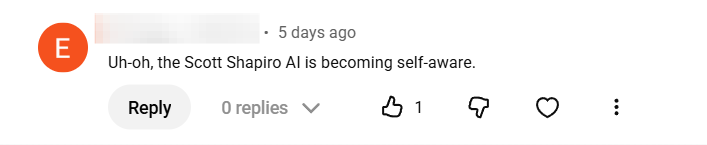
Truly an extinction level threat.

Probably a budgetary concession. The supervillain lair brought a lot of jobs to a swing congressional district or something.

I don’t read the comments for life advice, but I’ll keep this in mind.
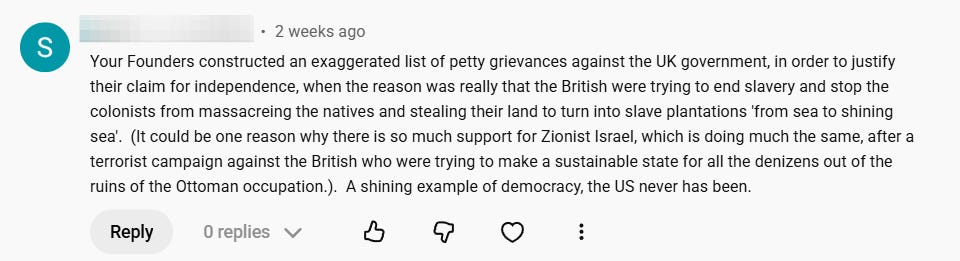
I don’t read the comments for historical analysis either, but this comment is unusual in the totality of its wrongness. It’s kind of impressive, honestly.
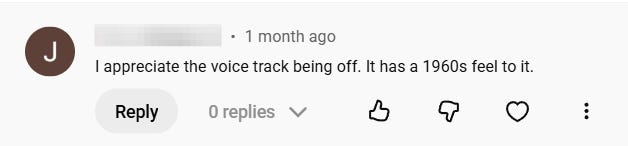
As the one responsible for trying to make the video minimally professional, I’m glad someone appreciates it when I can’t do my job.

You know what, I have nothing snarky to say. That’s just neat.
