


Good Evening:
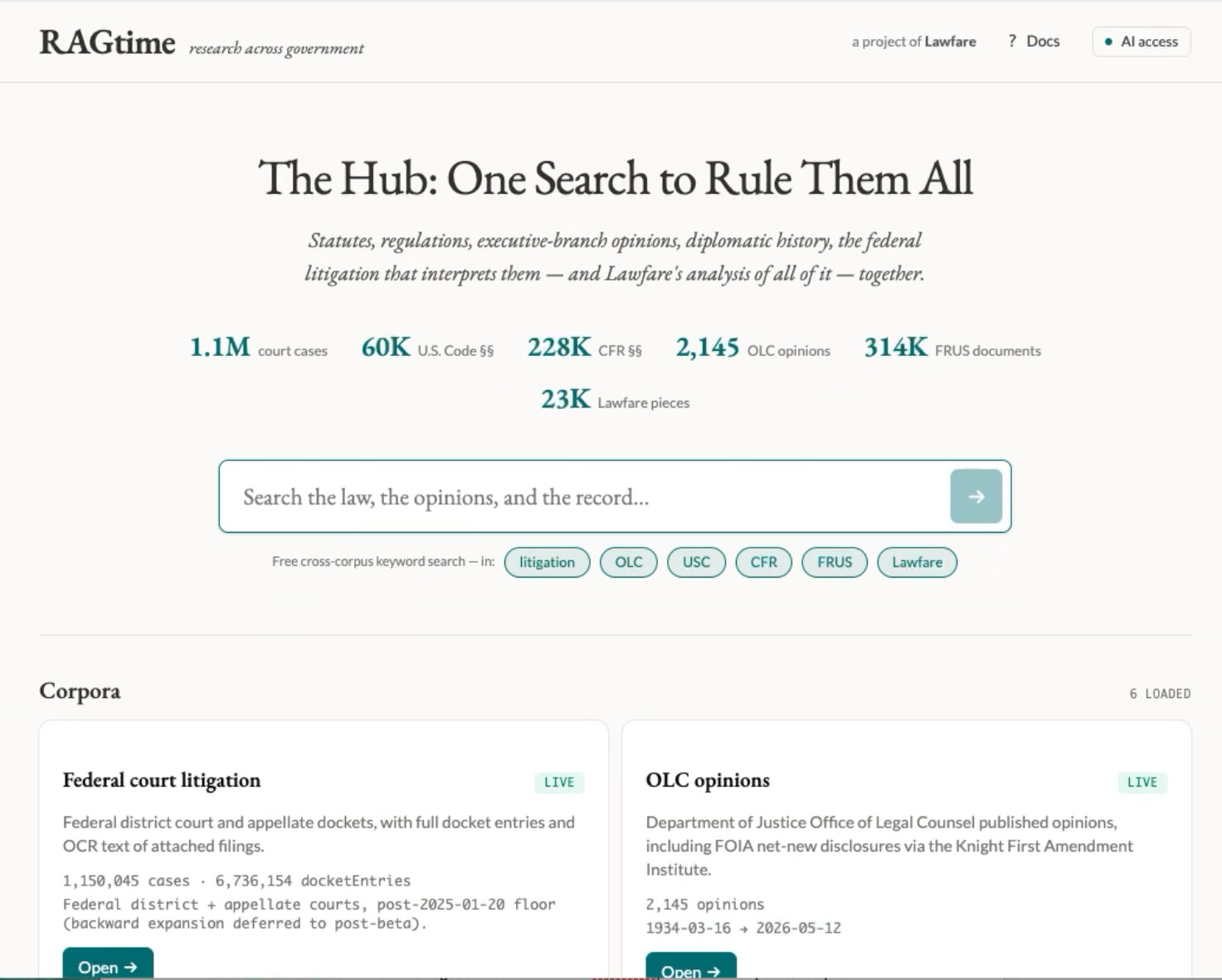
Tomorrow is the beta roll-out of RAGtime, the research platform I have spent the last several weeks developing for Lawfare. Today I ran my first natural language searches on it against the Lawfare corpus—which is to say I tested its capacity to answer questions about Lawfare’s own contents and return relevant results. The results were semi-breathtaking. It handled wonderfully such questions as:
Do Jack Goldsmith and Benjamin Wittes agree or disagree about presidential immunity?
Who has written for Lawfare about a specific test with respect to war powers and what have those writers had to say on the subject? and
How does the Insurrection Act interact with the Posse Comitatus Act?
We are opening beta testing of RAGtime tomorrow for material supporters of Lawfare. If you’re interested in helping us kick the tires, join one of the public demonstrations taking place tomorrow and Wednesday and sign up for an account.
An important note on tomorrow’s show. It is not taking place at the regular time. It is, rather, taking place at 6:30 pm Eastern time, so that a special guest can join the estimable Holly Berkley Fletcher and me. If you come at the regular time, you will be disappointed.
Wednesday on #DogShirtTV, the estimable Holly Berkley Fletcher had a speech to write and enlisted the Greek Chorus to do the work for her:
Thursday on #DogShirtTV, the estimable Mike Feinberg remembered Tiananmen Square and the estimable Holly Berkley Fletcher practiced the speech we wrote her:
And Friday on #DogShirtTV, the estimable Holly Berkley Fletcher showed off the final form of her speech, and the estimable Katherine Pompilio came on the show to talk about her investigation of January 6 recidivism:
Recently On Lawfare
Compiled by the estimable Marissa Wang
A Hybrid Role for the Court in U.S. Person Queries
Alex Joel argues that the debate over renewing Section 702 of the Foreign Intelligence Surveillance Act (FISA) is not as polarizing as it seems when it is framed as a choice between requiring warrants for all U.S. person queries versus maintaining the status quo. Instead, Joel proposes a hybrid model in which the FISA courts play a more targeted oversight role to better balance between civil liberties protections and national security needs.
Ultimately, whether the Fourth Amendment imposes a warrant requirement for queries involving U.S. individuals is a question for the judiciary to determine. To date, one case has ruled in favor of such a requirement, while other cases have found that a warrant is not required. For lawmakers, however, the choice should not be a binary one. There are other options for enhancing civil liberties protections through the involvement of the Foreign Intelligence Surveillance Court (FISC) that maintain this vital intelligence asset’s effectiveness.
Locked In: How African Data Protection Laws Move from Shield to Lever
Jane Munga examines how African data protection laws have allowed governments to block or reshape international health and biometric data-sharing agreements that conflict with domestic law. Munga contends that, while effective as a defensive legal architecture, African states should further leverage these laws to negotiate agreements that protect their economic interests in the long-term value generated by their data.
When Kenya’s High Court suspended a bilateral health agreement with the United States in December 2025, domestic law disrupted a $2.5 billion health cooperation agreement. Kenya’s High Court cited a legal framework, including its Data Protection Act of 2019 and Digital Health Act of 2023, to halt the process. That holding was not an aberration. It reflects the intended operation of a broader legal architecture that more than 40 African countries have constructed over the past decade. In several cases, that architecture now operates without judicial intervention. Ghana and Zimbabwe have each halted negotiations over comparable health data agreements, citing concerns grounded in domestic data governance frameworks. The pattern is consistent: Cross-border data arrangements that do not align with domestic law are increasingly blocked at the threshold.
The Jihadist Wave in West Africa
In the latest edition of Lawfare’s Foreign Policy Essay series, Alexander Palmer analyzes how the rapid expansion of jihadist groups across West Africa signals a broader shift in the regional balance of power away from governments and toward militant organizations. Palmer warns that, if current trends continue, the region could be headed toward state collapse, prolonged instability in the Sahel, or even the emergence of a new hub for global terrorism.
On April 25, 2026, al-Qaeda affiliate Jama’at Nusrat al-Islam wal Muslimin (JNIM) launched a major offensive against the Malian government alongside the Azawad Liberation Front (FLA), a separatist group. They have conducted attacks across Mali, killed the country’s defense minister, and established a blockade of Bamako, the capital. The groups now control vast swathes of the country—including positions near Bamako.
The ongoing offensive is the most visible manifestation of a years-long shift in favor of West Africa’s Salafi-jihadist organizations. The growing power and reach of these groups is upending the current order. Policymakers should be planning for multiple scenarios, ranging from the emergence of a trans-national terrorist hub to a frozen conflict.
AI Cyber Risks Are Testing the Office Built to Coordinate Them
Kevin Frazier examines how emerging cyber threats enabled by artificial intelligence (AI) are exposing weaknesses in the design and authority of the Office of the National Cyber Director, which Congress created to coordinate U.S. cyber policy. Using the Trump administration’s inconsistent responses to advanced AI models as a case study, Frazier contends that Congress should strengthen the office’s authority, resources, and coordinating role to ensure the federal government can effectively manage increasingly complex AI-cyber risks.
AI models with increasingly sophisticated cyber capabilities are forcing a basic institutional question: Is the federal government prepared to help public and private actors anticipate and respond to the risks those models may create? A review of the administration’s whipsaw approach to AI-related cyber risks indicates that a component of that preparedness—the Office of the National Cyber Director (ONCD)—may not be fulfilling its intended purpose. More specifically, the ONCD does not seem to be leveraging its cyber expertise to inform and coordinate the executive branch’s response to emerging issues.
Indict and Evade: The Indictment of Raul Castro
Christopher Hardee argues that the Trump administration is using the indictment of former Cuban President Raúl Castro to support a flawed legal theory that allows the U.S. to justify military intervention abroad as a law enforcement operation. Hardee explains how this “indict-and-invade” rationale misinterprets the president’s legal authority and undermines domestic and international law.
But the Trump administration claims to have found a legal workaround for regime change in the Western Hemisphere: indict a foreign leader and then justify an invasion as a giant law enforcement operation. That was the legal justification for the Venezuela invasion, and now the Castro indictment appears to follow the same path. As the New York Times has reported, the charges have “laid the grounds for potential action by the military to remove him from the country through a means similar to how U.S. Special Operations forces used an indictment against Nicolás Maduro, the former leader of Venezuela, to swoop into Caracas in a brazen operation in January and capture him.”
The indict-and-invade theory is not only an absurd pretext, but it is also a legally baseless justification to invade. The UN Charter binds the president and contains no law enforcement invasion exception.
Rules of Engagement When the Troops Appear at Polling Sites
Dan Maurer examines the possibility that the Trump administration could deploy federal troops or immigration agents near polling places and argues that state election officials should proactively educate voters on their rights and the legal limits on military and law enforcement. Maurer contends that clear public “rules of engagement” could reduce intimidation and potential confrontations if armed federal personnel appear at election sites.
Open, noncoercive, and safe elections are a hallmark of a healthy democracy. Today, those characteristics are in jeopardy. In January, President Trump boasted of his administration’s first year back in office and said, “When you think of it, we shouldn’t even have an election.” Speaking on former Deputy FBI Director Dan Bongino’s podcast in early February, Trump claimed that illegal immigrants “were brought to our country to vote, and they vote illegally.” He continued, “The Republicans should say, we should take over the voting in at least 15 places. The Republicans ought to nationalize the voting.” And in September 2025, Trump blamed “radical left democrats” for political violence and designated “antifa” activities as “domestic terrorism.”
These three statements come amid a campaign by popular MAGA influencers and some members of Congress urging Trump to deploy forces at polling sites. The fact that 46 percent of the public supports the idea of the National Guard monitoring or patrolling the ballot provides the administration enough of a basis to claim it has a “mandate” to do so.
The Remediation Gap in Civilian Camera Security
Branko Ruzic explains that if the U.S. became the target of the increasingly common exploitation of civilian internet-connected cameras by foreign states for intelligence gathering, the current framework of U.S. cybersecurity policy would not be equipped to handle the security risks posed by pre-existing civilian camera networks.
Hacking civilian cameras is now a recurring feature of war. The question for the United States is whether its legal framework can compel remediation of the millions of exploitable devices already deployed across U.S. cities. A walk through the existing statutory landscape suggests the answer is no, and that the authority architecture capable of changing that answer would introduce risks of its own.
The Jan. 6 Pardons: How Many Clemency Recipients Have Faced Other Charges?
Katherine Pompilio analyzes the post-clemency records of individuals pardoned for their roles in the Jan. 6 Capitol attack and found that at least 97 pardonees have since been arrested, charged, or convicted of other crimes. Pompilio explains that the study reveals the scale of subsequent criminal activity by Jan. 6 insurrectionists and highlights the lack of review, oversight, and accountability associated with the clemency process, especially when issued en masse.
At least 97 of the more than 1,500 individuals granted clemency by President Trump for their roles in the January 6 Capitol attack have been arrested for, charged with, or convicted of crimes separate from Jan. 6 since their participation in the Jan. 6 riot.
A Lawfare study reveals that almost one in 16 insurrectionists subject to the president’s clemency order has been arrested for and charged with—and in the vast majority of cases convicted of—other crimes, at least some of which were actively enabled by the clemency actions.
The Criminal Probe of E. Jean Carroll’s Lawsuits
Roger Parloff examines the Department of Justice’s reported criminal investigation into E. Jean Carroll and Reid Hoffman, arguing that the probe appears to be a politically motivated abuse of prosecutorial power and will be difficult to justify on legal grounds.
Obviously, we do not know if some unknown source has suddenly come forward and dropped new and credible information into the lap of someone at the Department of Justice that radically changes the landscape of the case described above. That is possible—though unlikely.
Absent such an anomaly, there is nothing in the record that warrants a prosecutor of integrity from initiating an inquiry into either Hoffman or Carroll.
On the other hand, such an inquiry could well result from a vindictive president pressuring compliant and frightened subordinates to harass his enemies. During Trump’s second term, the Justice Department has already compiled a long, shocking, and unprecedented record of seemingly vindictive prosecutions.
And if that is what is happening, this inquiry can only be described as a grotesque abuse of a compromised and debased Justice Department.
Pulte’s Appointment Shows Flaws in the Vacancies Act
Thomas Berry argues that President Trump’s appointment of William Pulte as acting Director of National Intelligence (DNI) exposes major flaws in the Federal Vacancies Reform Act. Berry explains that Congress should narrow eligibility for acting appointments to officials within the same agency and apply qualification requirements to acting officers to prevent unqualified or politically influenced appointees from bypassing Senate scrutiny.
On Tuesday, June 2, President Trump announced that William Pulte will serve as the acting director of national intelligence (DNI). Pulte is the director of the Federal Housing Finance Agency and has no prior national security experience. Concerns have already been raised that his selection was based on loyalty to Trump rather than his qualifications to serve in an intelligence role. Pulte’s installation in a critical position highlights several flaws in the law that authorizes acting appointees of the executive branch. Congress can and should fix these problems to ensure that acting officers are qualified and constitutionally authorized to serve in their positions.
Is Trump’s “Anti-Weaponization” Slush Fund Dead? Or Is It Undead?
Anna Bower and Eric Columbus explain how, despite the Trump administration’s abandonment of its plan to create an “Anti-Weaponization Fund,” the administration can still use other legal tools—including the Judgment Fund and the Federal Tort Claims Act— to achieve a similar goal with little meaningful oversight from Congress or the courts.
But don’t mistake retreat for surrender. The administration scrapped the fund in characteristically shifty fashion, leaving open the question of whether it is truly dead or merely on pause. At the hearing, Blanche refused members’ entreaties to issue a written order rescinding the program. Even that would seem not to suffice, because the settlement agreement between the government and the Trumps, which obligates the attorney general to establish the fund, provides in Section VIII that it “may be modified only with the written agreement of the Parties.”
More importantly, the fate of the fund itself may be beside the point. Existing law already provides the Justice Department with the tools it needs to funnel taxpayer money to many of the same beneficiaries. In the wake of the fund’s alleged demise, will the administration use those tools to accomplish its objectives by other means? And, if so, can Congress or the courts do anything to stop it?
Inside the Implementation of Schedule Policy/Career
Nick Bednar assesses President Trump’s implementation of Schedule Policy/Career, which recategorizes roughly 8,000 federal employees into positions with reduced civil service protections. Bednar argues that the executive order is part of the Trump administration’s effort to expand presidential control over career civil servants and threatens the political independence of the federal workforce.
Immediately following his second inauguration, President Trump signed an executive order establishing “Schedule Policy/Career,” which promised to strip approximately 50,000 employees in positions of a “confidential, policy-determining, policy-making, or policy-advocating” character of their tenure protections. The order also authorized the removal of employees who failed to “faithfully implement administration policies to the best of their ability.” Schedule Policy/Career effectively revived and rebranded a similar policy—Schedule F—from the first administration. Scholars including Catherine Fisk, Don Moynihan, and I have warned that Schedule Policy/Career threatens to politicize the federal workforce in ways not seen since the “spoils system” of the 19th century.
A First Step to Unpacking Cyber, Deception, and Intelligence Contests
Jason Healey reviews Jon Lindsay’s book, “Age of Deception: Cybersecurity as Secret Statecraft,” on the roles of trust and deception in statecraft and cybersecurity. Healey explains that, while deception is a crucial feature of intelligence contests and high-end cyber operations, it cannot explain cybersecurity as a whole without considering factors such as vulnerabilities, ransomware, cybercrime, software insecurity, and emerging threats driven by artificial intelligence.
“Age of Deception” is two books in one. The first explores secret statecraft, drawing from international relations, intelligence, and cyber conflict. Anchored in crucial case studies, it provides novel insights about how the logic of deception affects gray-zone cyber competition between states.
The second book extends that foundation to claim that all of cybersecurity—not just the competition between states taking place in cyberspace, but all of it—is best seen through the lens of deception. Here Lindsay overreaches. Deception of course matters, but he overlooks other key factors, especially vulnerability.
Deception in cybersecurity may never have received such sustained attention from an academic of Lindsay’s caliber. His book deserves the attention of all those interested in the ways in which governments use their intelligence and cyber capabilities. The book’s importance would have been magnified had he either focused more fully on developing his theory of deception and secret statecraft or more systematically addressed the complex ways deception plays out across all of cybersecurity.
NATO’s Cyber Approach Needs Change
In the latest edition of the Seriously Risky Business cybersecurity newsletter, Tom Uren unpacks the rising threats facing NATO’s cyber operations, the use of commercial location data to target U.S. military personnel in conflict zones, and more.
Last week, The Grugq and I traveled to Estonia for CyCon, NATO CCDCOE’s conference on Cyber Conflict. Our biggest takeaway from the conversations we had there is that NATO, unsurprisingly, is well prepared for one-off, large-scale military attacks. But it is failing to counter small, unremitting cyberattacks, and this needs to change.
Documents
Katherine Pompilio shares President Trump’s executive order on AI, which directs federal agencies to strengthen AI-enabled cybersecurity defenses by coordinating with the private sector.
Podcasts
Lawfare Daily: The Trials of the Trump Administration, May 29: I sit down with Anna Bower, Eric Columbus, Roger Parloff, and Molly Roberts to discuss three legal challenges to the Trump administration’s “Anti-Weaponization Fund,” U.S. District Judge Christopher Cooper’s order to block the shuttering of the Kennedy Center in Washington, D.C., post-dismissal developments in the Kilmar Abrego Garcia case, and more.
Lawfare Daily: Inside the Upheaval of the Second Trump Administration with Emily Bazelon: Tyler McBrien sits down with Emily Bazelon to discuss three pieces Bazelon and her colleagues recently published in the New York Times Magazine that shared stories from dozens of current and former government employees on the insider’s perspective of navigating the upheaval of the second Trump administration.
Scaling Laws: Governing the Frontier with Owen Larter of Google DeepMind: Frazier sits down with Owen Larter to discuss how Google’s DeepMind approaches frontier governance, including how DeepMind establishes national AI partnerships, the role of the Frontier Model Forum, and the challenge of expanding AI adoption.
Lawfare Daily: Pope Leo XIV Takes on Silicon Valley with Christopher Hale and Renée DiResta: Renée DiResta sits down with Christopher Hale to discuss Pope Leo XIV’s entrance into the artificial intelligence (AI) debate, what it means to “disarm” AI, the perspective of the Pope’s new encyclical, and Silicon Valley’s response.
Lawfare Daily: Drone Wars in Ukraine: I sit down with an American Army veteran who volunteered in 2022 with the Ukrainian military, known by the call signal “Jackie,” to discuss how Jackie came to serve in the Ukrainian army, the changes in drone warfare over the course of the war, and how things are starting to look up for Ukraine.
Rational Security: The “Mosquitos and Heat and Sweaty and Eww” Edition: Scott R. Anderson sits down with Anastasiia Lapatina, Tyler McBrien, and Ariane Tabatabai to unpack the current state of Russia’s offensive operations in Ukraine, developments in the U.S.-Iran War negotiations, and Trump’s unexpected selection of Pulte as the next DNI.
Lawfare Daily: The Jan. 6 Pardonee Crime Wave with Katherine Pompilio: I sit down with Katherine Pompilio to discuss her new Lawfare piece in which Pompilio found that at least 97 individuals who were granted clemency for their roles in the Jan. 6 Capitol attack have since been arrested for, charged with, or convicted of other crimes.
Lawfare No Bull: Acting Attorney General Todd Blanche Testifies on DOJ’s Anti-Weaponization Fund: Marissa Wang shares audio from acting Attorney General Todd Blanche’s testimony at the U.S. House of Representatives Appropriations Committee hearing on June 3, where Blanche was questioned about the “Anti-Weaponization Fund,” the Trump family’s settlement terms with the IRS, and more.
Scaling Laws: Tom Davidson on the Importance of AI Character: Kevin Frazier sits down with Tom Davidson to unpack the increasingly urgent debate over “AI character” and how the character of future AI systems may influence democratic governance, military conflict, and institutional trust.
Videos
At 4 pm ET on June 5, Roger Parloff, Molly Roberts, Bower, and Columbus joined me to discuss a hearing over the construction of the White House ballroom, the halting of civil lawsuits against Trump over his role in Jan. 6, and more.
Today’s #BeastOfTheDay is the ferret, seen here demanding attention and admiration for its babies:
Today’s #BeastOfTheDay is not the unidentified bird which attacked me—EJ Wittes—without provocation today for the third time in the last two weeks. Let the record reflect that the bird—not I—chose to build its nest in a bush right next to the exit from my apartment, and therefore my presence near its nest is solely a result of its own negligence and cannot be reasonably construed as a threat to its babies. My attempts to point this out to the bird have not resulted in a productive dialogue.
Be like today’s Beast, the ferret, and show off your babies to interested third parties. Do not emulate today’s non-Beast.