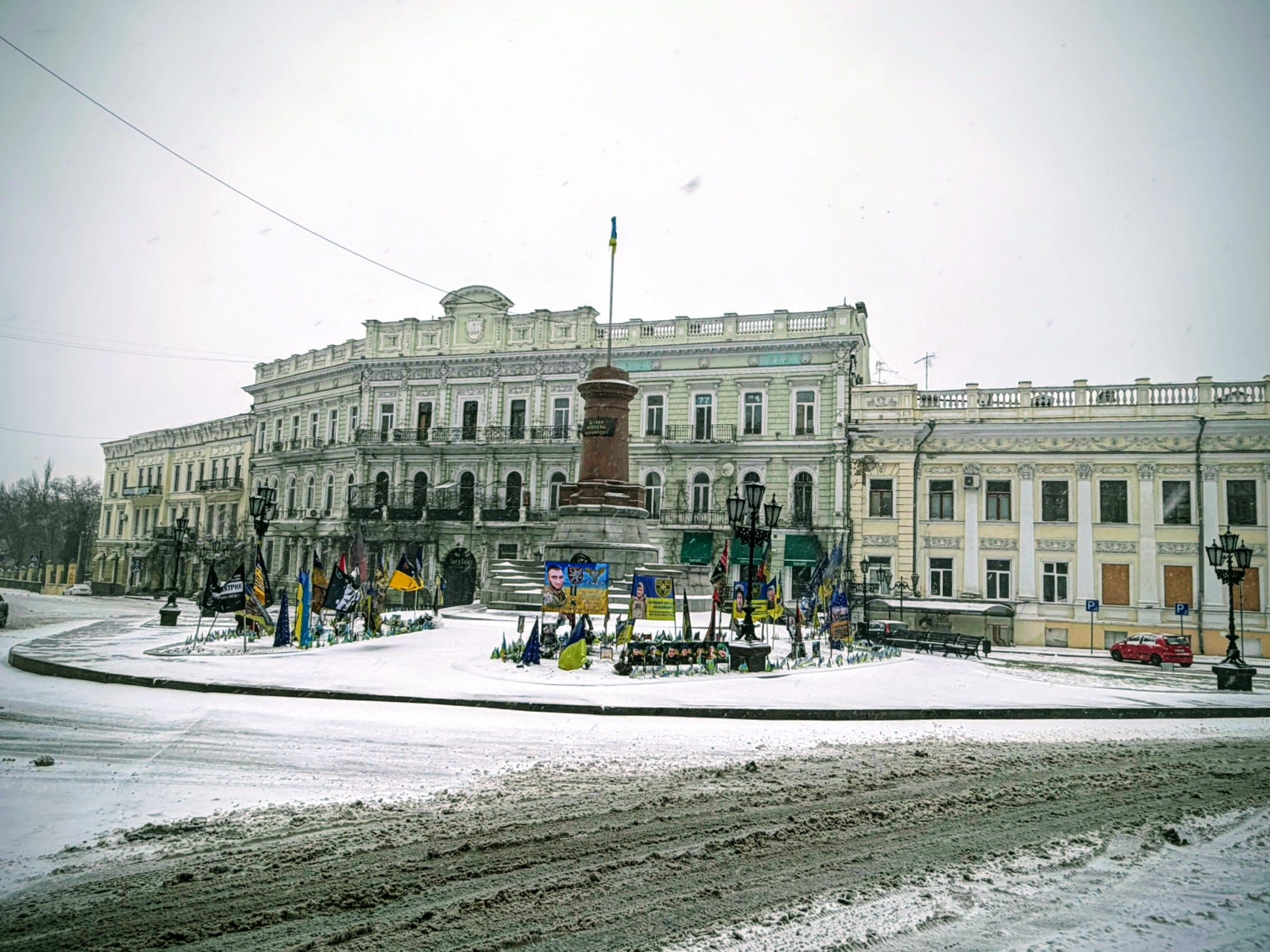
Odesa In Snow: A Photo Essay
A city of uncommon beauty facing war, bombardment, and atypical cold
Good Morning:

It doesn’t snow in Odesa often. The city is warmed by the Black Sea and is almost as close physically to Istanbul as it is to Kyiv. A tour guide I talked to yesterday told me snow here is a once every other year event.
The following are pictures of the city taken yesterday both by me and by the estimable Anastasiia Lapatina during a rare snowfall—supplemented by a few additional photographs I shot today.
As with most of Ukraine, a great many people don’t have power here. But Odesa is not like Kyiv. It is closer to active fighting, and the front line earlier in the war was not far from here. The historic city center—which has been designated a UNESCO world heritage site and has a density of architectural gems that invites comparison to the great tourist destinations of Southern Europe—has not found the UN’s designation an effective protection against Russian bombardment. The city has taken a beating the last few years.
I am mostly going to let these images speak for themselves, but a few of them require a certain amount of explanation.
The Odesa waterfront features a series of palaces built in the early 19th Century along with certain modern building. Few have escaped damage:


This is a close-up of the hotel pictured on the above-right. As you can see, it has been destroyed.
The hotel, I am told, was deeply resented by Odesans when it was built some years ago, as it blocks the view of the sea from the see. Since its destruction, however, it has become a symbol of city defiance.
Similarly, note that all of the windows in the buildings in the center image are broken. Here’s a closer view:
When windows aren’t broken, as in the other mansion in that same center photograph, it’s because they are brand new:
Even some major public buildings that are still functioning are doing so despite damage from shelling. The Museum of Literature has holes in the ceiling from a drone attack:
And it has new windows in its main concert and lecture hall—the old ones having been blown out:
Not all of the windows have been replaced. Here’s a view from the outside:
Indeed, the extent of damage in the city center is actually masked both by people’s propensity to fix and protect beautiful things quickly and by the city’s tendency to make a kind of wartime chic vibe out of a grim situation. This is the interior of the restaurant I ate Friday evening:
None of this is bomb damage—in this case. It is the design aesthetic. But it is a design aesthetic influenced by years of bomb damage. And while in this case it is obvious, it honestly can sometimes be hard to tell the difference as an outsider. Today I walked by this abandoned movie theater and couldn’t immediately tell why all of the windows were broken; was it a blast or just neglect of a derelict building?
I have nothing to say about the opera house. It requires no explanation:


And yes, it looks really amazing glazed in ice. But remember, before you get romantic about these images, that people don’t have heat here. As I snapped pictures of a man a few blocks from the opera house pushing a load of firewood, my guide nodded grimly and said, “Yes, this is a perfect representation of modern human life in a 21st Century city.” This firewood is not going to be used for cosy atmospherics.
The store’s sign behind this gentleman says, “Lviv Manufacture.” It is a coffee shop.
The bombing of the Spaso-Preobrazhensky Cathedral is particularly ironic—on a number of different levels. First of all, the cathedral is part of the wing of the Orthodox Church that is under the Moscow Patriarch, which is to say that Putin bombed a church under the authority of his own thuggish religious lackey.


Another layer of irony is that this isn’t the first time the Russians have destroyed this particular cathedral. The current version is a post-independence reconstruction of the original, which the Soviets blew up. The postcard below reflects what the site looked like with a statue of Stalin sitting observing the many hydroelectric plants built with slave labor across his realm:
Here are shots of what the inside of the rebuilt cathedral looks like today:


Attacks on religious sites in Odesa took place as recently as Wednesday.
Somehow, this incredible 19th Century shopping mall has managed not to be similarly damaged:


Finally, azza Jew visiting one of the iconic centers of European Jewish life, it would be very wrong of me not to share this Yiddish typewriter—the only one I have ever seen in my life—and a really great Odesa Jewish joke told me yesterday by a prominent member of that dwindling but still proud band.
Two Odesa Jews are walking down the street speaking Yiddish. A third Jew walks up to them and asks in Russian (the native language of most Odesa Jews and many others here) why they are speaking Yiddish. One of them explains: “So that Putin doesn’t think he should come and protect us!”


I really appreciate your photographs here. This is a very interesting city.
Thanks so much for having made this trip and for sharing it with all of us.