Good Evening:
I launched today’s #DogShirtTV expecting to talk to the estimable Anastasiia Lapatina and the no-less-estimable Mike Feinberg about their favorite books. The show didn’t quite work out as planned for two reasons:
The first was that Mike’s connection was untenably unstable, unsurprising as he was joining the show from the road—quite literally—as he drove by, ironically enough, Quantico, Virginia. The second reason was that the estimable Andrew Steele showed up with a very good idea: why not have MARA (Make America Read Again) Book Club episodes on Platonic dialogues?
For that matter, why not have them on essays? Or poems?
The Greek Chorus lit up at the idea of MARA Book Club meetings on shorter writing, and I promised both to execute the idea and to solicit feedback on what sort of writing people want to discuss.
So here’s what we’re going to do: Because this whole thing was Andrew’s idea, we’re going to start with some Platonic dialogues. I will coordinate with him to get a few of these scheduled. In the comments below, please leave suggestions for shorter writing forms you’d like to discuss. I will organize shorts on these as well. Some of them I can manage myself—and I’m happy to prepare mini-lectures on ones on which I feel competent to speak. With others, I will invite learned guests to lead discussions.
As with all MARA Book Club meetings, these will be for paid subscribers only. So, you know,
Experiment!
Another Experiment
Speaking of experiments, the estimable Anastasiia Lapatina the other day suggested to me that I should send out the full “The Situation” column as a newsletter. I’m not going to create a whole new newsletter, and I don’t think Lawfare should either for purposes of distributing my column. That said, I see no reason not to include full text of The Situation within #DogShirtDaily, so starting now, the full text will be part of this newsletter. This will save you one click.
Don’t thank me.
The Situation
Comments on the Meta-Situation
The Situation on Dec. 19 asked whether it would be lawful to project an unflattering image of FBI Director Kash Patel on the Hoover Building in Washington, D.C. (Spoiler alert: Yes, it’s lawful, and I’m going to do it.)
Then I took a week off.
Today, however, I want to reflect on one year of The Situation.
The name “The Situation” has given rise to a bunch of questions and origin theories since I began writing this column the day after Donald Trump’s election to his second term of office.
One Lawfare contributor told me he assumed it was a reference to the sort of thing one deals with in the Situation Room of the White House—which was an excellent theory, though entirely incorrect.
In fact, as I explained in The Year that Was 2025, the term “the Situation” is a linguistic borrowing from Hebrew, where the phrase “hamatzav” refers to Israel’s general security woes—a kind of chronic security crisis that bubbles along from day today, with no beginning and no end and just has to be managed.
Years ago, the Israeli daily Ha’aretz used to publish a regular column entitled “Five Comments on The Situation.” This is where the name comes from.
Indeed, on Nov. 6, 2024, the phrase “The Situation” struck me as a good metaphor for the crisis of democracy into which the United States had suddenly entered, or—depending on one’s perspective—long ago drunkenly stumbled into. However we had gotten there, the second Trump administration would be a chronic, unfolding, hydra-headed set of maladies—some predictable, some wholly unpredictable, some more manageable than expected, some far less so, some about as anticipated.
Yes, there would be discrete episodes within The Situation, but The Situation itself would be a kind of continuous wave—one that would progress from day to day in a kind of stream of consciousness. Only the rub was that our security crisis—our Situation—would not be some foreign threat but the management of our own executive branch. It would be our own presidential administration. It would be, it already was, our own politics.
The goal of the column was to capture this ongoing crisis of democracy in a kind of never-ending chronicle, one that linked each day to the previous day and to the next day in a kind of reflection of that stream of consciousness quality—what I sometimes call “the screaming.”
That chronicle has now been going more than a year. There have been 140 installments of The Situation so far (not including this one), according to the Lawfare site.
There is a bit of a methodological question as to how to measure when the first year of The Situation really ends. The column, after all, began at the time of Trump’s election, not either at the turn of the calendar year or at the time of his inauguration. On the other hand, what I have called the “Full-Scale Situation” clearly dates from Jan. 20, 2025. Still, the end of the calendar year is a good moment at which to reflect on some of the major meta-developments within The Situation—to break through to higher ground, if you will.
Here, then, are three meta-Situational points:
The Situation’s pace is slackening. The first half of the year saw Trump rampaging across the federal government, taking bold actions against a diverse array of political foes, making outrageously broad assertions of executive power, and attacking vulnerable populations. One action followed hard upon another. There was a shock-and-awe quality to it all. One couldn’t catch one’s breath. While the outrages haven’t stopped, by any means, they are spacing farther and farther apart. This is not because Trump has repented or been defeated. It’s partly because you can’t blow up the same building more than once. He has accomplished certain destructions, and those are done now. It’s partly because a bunch of other things have been mired in litigation—or just stopped. It’s partly because non-judicial actors, from the Indiana legislature to grand juries, have put their feet down about certain other things. And it’s partly because voters have expressed themselves and sent some loud messages. For whatever combination of reasons, things are definitely slowing—and that is good. I went on vacation last week, and I returned feeling like I had missed very little. That would not have happened six months ago, let alone a year ago.
The regime has not changed. One way to think of The Situation is as an attempt at regime change in the United States. As I put it back in March, Trump proposes “nothing more or less than an attempted regime change in a country with a historically stable, liberal democratic regime.” The Situation “is clearly an effort to replace one regime—comparatively liberal, comparatively democratic, comparatively impersonal—with another one—less liberal, less democratic, more clientelist, and more personal.” One year in, it is too early to say that Trump has failed in his effort to change the American regime. It is not, however, too early to say that the regime has not been changed. Trump has done damage, yes. Trump has injured institutions in ways that will require many years or decades to repair. He has also exposed huge dysfunction in America’s democratic polity and defenses. And yet, he ends his first year in office unpopular, unsuccessful in consolidating power, unable to pass legislation through Congress, facing electoral rebuke with greater rebukes looming, and staring at early lameness in his duckhood. It is far too early to declare the threat passed—the nature of The Situation being that the threat never really passes but only evolves and morphs. That said, the United States exits 2025 decidedly not as an autocracy, whatever Trump’s ambitions may have been and whatever they may still be. Which is to say that one acute manifestation of the threat has ebbed a bit.
We have entered a period in which Trump loses. In the early phase of the Full-Scale Situation, Trump just did things: destroyed federal agencies, fired people, deported people. And while lower courts struggled to keep up, the Supreme Court showed a remarkable tolerance for allowing the executive branch to—while litigation was pending, at least—get away with stuff and proceed with activity whose legality was very much subject to challenge. There were no elections. Congress never said no. So Trump appeared to be winning. But eventually, you’re not on the emergency docket any more. You actually reach the merits of big questions with developed records. And eventually, there are elections. And eventually, politics return to legislative bodies, and people who appeared to have no limits find that some things—whether partisan midcycle redistricting or double-tap strikes in international waters—are just too much and that the president just isn’t popular enough to demand that each and every legislator look the other way about each and every outrage. And so The Situation enters a different phase. It’s the phase in which institutions find their limits. It’s the phase in which politics returns partly because, well, elections were scheduled and Trump’s party lost them all and more are coming down the pike. And politics returns as well because people expecting to lose elections—leaving aside whether they really do lose them—behave differently towards their party’s leadership than people who are confident that leadership has their backs. And politics returns as well because “so much winning” only works if you are, in fact, winning so much, and it requires the momentum of that early rampage. The Situation has a very different logic when the courts are saying no and the electorate is saying no—and is expected to say no some more—and when the president is unpopular.
All of this is not to say that The Situation is over. The Situation, as I mentioned, has no end. It is our democratic reality from now until such time as we evolve a profoundly different political culture. There’s a reason every column ends by stressing that it continues tomorrow.
And all of this is not to say that the guardrails have held. May it please God, my point is nothing so banal. Some guardrails have definitely not held. Some are holding—for now, at least. Some have proven robust. The guardrails are not a tribe that “holds” or fails as one.
And all of this is emphatically not to say that the crisis is past us.
All of this is just to say that the year ends with The Situation looking quite different from how The Situation looked as the year swept in. It is less of a juggernaut. It is more vulnerable for all its continued swagger. It has found that it has opposition. And while it still poses all sorts of dangers, it is having a lot of trouble finding its footing.
And it continues tomorrow—and next year. Because that is what The Situation does.
Operation Brahms
Today’s installment is a middling work of songs in praise of the Virgin Mary. I was unaware of this work, to be honest, and candidly, it doesn’t sound much like Brahms to me. Written for mixed chorus, it draws on peasant songs in praise of the virgin and sounds very little like any other Brahms I have ever heard. They are pretty enough. But I confess they don’t move me much. I’m glad to know they exist, though.
Oh, well. There’s a bell curve in everything, I suppose.
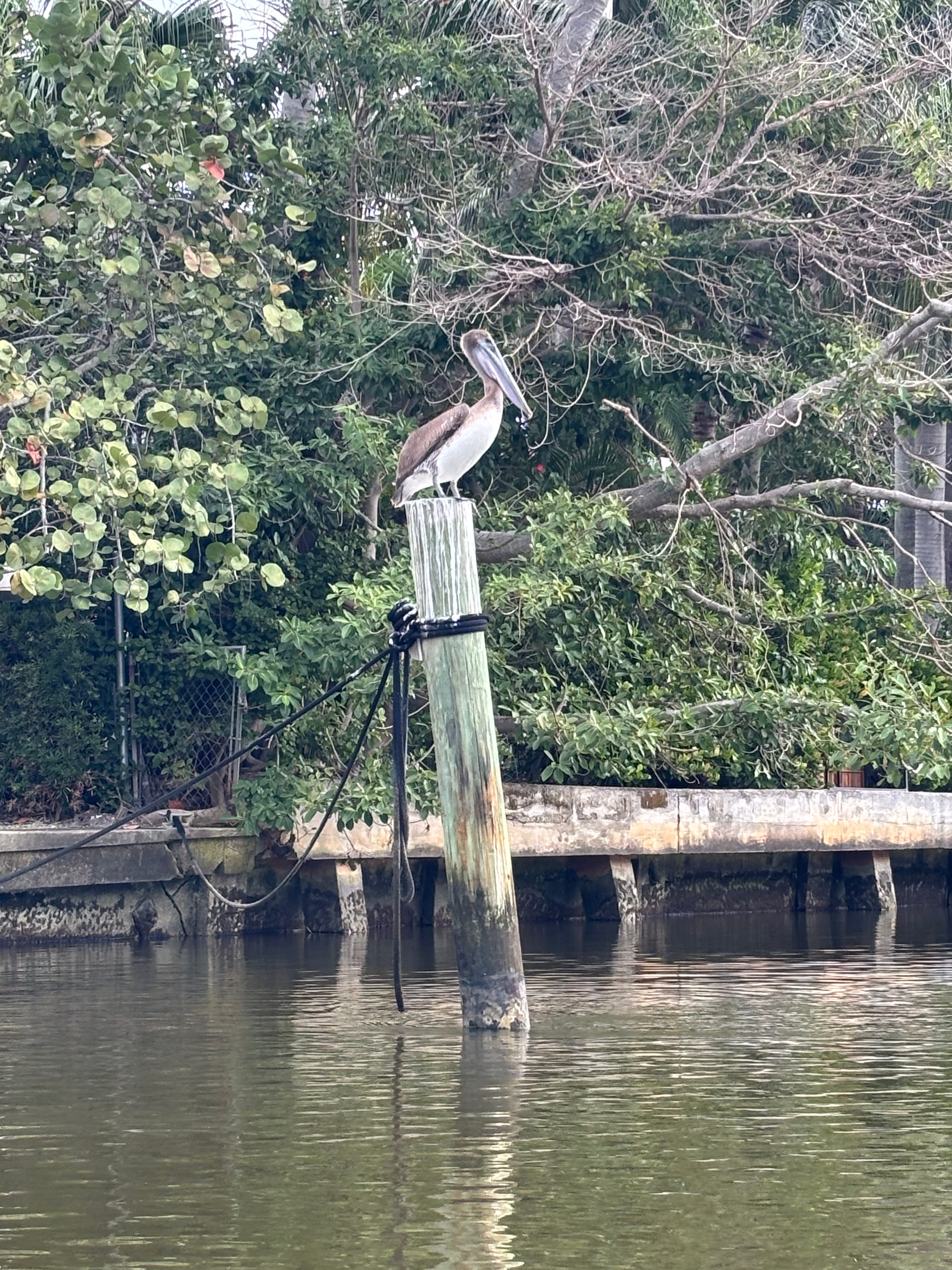
Today’s #BeastOfTheDay is this pelican, photographed by the estimable Tamara Cofman Wittes during our manatee kayaking adventure: