


Good Morning:
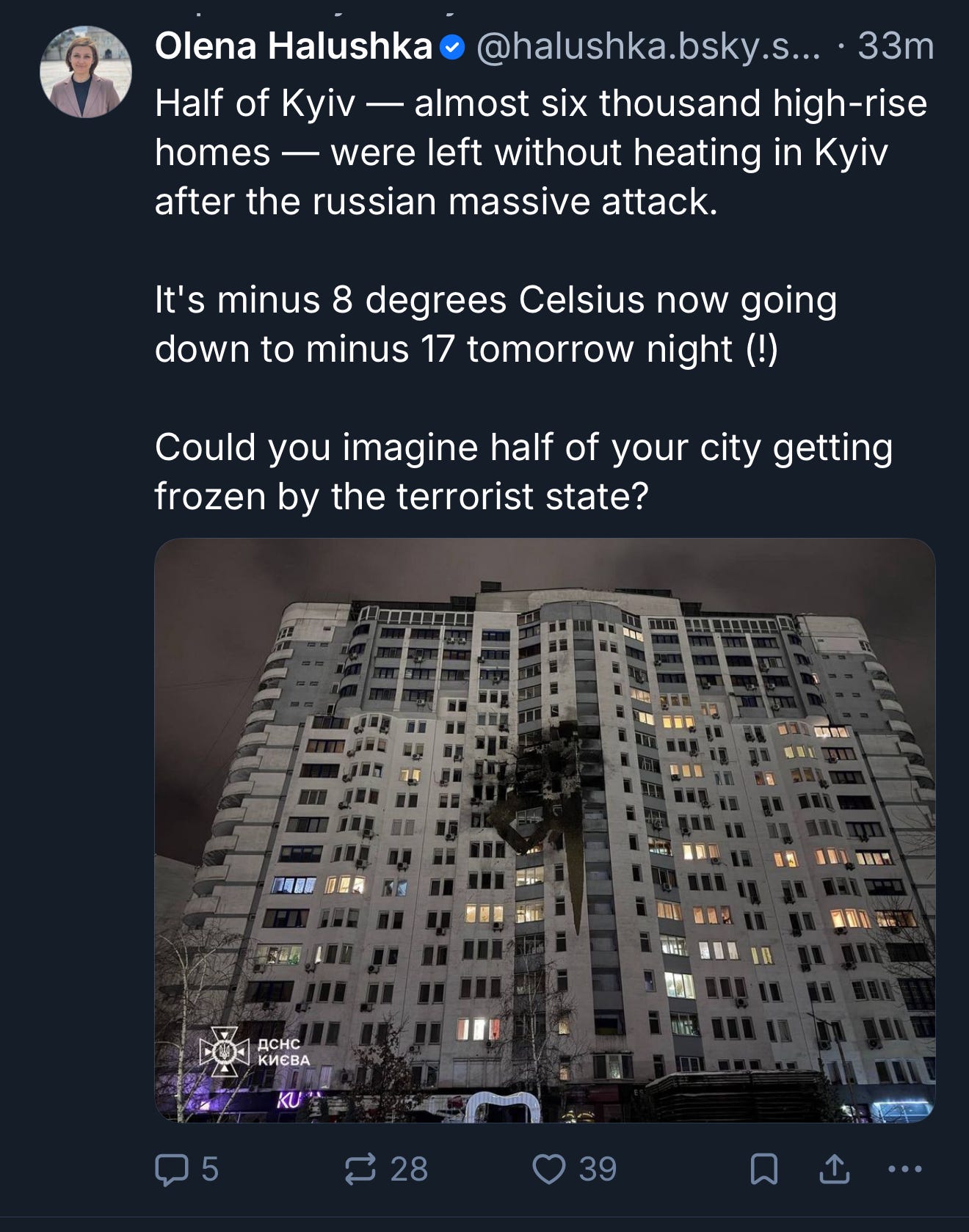
We will be discussing last night’s mass attack on Kyiv with the estimable Anastasiia Lapatina this morning on #DogShirtTV.
Yesterday on #DogShirtTV, the estimable Amanda Carpenter came by to talk to us about the organization Protect Democracy, where she works. We also talked long-distance running, just because:
Operation Brahms
I was nineteen or twenty years old and sitting in the living room of my parents’ house in New Haven—the room in which my father had his extensive CD and record collection and his stereo system. My father walked into the room and another family member said to him as he approached his collection, “I know what I want to hear” evidently expecting to make a request.
He responded, “I do too.”
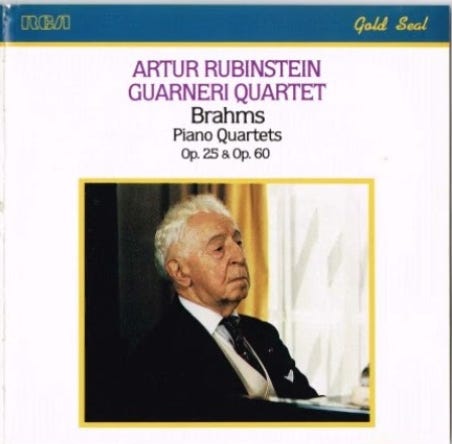
And he went over to his shelf and pulled off this CD of Arthur Rubinstein and the Guarneri Quartet playing the Brahms Op. 25 piano quartet:
She was astonished.
Somehow, and I’ve never known quite how, he had intuited—of all the music in the world and all the CDs in his rather extensive collection—the precise piece of music she in fact wanted to hear: the Brahms Op. 25 piano quartet.
I won’t pretend that this incident represents the origin story of my love of Brahms, which predates this by a few years and really owes more to my discovery of the Op. 40 horn trio as a teenage brass player. But it was a magical moment that I recall every time I hear the delicate piano opening of what is a truly mesmerizing piece of chamber music that just never ever gets old.
Brahms’s chamber music is, in my humble opinion, his most important body of work. And I can think of no better way to introduce yourself to it than the Op. 25 quartet. I have sung the praises earlier in this series of several pieces by the young Brahms, particularly the Op. 17 sextet and the first piano concerto. But this quartet really represents the first work of the fully mature Brahms showing all of his composition power. It was written over five years and premiered in 1861 with Clara Schumann playing piano—which is kind of a grand way to introduce a piece of music to the world.
There are many great performances of this piece, but that disc that my father pulled off the shelf that day is still my favorite:
For those who prefer videos of live performance, this one by the Faure Quartet is excellent:
And I would be remiss if I did not mention that the 20th Century twelve tone composer Arnold Schoenberg arranged the quartet for orchestra in the late 1930s. Here’s a performance of that orchestration—performed at a much slower tempo—by the Frankfurt Radio Symphony with Christoph Eschenbach conducting:
A few things to note about this piece, and really all Brahms chamber music to come.
The first is the sheer density of memorable—heart-melting, really—melodic lines. This begins right from the first notes, where the piano offers a tense and tantalizingly delicate ten bar melody that then taken up by the cello and handed back and forth between the strings and the piano. It continues straight through the fast-paced fourth movement. There is literally never a moment in this piece in which you are not being confronted with a gorgeous tune. They melt into one another. They explode out of one another. Some of them are brief. Some of them are quite lengthy. But he weaves them together in a fashion that is remarkable and creates a kind of density of beauty.
Second, note the Eastern European flavor of the fourth movement. Brahms was fascinated by Hungarian and other Eastern European melodic traditions. He would later write and set a series of Hungarian dances. Like other 18th and 19th Century composers, he was also inspired by Roma music; indeed, the fourth movement of this quartet is called “Rondo alla Zingarese”—which is to say “Rondo in the Gypsy style.” This vacillation between and integration of Austro-Hungarian folk themes with the highest of German classical composition becomes central to Brahms chamber music—and orchestral music too.
Finally, don’t miss how perfect it is. It is dense and complicated. It is extremely difficult to play. And yet there is no note out of place. There is no needless virtuosity. At no time in this piece is Brahms showing off his prowess—either as a pianist or as a composer.
It is as close to a perfect piece of chamber music as I know.
Today’s #BeastOfTheDay is an Argentinean dog, which performed an Act of Valor sufficient to qualify it as today’s Beast by taking part in a professional soccer game and then giving a post-game interview—and eating the microphone. Admittedly, today’s Beast performed this Act of Valor in September 2017, but no one was nominating Beasts for the #BeastOfTheDay back then. This Beast deserves recognition, even if only retrospectively. Just look at this Beast:
Eventually, two men on the sideline realized that the best way to allow the players to get on with the game would be to get a second ball to distract the dog.
In honor of today’s Beast, try to find within yourself one one-thousandth of the joy of a dog confronted with a game in which all the humans are running after a ball.
AI Adventures
I—EJ Wittes—bring you once more a weird/fascinating paper on LLM behavior. Today with extra emphasis on the ‘weird.’