


Good Evening:
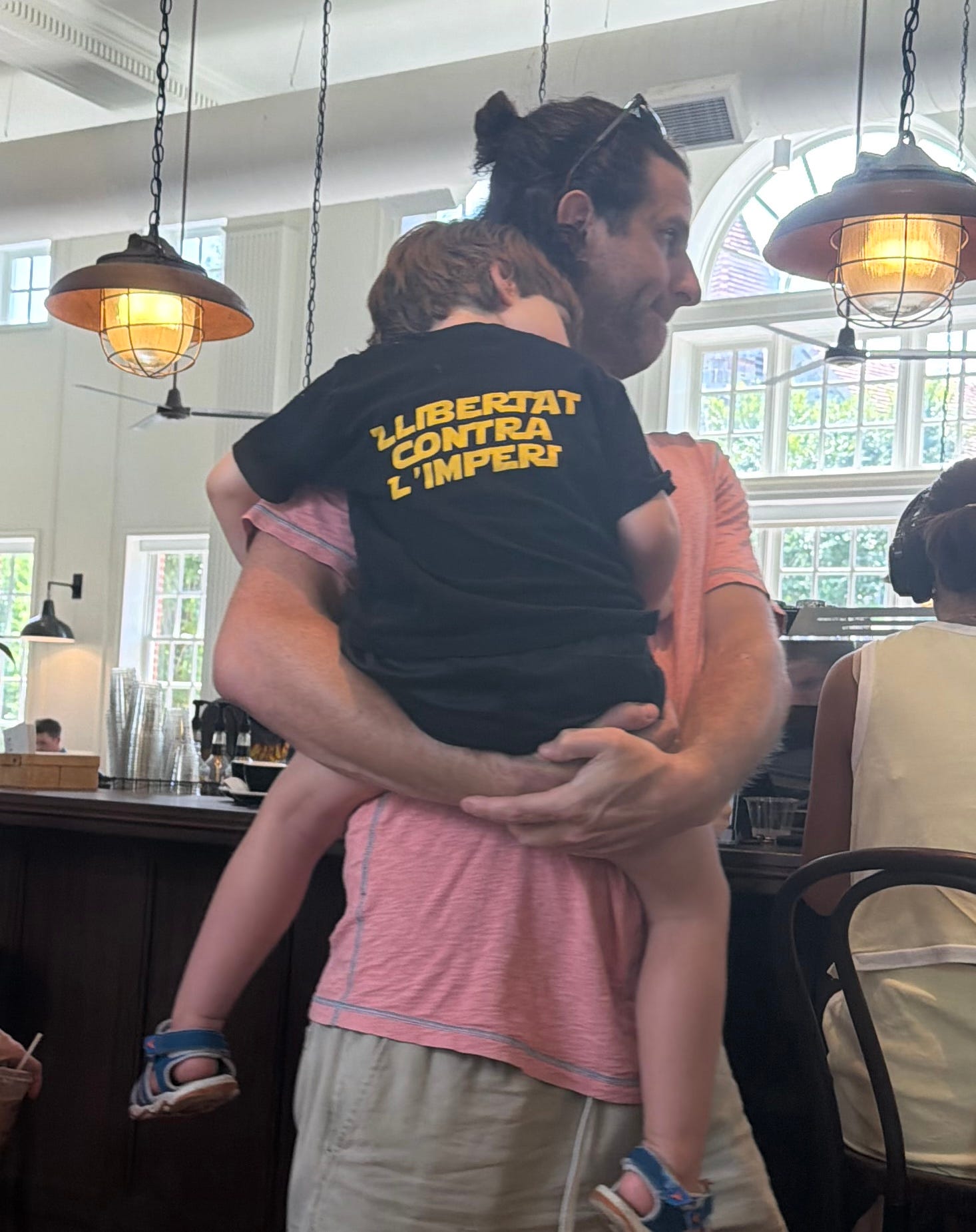
For those who cannot read Catalan, the t-shirt of the day reads, “freedom against empire”—or so Google Translate tells me.
Tuesday on #DogShirtTV, the estimable Holly Berkley Fletcher introduced our safari guide and talked about Rwanda, and the estimable Jonathan Rauch had some SCOTUS questions:
Wednesday on #DogShirtTV, the estimable Mike Feinberg decided to make law professors angry on the internet:
Thursday on #DogShirtTV, the estimable Anastasiia Lapatina gave an update on parenting under Russian bombardment, and the estimable Holly Berkley Fletcher had arch-related news:
And Friday on #DogShirtTV, I roped the estimable Mike Feinberg and the estimable Alicia Wanless into a very silly discussion about anti-American and anti-Canadian music:
Recently On Lawfare
Compiled by the estimable Sarah Willrich
Rethinking Treasury’s Terrorism and Financial Intelligence Office
Alex Zerden and Rachel Lyngaas argue that the Treasury’s Office of Terrorism and Financial Intelligence (TFI) is overdue for reform. Zerden and Lyngaas explain that, more than two decades after its founding in the wake of 9/11, TFI’s name, structure, and component mandates no longer reflect its actual work, and suggest that TFI change its name, establish a permanent chief economist, and return the U.S. Secret Service to the Treasury Department to give the office a criminal enforcement capability it currently lacks.
TFI should rebrand as the Office of National Security and Financial Crimes (NSFC). The name better captures the office’s actual capabilities and mission, particularly in combination with the other reforms recommended below. “Terrorism” as a framing made sense in the wake of 9/11, but terrorism is now just one of many priorities competing for TFI’s attention—alongside nation-state threats from Iran, North Korea, Russia, and China, and transnational threats involving cybercrime and fraud, narcotics trafficking, and human rights/corruption. Similarly, “financial intelligence” describes one important tool the office uses, but the framing often confuses private-sector stakeholders and raises concerns among civil libertarians.
Slaughter’s Silence
Nick Bednar analyzes the Supreme Court’s ruling in Trump v. Slaughter, which overruled Humphrey’s Executor and held that Congress cannot limit the president’s authority to remove principal officers of independent agencies. Bednar explains that the majority’s indeterminate language—relying on the broad term “subordinates” rather than the traditional principal/inferior officer distinction—leaves open whether the removal power now extends to inferior officers and civil service employees.
Overruling Humphrey’s Executor was preordained. The real question was what reasoning would replace it. A minimalist approach could have held that the Federal Trade Commission exercises more executive power today than it did in 1935, preserving the Humphrey’s Executor exception for multimember agencies with more limited authority. A maximalist approach would embrace the most expansive form of unitary executive theory and abolish removal protections for all officers and employees within the executive branch.
So which reasoning did the Supreme Court ultimately adopt? After reading all 191 pages in Slaughter and its sister case Trump v. Cook (twice), I am not entirely sure.
NATO 3.0: A Tagline in Search of a Concept
Ahead of next week’s NATO summit in Ankara, John Drennan and Ariane Tabatabai analyze the Trump administration’s vision for “NATO 3.0,” the newest step in the administration’s efforts to increase burden sharing between member countries. Drennan and Tabatabai agree that member countries needed to increase their efforts, but argue that it must not be viewed as an end in itself, but rather as part of NATO’s goal of deterring Russia.
Although Trump is not the first U.S. president to take issue with lower defense budgets and burden-sharing across Europe, he is the only one to frame his entire approach toward NATO around them. Where predecessors at least framed burden-sharing within a broader vision for the alliance’s future, the Trump administration has instead focused on burden-sharing only as an end, not a means to achieve a stated objective. Without clear objectives for the future of the alliance, Washington cannot expect to sell NATO 3.0 to its allies and to generate the support necessary to truly advance the concept.
Will the New Export Controls Shake the Foundations of the U.S. AI Industry?
In the latest edition of Lawfare’s Foreign Policy Essay series, Alvin Wang Graylin and Jon J. Rosenwasser highlight two assumptions in U.S. artificial intelligence (AI) policy discussions: that the U.S. can stay ahead in the AI race by denying foreign access to top U.S. models and that AI regulation slows progress in the race against China. Graylin and Rosenwasser argue that both assumptions are flawed and that continued belief in them harms the U.S.’s position in the AI race.
A deployed commercial AI model is not enriched uranium that can be physically contained with no consequences. It is a service on which hundreds of millions of users have built dependencies, and when Washington shows that access can vanish overnight, it teaches every other government and foreign business that depending on American AI is itself a risk. The rational response is to seek alternatives from other countries, and the most available ones are from China and open sourced. Singapore’s national model now builds on Qwen, as do the United Arab Emirates’ K2-Think and a lengthening roster of other national systems.
Justice Delayed, Justice Denied? The HCJ’s ICRC Visits Judgment
Yuval Shany and Amichai Cohen analyze Israel’s High Court of Justice’s decision compelling the Israeli government to resume the International Committee of the Red Cross’s access to Palestinian prisoners after a yearslong ban. While Shany and Cohen credit the court for reaffirming legal limits on government conduct amid war, they argue that the decision is a weaker win for judicial oversight than it seems: the government mounted no real defense, and the court itself may have delayed ruling until the hostage crisis ended to avoid political backlash.
The delays, however, were likely indicative of the government’s weak legal argument and its efforts to “buy time” in order to avoid implementing a nonreciprocal and highly unpopular legal obligation, perceived as “soft on terror.” The repeated requests for delay also seem to reflect the government’s lawyers’ decreasing ability to force politicians to comply with an unpopular law, even when the law’s content is clear and straightforward.
An Optimist’s Account of Artificial Intelligence
Paul M. Barrett reviews Josh Tyrangiel’s book, “AI for Good: How Real People Are Using Artificial Intelligence to Fix Things that Matter.” Barrett applauds the book’s rigorous reporting on case studies of artificial intelligence (AI) deployment for good and highlights its call for individualized, human-driven analysis when implementing AI tools in daily operations, especially in fields like education and medicine.
At a thematic level, Tyrangiel complicates my glib opening sentence by demonstrating that the AI story is, in fact, many stories, that neither AI doomers nor cheerleaders deserve our deference, and that particular applications of AI demand individualized scrutiny before we conclude that the technology will resolve all human woes (it will not) or erase all meaning from human life (it could, in theory, but it doesn’t necessarily have to).
Podcasts
Lawfare Daily: ‘The Reverse Centaur’s Guide to Life After AI’—A Conversation with Cory Doctorow: Kate Klonick and Alan Rozenshtein speak with Cory Doctorow about his new book, “The Reverse Centaur’s Guide to Life After AI.” They discuss the historic investment bubble being built on top of the artificial intelligence (AI) boom, whether the AI bubble will actually burst or merely deflate, and the “reverse centaur.”
Lawfare Daily: Trump’s Cuba Problem: Daniel Byman sits down with Javier Corrales to discuss the Trump administration’s efforts to pressure Cuba and spur regime change there. They discussed why the Cuban regime stays in power, the effectiveness of different U.S. policy instruments used against Cuba, why Corrales thinks that the Venezuela approach would probably not work in Cuba, and what a post-communist Cuba might look like.
Lawfare Daily: What the Supreme Court Said About the President’s Power Over Independent Agencies: Natalie Orpett sits down with Nick Bednar to discuss two Supreme Court rulings, in Slaughter v. Trump and Cook v. Trump, issued the previous week that will have a huge impact on the president’s authority to remove personnel at agencies that Congress set up to be independent.
Videos
I sit down with Molly Roberts, Kate Klonick, Eric Columbus, and Roger Parloff to discuss the Supreme Court’s decisions on birthright citizenship, the president’s ability to fire the heads of independent agencies, constitutional protections for location data, and more.
Today’s #BeastOfTheDay is the wolf, seen here experimenting with gravity:
Tell Me Something Interesting
I—EJ Wittes—mentioned in my last TMSI post that I had been investigating the history of dueling. In the process, I’ve been reading about the various pseudo-legal codes that governed the practice of duels in the 18th and 19th centuries, and I’m very nearly convinced that the earliest documented of these codes, the so-called Irish Code of Honor, is actually bullshit.
It is, to be sure, very appealing bullshit. It has all the trappings of legitimacy, including a heading announcing that it was composed “at Clonmell summer assizes, 1777, by the gentleman delegates of Tipperary, Galway, Mayo, Sligo and Roscommon, and prescribed for general adoption throughout Ireland,” a note about the committee which should be contacted if clarification is needed, and the signatures of the president of the assembly and two secretaries.
It’s also thoroughly bloodthirsty. The rules require that at least two shots be exchanged before a quarrel can be considered settled, prohibit apologies once both parties have arrived for the duel, and even ban deliberately shooting into the air or otherwise avoiding lethal violence.
This bloodlust makes the document a very tempting primary source indeed, and I have found it quoted in full everywhere from PBS to the .gov sites of several US states, which use its text to explain the prohibitions against dueling in their state constitutions. I started researching it with an eye to making its bellicosity the subject of an amusing post.
But then I happened upon these two blog posts by Dianne L. Durante, which are, of all things, part of an in-depth analysis of the lyrics of the musical, “Hamilton.” Durante points out that the earliest printed attestation of the Irish Code of Honor dates to the late 1820s, fully 50 years after it was supposedly drawn up. That attestation comes from Jonah Barrington, an Irish judge and politician, who includes the full text of the Code in his memoirs . Now, Barrington’s account of Irish dueling culture is hilarious, but I do concur with Durante that it should absolutely not be taken seriously.