


Good Morning:
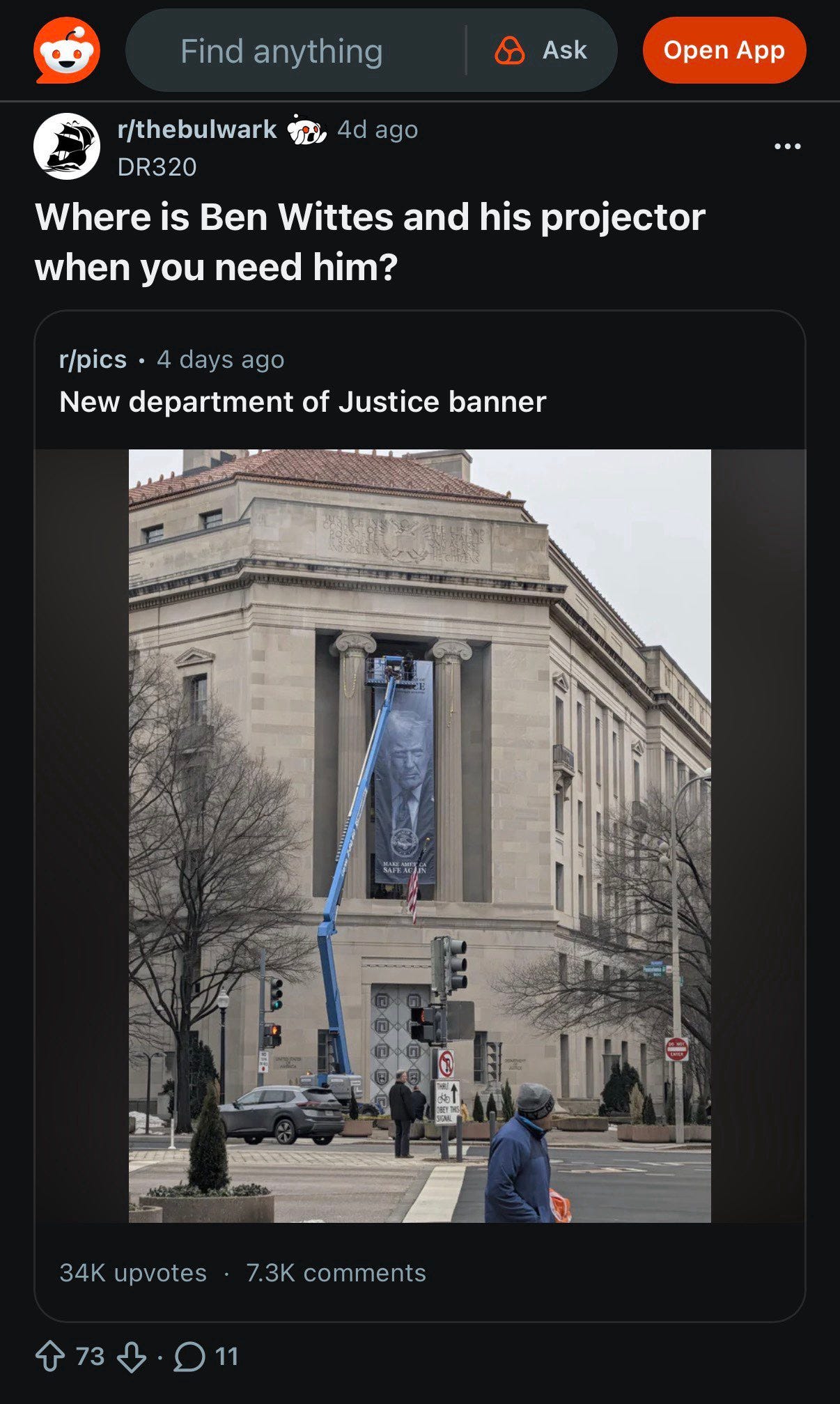
I have heard your cries, oh my people.
I have heard your cries.
Today, however, is Feb. 24, which is the fourth anniversary of the full-scale invasion. So I have a date with a different building.
Yesterday on #DogShirtTV, the estimable Holly Berkley Fletcher and I debriefed from last weekend’s Principles First conference, and the estimable Anastasiia Lapatina gave us a battery update:
Yesterday On Lawfare
Compiled by the estimable Marissa Wang
Lessons from the Minnesota Civil Contempt Case
Roger Parloff unpacks a Minnesota federal judge’s civil contempt sanction against a U.S. attorney in an immigration habeas corpus case, illustrating a broader breakdown in compliance with judicial orders, mounting frustration from the judiciary, and limited accountability for senior officials under the Trump administration’s Operation Metro Surge.
Judge Provinzino then delivered her oral decision, later commemorated in a minute order. She observed that “willfulness” was not a requirement to impose coercive civil contempt sanctions. “More to the point,” she continued, “the government’s understaffing and high caseload is a problem of its own making and absolutely does not justify flagrant disobedience of court orders.”
Can a President Unilaterally Withdraw—and Rejoin—the UN Climate Treaty?
Mark Nevitt and Anissa Patel explain how President Trump’s withdrawal from the UN Framework Convention on Climate Change exposes a constitutional gray zone over treaty exit and reentry in which it is unclear whether Congress or the president has the final say. Nevitt and Patel analyze precedent to discern where the power to terminate treaties lies in practice and what it means for American credibility in global climate cooperation.
On Jan. 7, the Trump administration withdrew the United States from more than 60 international agreements and organizations, including the United Nations Framework Convention on Climate Change (UNFCCC). The administration justified these withdrawals by deeming the agreements “contrary to the interests of the United States” and characterized them as “anti-American, useless, and wasteful.” When the Trump administration announced the United States’s withdrawal from the UNFCCC, it revived two long-standing but unresolved constitutional questions: (a) Can a president unilaterally terminate a Senate-ratified treaty—and if so, (b) can a future president unilaterally rejoin it?
The Jihadist Movement’s Leadership Deficit
In the latest edition of Lawfare’s Foreign Policy Essay series, Tricia Bacon and Elizabeth Grimm assess how the global jihadist movement has been weakened by the lack of a unifying leader, which it previously had. Bacon and Grimm contend that this absence has increased division within the movement and made it less dangerous to the U.S.
At first glance, things could not be better right now for the Sunni jihadist movement. The Afghan Taliban and Hay’at Tahrir al-Sham (HTS) have seized power and are now the governments in Afghanistan and Syria. Jihadist groups have made unprecedented gains in Africa and pose existential threats to multiple governments in the region. The conflict in Gaza and the Israeli government’s reported plans to relocate Palestinians to other countries tapped into the most galvanizing cause in the movement. This instability coupled with the geographic reach of the movement should be potent.
Yet the jihadist movement—meaning the individuals, factions, and organizations that use violence in pursuit of resurrecting the caliphate—has failed to capitalize on these circumstances. The movement has failed to seize this opportunity because it is experiencing a prolonged deficit of leaders who can inspire and direct it.
Podcasts
On Lawfare Daily, I sit down with Eric Columbus, Roger Parloff, Anna Bower, Molly Roberts, Troy Edwards, and Peter Harrell to discuss the Supreme Court’s ruling that overturned President Trump’s IEEPA tariffs, a Minnesota federal judge holding a government attorney in contempt, the Fulton County suit over the FBI’s seizure of 2020 presidential election ballots, and more.
Today’s #BeastOfTheDay—who earned an exemption from the usual “no dogs” rule on account of a recent Act of Valor—is Nazgul, a Czechoslovakian wolf-dog seen here captured by an Olympic finish line camera:

A local dog made a bid for Olympic glory Wednesday morning, breaking out of his doghouse and onto the homestretch of the cross-country ski course in the middle of a race.
Two-year-old Nazgul was quickly collared by race officials and returned unharmed to his home at a nearby bed-and-breakfast, but not before his genial presence lit up television sets and social media channels around the world — even if he perplexed some of the athletes who encountered him.
“I was like, ‘Am I hallucinating?” said Tena Hadzic, a 21-year-old Croatian skier who encountered the dog on her trip down the homestretch. “I don’t know what I should do, because maybe he could attack me, bite me.”
Race organizers did not make Nazgul available for questions after his capture.
In honor of today’s Beast, I personally will be thankful for the relative lack of chaos that my Beast, Kleio, causes during her (many, many) escapes. At least she’s never ended up in the Olympics.
In honor of today’s beast, go disrupt something.