


Good Morning:
Monday on #DogShirtTV, the estimable Elizabeth Tsurkov came on the show to tell us about the Israeli perspective on the war with Iran:
Yesterday on #DogShirtTV, after the great labor of providing such an estimable guest the day before, I left the show to the estimable Holly Berkley Fletcher to run. We talked about the referendum in Virginia on redistricting, which passed. And we talked about drones in Ukraine—ground robotics and flying drones:
Recently On Lawfare
Compiled by the estimable Marissa Wang
How a Gambling Warrant Could Change Immigration Enforcement Authority
Gigi Liman explains how a class-action lawsuit over an immigration roundup in Idaho that stemmed from a gambling investigation uses novel legal theories, relying on Reconstruction-era statutes, that could lead to more avenues to challenge federal immigration enforcement.
On a Sunday afternoon in October 2025, hundreds of community members from the majority Latino city of Wilder, Idaho, poured into the La Catedral horse racetrack for a popular weekly event with horse racing, Mexican food vendors, music, and family-friendly games. In the weeks prior, the FBI had obtained warrants to arrest five individuals—including the racetrack’s owner—for allegedly gambling without a license, along with a warrant to search portions of the property related to the gambling. The investigators executed those warrants on that Sunday.
What unfolded, however, bore little resemblance to a typical search and arrest for nonviolent gambling offenses. As the attendees began to gather for lunch, 200 federal, state, and local officers descended on the property, armed with guns and tactical gear, with helicopters and drones overhead. The consortium of law enforcement officers detained 400 adults and children, the majority of whom were citizens or lawful residents, hours after those accused of gambling violations were taken into custody until their citizenship status could be verified. Detainees were reportedly grouped based on perceived ethnicity; Latino-appearing attendees were allegedly denied water, referred to as “monsters,” and treated with more physical aggression than their lighter-skinned counterparts.
Tarasoff Meets the AI Age
Anat Lior argues that imposing a negligence-based duty to warn or protect against foreseeable harm on artificial intelligence (AI) chatbot companies would clarify company liability and resolve tensions between privacy interests and safety concerns, especially as these platforms increasingly encounter users exhibiting dangerous behavior.
When a therapist learns that their patient intends to harm someone, the law may require them to act. This principle, born from the landmark Tarasoff v. Regents of the University of California decision, raises an urgent and largely unresolved question in the age of generative artificial intelligence (AI): What happens when the entity with foreknowledge of harm is not a human clinician, but a chatbot? As OpenAI, Anthropic, Google, and other AI companies deploy increasingly powerful conversational systems, they may find themselves in possession of information suggesting that a user—or someone that user intends to target—is at serious risk.
The Russia-Iran Partnership
In the latest edition of Lawfare’s Foreign Policy Essay series, Delaney Soliday unpacks the current state of Russia-Iran relations by examining Russia’s aid to Iran in its current conflict with the U.S. and Israel and Moscow’s motivations in the partnership.
The war in Ukraine was a turning point for the Russia-Iran partnership, spurred by Russia’s need to purchase and mass-produce thousands of uncrewed aerial vehicles (UAVs). Now, it’s Tehran’s turn to ask for help, and the dangerous effects of this partnership are threatening American lives directly. Almost as soon as Operation Epic Fury began on Feb. 28, Russia began sharing intelligence with Iranian troops—including the location of U.S. personnel and satellite photos of U.S. military assets positioned in the region. More recent reporting revealed that Moscow is also helping Tehran improve its drone operations based on lessons learned from the aerial battlefields over Ukraine and organizing shipments of one-way attack drones to boost Iran’s offensive capabilities. One of Washington’s main adversaries—armed with several thousand nuclear warheads—is now aiding its ally in a major war against the United States. If policymakers had any doubts in the past about the importance of disrupting the Russia-Iran partnership, this should be their wake-up call.
The Serious but Not Literal Blockade
Todd Huntley argues that—despite President Trump’s initial declaration on social media platforms of plans to execute an unlawful total blockade of the Strait of Hormuz—the U.S. ultimately implemented a narrower, legally compliant blockade targeting Iranian ports. Huntley then evaluates the legality of the Trump administration’s actions in the strait, including the question of congressional authorization and international law concerns.
“Effective immediately, the United States Navy, the Finest in the World, will begin the process of BLOCKADING any and all Ships trying to enter, or leave, the Strait of Hormuz.” So wrote President Trump in a Truth Social post on Sunday, April 12, that was then also posted to the White House’s official X account. Despite floating the idea earlier that the U.S. would enter into a joint venture with Iran to charge tolls, Trump, in the same post, “instructed our Navy to seek and interdict every vessel in International Waters that has paid a toll to Iran.” He continued, “No one who pays an illegal toll will have safe passage on the high seas.” Trump had previously stated that he was thinking of charging tolls on ships for safe passage through the Strait of Hormuz as a joint venture with Iran.
El Niño Will Supercharge Shocks Like the Iran War
Tom Ellison explains how the convergence of the Iran war and the El Niño weather pattern in June will significantly exacerbate global energy, food, and geopolitical instability. Ellison contends that while the conflict has already disrupted oil, gas, and fertilizer markets, El Niño-driven extreme weather—including heat, drought, and flooding—will intensify these shocks, worsening supply chains and humanitarian crises.
The Iran war has sparked generational shocks to global energy and food security. As the effects of these shocks—from fuel shortages to food price spikes—become increasingly apparent, they will strain peace and stability worldwide. Some of these impacts are already unavoidable, with disruptions intensifying if the conflict persists. But independent of U.S. actions in the region, the coming of a hotter, more dangerous weather pattern known as El Niño is set to exacerbate the food and energy security fallout of Iran—reminding us that Mother Nature gets a vote on our priorities, too, and that climate resilience is inseparable from global security goals.
Podcasts
Lawfare Daily: The Trials of the Trump Administration, April 17: I sit down with Anna Bower, Eric Columbus, and Roger Parloff to discuss the disbarment of John Eastman, the Justice Department’s motion to drop the last Jan. 6 criminal matters, a warrant issued in the investigation of the first state criminal charges against an ICE agent, the firing of six immigration judges, and more.
Lawfare Daily: DOJ’s Very Online Civil Rights Head, with Quinta Jurecic and Anna Bower: Anna Bower and Quinta Jurecic join Tyler McBrien to unpack the tenure of Department of Justice’s current head of the civil rights division, Harmeet Dhillon; her extensive social media presence; and why there may be limits to how high she can climb in the Trump administration.
Scaling Laws: AI as Abnormal Technology? Scott Sullivan Analyzes AI in the Military Domain: Kevin Frazier sits down with Scott Sullivan to discuss how artificial intelligence (AI) diffusion in the military challenges prevailing AI governance frameworks, what current military deployments reveal about the trajectory of AI adoption, and whether existing legal and policy tools can keep up with the pace of technological integration.
Today’s #BeastOfTheDay is Harpo, who might:
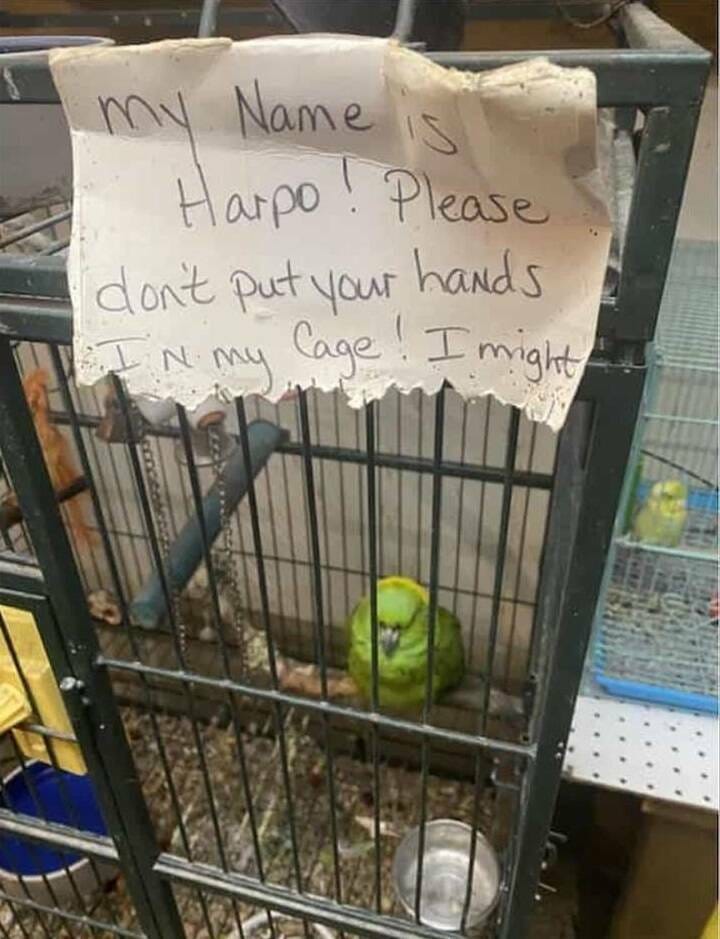
In honor of today’s Beast, be grateful for your remaining fingers.