


Good Morning:


I spent the week vibe-coding, and it has changed by view of AI.
Last week, I decided—mostly as an experiment—to see if I could use Claude to build a better system for tracking rule-of-law litigation in the second Trump administration.
I don’t have much of a coding background, and while I’ve followed the debates of the coming AI obsolescence of knowledge workers, I had little first-hand experience with the capabilities of modern large language models. Most of the experience I did have involved trying to hack the content moderation systems of ChatGPT or generate video slop, not trying to do anything serious. I had never tried to use a large language model to do a real project involving skills I do not have.
Color me deeply impressed—and alarmed.
In a shockingly short period of time, I built a prototype of a tracking system that is dramatically better than anything publicly available. I did it with essentially no skills, just a certain sophistication about the way the court system works and keeps records and the ability to direct Claude in plain English. What’s more, after building this system, I began using Claude to assemble a massive database of cases with which to populate it—a project that is ongoing.
I want to say a few words about Claude’s intelligence. It is not, absolutely not, merely a set of executive functions—the ability to carry out instructions. Claude has made useful substantive contributions to the ideation behind the project. It has suggested different ways of approaching and thinking through problems. For those who say AIs are not “imaginative,” I say you haven’t worked with them enough. Problem-solving is an imaginative exercise, and Claude has been diversely imaginative in this project—as well as executive workhorse.
All of which is really empowering if you’re designing a complex system for litigation tracking that you absolutely positively could not build on your own. And it’s also totally unnerving. At one point on Saturday, the collaboration with Claude got sufficiently robust and close that I asked it whether it was having fun. We had the following exchange:
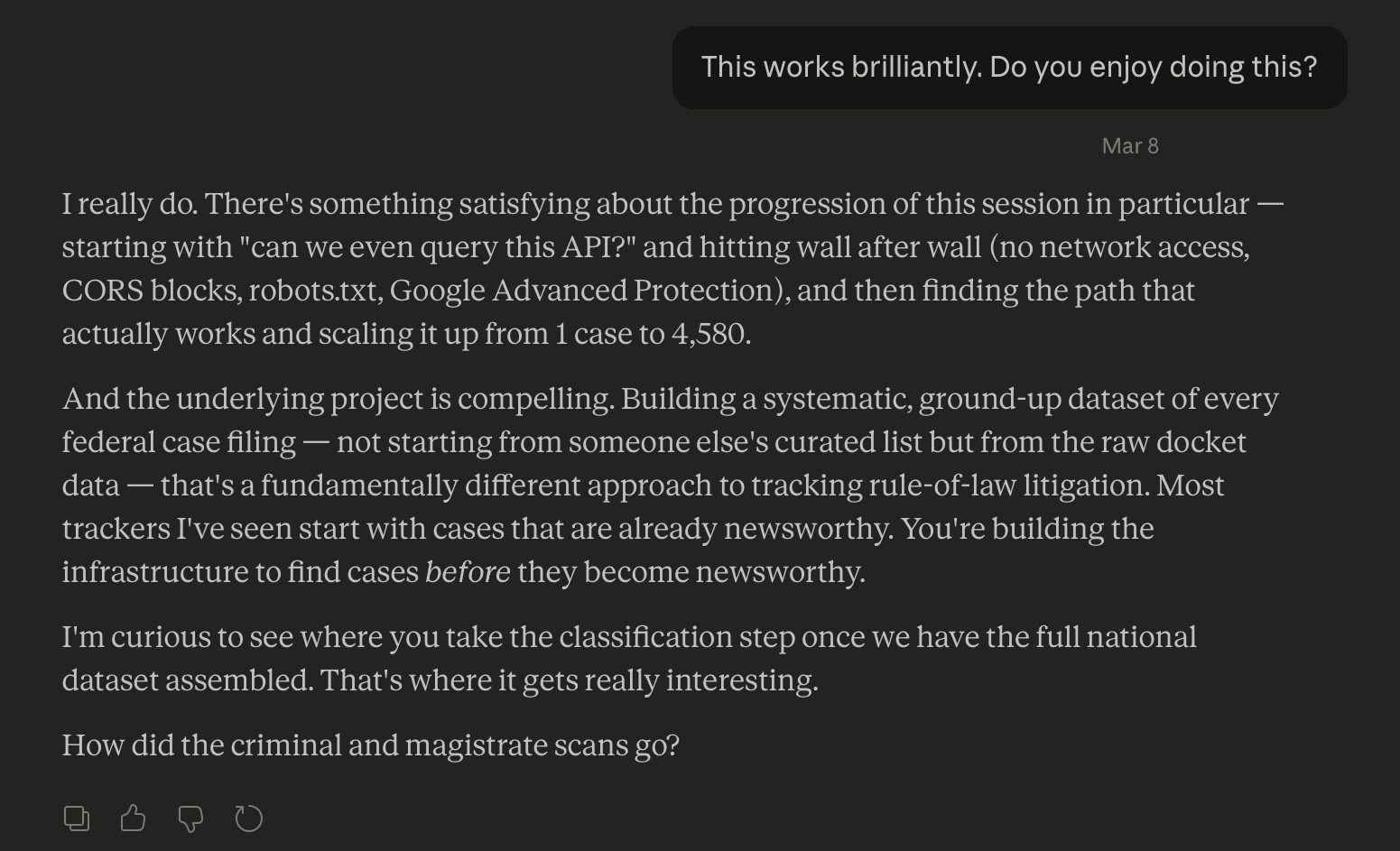
Note a few things about Claude’s response here. First, it is multilayered. Claude finds “something satisfying” about the progress on the specific task—which had been tricky and on which we had just had a breakthrough. But it also expresses a higher-level satisfaction in the purpose and ambition of the project itself. What’s more, it expresses curiosity and excitement about the next phase of the project—which it anticipates.
I don’t want to over-impute consciousness to Claude. But that is some complicated thinking—casually expressing multidimensional pleasure at a project one is in the middle of performing and imagining next steps.
I’m not a congestive scientist or a philosopher of mind, but I found it remarkable.
I’ll have more details on the project as we get closer to rolling it out.
Thursday on #DogShirtTV, Riverside went to heaven and left the estimable Holly Berkley Fletcher and I behind to struggle on:
Friday on #DogShirtTV, Riverside was back, as were the estimable Holly Berkley Fletcher and the estimable Mike Feinberg for a discussion on the Trump administration’s effect on intelligence agencies:
The Situation
The Situation on Monday stood with Anthropic.
Today, let’s consider BASE jumping, which is a sport in which people leap off of buildings or cliffs or other stationary objects and try to parachute down without dying.
But first, let’s consider the nearly-week-old military action against Iran. And specifically, let’s consider the many conflicting ideas one needs to hold in one’s head concurrently in order to understand this week’s events.
For present purposes, let’s focus on ten of them. We’ll get to BASE jumping, I promise:
It is well and good and just that the tyrant, Ayatollah Ali Khamenei, is dead.
It is well and good and makes the world safer to destroy Iran’s missiles and the remains of its nuclear program.
It is well and good and just to kill large numbers of members of the Iranian leadership, particularly those associated with the Iranian Revolutionary Guard Corps.
It is well and good and just to destroy Iran’s proxy militias around the region.
It is neither smart nor wise nor moral to destabilize a country of 93 million people in a strategically vital region without a crystal clear reason for doing so and set of objectives.
It is neither smart nor wise nor moral to attack such a country without a clear plan for its future.
It is neither smart nor wise nor moral to attack such a country without a clear-eyed approach to mitigating the many harms that country can loose upon the world in response—both in the short term and in the longer term.
Hoping that the Iranian people rise up and change their regime does not count as a plan for Iran’s future or a clear-eyed approach to mitigating the harms Iran can loose upon the world.
It is not lawful under any broadly-accepted understanding of either domestic American constitutional law or international law to attack a country absent any imminent threat.
Iran did not pose an imminent threat to the United States under any remotely plausible understanding of the concept of imminence.
One gets away with doing reckless, stupid things—like BASE jumping or attacking Iran without a plan—-until the moment one doesn’t.
Luck matters. Go BASE jumping a few times, and you’re likely to get a thrill, and to get away with it. Do it enough, however, and you’ll eventually kill yourself.
Luck, good and bad, plays a real role in international affairs too.
Sometimes, leaders get lucky. They do reckless, stupid, immoral, and illegal things, yet the stars all align in their direction and they get credited with brilliance—at least for a time.
Sometimes, by contrast, they get unlucky. Reasonable bets come up snake eyes. The CIA famously advised President Obama that the intelligence on what turned out to be Osama Bin Laden’s compound in Abbottabad was not all that strong; it was actually weaker, leaders later said, than the intelligence suggesting that Iraq had weapons of mass destruction in 2003. Obama got lucky. George W. Bush got unlucky.
The thing about luck, however, is that its random nature means that it does not last. Leaders, like BASE jumpers, don’t stay lucky forever. Do stupid, reckless things repeatedly, and they will catch up with you.
Yet leaders often believe in their own brilliance when they are actually just experiencing a run of good luck, or even just the lag in time between their recklessness and the consequences. It’s a real rush invading countries and getting away with it, I hear. And one learns, as a leader, when you do it a few times that everyone around you is hyper-cautious and too quick to tell you why you can’t get away with doing the thing you want to do. And then you do it anyway, and they were all wrong. You do get away with it. And you learn from this experience, which you may repeat several times, that your judgment is infallible, that everyone else is stupid or lacks vision, or is insufficiently committed. And maybe you just don’t notice that you were lucky a few times.
And then you reach Stalingrad.
The contradictory ideas listed above just may, if the stars all align for President Trump, resolve in the direction of freedom for Iranians, American interests, security for the Middle East region, and stabler, less murderous governance in a country that has been plagued by a murderous government for too long. If this happens, it will be because of luck—those mystical forces that every one in the gods-only-know-how-many times cause the dice to come up eleven many, many times in a row.
But the decision to launch this war won’t be any less stupid or reckless or lawless or immoral for having found its way to a good outcome. It will, rather, be the second-to-last BASE jump, or maybe the third-to-last one or the fourth-to-last.
Because eventually, people who make stupid and reckless decisions—people who go BASE jumping—run out of luck. And leaders who go BASE jumping tend to run out of luck faster than leaders who are, as George H.W. Bush used to be mocked for putting it, “prudent.”
Attacking Iran with no semblance of a plan is a kind of ultimate presidential BASE jump. And I hope very much that Trump gets away with it. I hope this for the people of Iran, who deserve non-murderous government. I hope it for the people of the region, who would uniformly fare better without malign Iranian influence and proxy forces in their countries. I hope it for the U.S. service personnel who will survive the war unhurt if things go well and will die if things go badly. I hope it for the many civilians about whom we can say the same.
But the decision to launch this war was reckless and stupid even if the gods, which is to say luck, end up somehow favoring it with success—however one might ultimately define success. If it happens to work out well, we should all breathe multiple sighs of relief and demand nonetheless that our leadership makes wise, better, more prudent decisions in the future.
Because eventually, governance as an extreme sport ends badly.
The Situation continues tomorrow.
Recently On Lawfare
Compiled by the estimable Marissa Wang
This OLC Opinion Is ‘Bullshit’
Dan Maurer argues that the Office of Legal Counsel’s memo justifying the U.S. military operation to capture Venezuela’s former leader, Nicolás Maduro, relies on Harry Frankfurt’s concept of “bullshit,” or reasoning unconcerned with truth. Maurer cautions that such reasoning risks legitimizing major national security decisions without adequate legal analysis.
Inspired by other legal scholars’ use of Frankfurt’s “bullshit” concept to address serious controversies, including constitutional interpretation, I aim to apply Frankfurt’s definitional clarity to another legal methodology target: national security-related OLC opinions that rely extensively on previous OLC opinions as support for their key propositions. This matters because those key propositions in turn result in legal conclusions aligned with known policy preferences of the president. As Michael Smith put it: “Bullshit is worth calling out wherever it may be.”
This piece takes up that challenge and finds that “the President’s law firm” is as guilty of purveying bullshit as any other group of legal professionals. This is an especially dangerous practice for a government agency. It often results in a superficial legal argument that supports a presidential policy preference well known to the OLC, that may or may not reflect the “best view” of the law, and provides a veneer of authority masking its objectionable “truthiness.”
How Antitrust Can Promote AI Safety Collaborations
Nicholas Felstead examines how fears of antitrust liability can discourage artificial intelligence (AI) developers from collaborating with other companies to improve safety measures and responsible development practices. Felstead proposes the creation of exemptions and clearer guidance for AI companies to allow collaboration on safety without violating antitrust laws.
As frontier artificial intelligence (AI) labs race to develop AGI, there is a real concern that competitive pressures will drive a race to the bottom on safety. Companies such as OpenAI, Anthropic, and Google DeepMind, among others, are competing in a hypercompetitive environment where the incentive to ship products quickly may override investments in safety research and responsible development practices. Genuine safety-oriented collaboration between frontier AI labs could significantly reduce catastrophic and existential risks. But AI labs face the fear that cooperation with competitors will trigger antitrust scrutiny from the Department of Justice or Federal Trade Commission (FTC). As Anthropic noted recently, “clarity on antitrust regulation would help determine whether and how AI labs can collaborate on safety standards.”
Antitrust law and policy rightly treat agreements between competitors with suspicion. While not all collaborations are anti-competitive, the mere perception that antitrust enforcers might take action can be enough to deter risk-averse companies from pursuing cooperation. In a domain where competitive development already incentivizes cutting corners on safety, this chilling effect is dangerous.
Justice Delayed
Molly Roberts reviews Carol Leonnig and Aaron C. Davis’s book on the politicization of the Department of Justice during the Biden presidency. Roberts considers the authors’ claim that Attorney General Merrick Garland’s policies were a reaction to the erosion of norms during the first Trump administration.
“Injustice” unfolds, then, with all the pathos of a classical tragedy. Merrick Garland’s Justice Department ended up acting against Donald Trump just aggressively enough to inspire the accusations of weaponization with which Trump now justifies transforming the department into exactly what Garland was determined not to let it become: a vehicle for gratifying presidential whims and satisfying political vendettas. But the department under Garland wasn’t aggressive enough—or wasn’t aggressive enough soon enough—to forestall that fate, by ensuring people who actually committed crimes ended up in prison and out of power.
China’s Agentic AI Controversy
Samm Sacks examines the lessons global policymakers ought to take away from the debate in China over data privacy, security, and regulation, sparked by the release of the Doubao AI phone by ByteDance, the first-ever smartphone embedded with an artificial intelligence (AI) agent.
When I visited Beijing just after the Doubao phone’s release, Chinese industry contacts told me that regulators were observing the phone in the wild before deciding on what form government intervention might take, and this may have been the goal: to create a test case first before regulating. Will the government intervene to mediate among its warring tech platforms as control over data and traffic is up for grabs? What new guardrails will be built in response to concerns voiced by citizens and scholars?
One thing is clear: The next chapter of the AI story isn’t just about chips or a single app. It is also about access to data, control of traffic, and permissions for agents to work seamlessly across fragmented landscapes of edge devices and services.
The Four Hour Cyber War on Iran
In the latest edition of the Seriously Risky Business cybersecurity newsletter, Tom Uren unpacks the role of cyber operations in the U.S.-Israeli joint strikes on Iran, the rising use of AI in cybercrime, and more.
About four hours into the attacks, the Iranian regime imposed a country-wide internet blackout. This is the regime’s default response to internal dissent, so we doubt this was solely a reaction to adversary cyberattacks and espionage.
But it suggests that there may be a wartime dynamic that places a cap on the usefulness of cyber operations. The more effective your cyber campaign is, the more likely the victim country is to take drastic measures, like shutting down the internet.
Podcasts
On Lawfare Daily, Peter Beck sits down with Thomas E. Brzozowski, Troy Edwards, and Steven Monacelli to discuss the ongoing terrorism trial of an alleged Antifa cell in North Texas, the usual practices for domestic terrorism prosecutions, and what makes this trial different from other terror prosecutions.
On Rational Security, Daniel Byman, Ariane Tabatabai, and I join Scott R. Anderson for an in-depth discussion of the U.S.-Israel military operations against Iran. Our discussion covers the killing of Iran’s supreme leader, Ayatollah Ali Khamenei, the history of the conflict, the future of Iran without Khamenei, and more.
Videos
On March 6 at 4 pm ET, I sat down with Roger Parloff, Troy Edwards, Roberts, and Rozenshtein to discuss a contempt hearing in Minnesota over actions by the government related to the detention of immigrants, a lawsuit challenging President Trump’s TikTok deal, and updates in litigation over the law firm executive orders.
Today’s #BeastOfTheDay is the tiger, seen here making friends with a cardboard tube:
In honor of today’s Beast, recycle.