


Good Afternoon:

This morning, after doing today’s #DogShirtTV, I drove downtown to the Middle East Institute, a think tank and educational organization that is busy concentrating many of the best Middle East scholars in the city for an event I was honored to participate in featuring my friend Elizabeth Tsurkov.
Liz, for those who need a refresher, is the Princeton PhD candidate who was kidnapped in Iraq by Kata’ib Hezbollah and held hostage for 903 days. A New York Times story about her case is available here.
I will have a lot more to say about Liz’s speech, about which I will probably write a The Situation column in the coming days. For now, I will just share video of the event and urge people to watch it. In it, Liz gives a riveting talk analyzing the evolving psychology of her captors as the post-Oct. 7 era wore on; she then answers questions from both me and Charles Lister, who is a first-rate Syria specialist at MEI.
Yesterday on #DogShirtTV, the estimable Holly Berkley Fletcher brought on a cat shirt provocateur. The estimable Micah Holden is used to sartorial protest, though his usual weapon of choice is the Speedo:
The Situation
The Situation on Friday detailed a temper tantrum in a legal brief.
Today let’s talk about the molten core problem at the heart of The Situation: The president is deranged.
I don’t know if President Trump is going to seize Greenland by force—and neither does anyone else, probably including President Trump.
I do know that we have entered a new era of imperial conquest: unashamed, resource-extractive imperialism that does not even pretend to have any higher purpose.
Sometimes, this takes the form of an American military adventure to depose an undesirable foreign leader who doesn’t do as Donald Trump wishes. Sometimes, it takes the form of an irrational demand on an allied government facing an existential military conflict for mineral extraction rights. This time, it may merely take the form of threats against a tiny country that has always been a staunch ally, threats intended to force it to capitulate and give up a gigantic ice sheet—or it may take a more militaristic form than that.
Trump’s imperialism speaks the language of resource extraction—or in the case of Greenland, the language of security. But it is not ultimately about resources. And it’s not ultimately about security either.
Trump’s imperialism is about grandiosity. Greenland is big—very big. And the United States would be bigger, a whole lot bigger, if it had the island. And Trump wants America to be bigger. And Trump wants to be the one who made America bigger. Because Trump is derangedly grandiose.
Nobody can actually doubt that the president is deranged.
Nobody, at least, who has read his text exchange with the Norwegian prime minister—an exchange in which he links his demands for Greenland to the Nobel Committee’s decision not to award him the Nobel Peace Prize. “Dear Jonas,” he wrote:
Considering your Country decided not to give me the Nobel Peace Prize for having stopped 8 Wars PLUS, I no longer feel an obligation to think purely of Peace, although it will always be predominant, but can now think about what is good and proper for the United States of America. Denmark cannot protect that land from Russia or China, and why do they have a “right of ownership” anyway? There are no written documents, it’s only that a boat landed there hundreds of years ago, but we had boats landing there, also. I have done more for NATO than any other person since its founding, and now, NATO should do something for the United States. The World is not secure unless we have Complete and Total Control of Greenland. Thank you! President DJT”
Nobody who watched him impose tariffs on European allies who oppose his imperial grandiosity can doubt his derangement either.
Nor can anyone who watched him extort the Nobel Peace Prize medal from Maria Corina Machado, and then get it from her and exult over having snatched it from a woman who led the Venezuelan opposition to victory even when she couldn’t run for president herself.
Nobody can watch him destroy NATO and the broader transatlantic partnership of which it is a part—all the while claiming to be its champion and demanding Greenland as payment—can doubt his derangement either.
What can Europe do about a derangedly grandiose president of the United States? For that matter, what can Americans do about him?
The Situation still has three years on its clock—three years to the day, to be precise. That’s a long time. And it’s a particularly long time in the absence of congressional push-back against the deranged man who is dragging us all into perdition.
Even if one hypothesizes that Trump will suffer some devastating electoral setback a mere nine months from now, that setback will still—under the best of circumstances—leave the deranged man in full control of “the Executive power” of the United States for the following two years and leave him almost wholly unchecked for the next year.
Impeachment is, of course, of no use at all. Sure, sure, Trump has committed impeachable offenses—too many to count. But the votes aren’t there to initiate impeachment, and the votes aren’t there in the Senate to remove Trump even if the House could somehow get its act together.
Whenever Trump lets his freakiest flag fly, whispers of the 25th Amendment inevitably follow. And sure enough, 25th Amendment talk is in the air these days. But this is foolishness too.
Even if the vice president and a majority of the cabinet were to declare, for so the amendment reads, “that the President is unable to discharge the powers and duties of his office,” and even if J.D. Vance were thereby “immediately [to] assume the powers and duties of the office as Acting President,” Trump would simply reply with a “written declaration” of his own “that no inability exists” and try to wrest them back.
Yes, Vance and a majority of the cabinet could hold their ground. But “Thereupon Congress [would] decide the issue.” And only if Congress “determine[d] by two-thirds vote of both Houses that the President is unable to discharge the powers and duties of his office [would] the Vice President . . . continue to discharge the same as Acting President; otherwise, the President [would get to] resume the powers and duties of his office.”
In other words, to remove the president using the impeachment process, the forces of sanity would need to muster a two-thirds majority in the Senate. To remove the president under the 25th Amendment, they would need to do it in both houses.
Don’t kid yourself, folks: There is no magic bullet here. There is no constitutional magic bullet. There is no investigative or prosecutorial magic bullet—no Bob Mueller or Jack Smith. There is no combination of protests and elections or lobbying that can make this problem go away quickly.
There is, instead, a long hard slog ahead of us—a long hard slog of elections, advocacy, protest, litigation, and people fighting for their rights.
And there is a long hard slog ahead of Europe too in handling the disaster the United States has unleashed on the world. Because that is what managing a deranged person is like.
Nine years ago, I wrote what I think was the first article to analyze seriously the notion of Donald Trump as a threat to national security. (It was not, I should note, the first article to posit that Trump posed a threat to national security; that distinction goes, to my knowledge anyway, to John Bellinger, also writing in Lawfare.) The article identified seven features of Trump’s personality that formed “an unusual combination of—from a national security perspective, anyway—terrifying liabilities” in a president. A number of these features have, alas, held up well analytically: the attraction to war crimes, for example.
For present purposes, however, item number six is worth revisiting.
I genuinely struggled at the time, as the text reflects, with whether and how to include it. This was long before George Conway wrote his famous Atlantic article about Trump’s malignant narcissism. Trump’s mental health was not a subject it was considered appropriate to discuss—at least not in a serious way, and I’m not a clinician, and Lawfare is not a medical or psychological journal. And yet, even then—eight months before he was elected the first time—there was, “the small matter of Trump’s—there’s no polite way to say this—evident clinical symptoms. I’m not a psychologist qualified to make a diagnosis, but it simply has to be significant that it’s hard to have a serious conversation about Trump without using words like egomania, grandiosity, or narcissism.”
There was no escaping it. He was deranged—grandiose, egomaniacal, narcissistic, the sort of man who would get obsessed with acquiring Greenland and blow up America’s most sacred international commitments to get it done. The sort of man who would respond to not getting the Nobel Peace Prize by declaring he was no longer solely interested in peace. The sort of man who would take the medal from its rightful winner and feel no shame at the theft.
The sort of man who would guarantee that The Situation might continue tomorrow—and 1,094 days after that.
Yesterday On Lawfare
Compiled by the estimable Marissa Wang
The Merit System Protection Board’s Independence Is Dead
Nick Bednar argues that the Merit System Protection Board no longer functions as the independent adjudicator that Congress had intended at its formation. Tracing the expansion of presidential removal powers, efforts by the Justice Department to bind the Protection Board to the Office of Legal Counsel’s interpretations, and recurring quorum failures, Bednar warns that without congressional action, the Protection Board will lose its structural purpose in its entirety.
On Jan. 9, the full D.C. Circuit declined to rehear Harris v. Bessent. The decision may represent the final nail in the coffin for the MSPB’s independence. Courts should no longer pretend that the MSPB operates as Congress intended. If Congress wishes to preserve independence in the adjudication of federal employment disputes, it must act legislatively—either by creating a court dedicated to civil service law or by permitting existing courts to hear such claims.
Searching for the Crime in Fed Chair Powell’s Testimony
Roger Parloff dissects the potential justifications behind U.S. Attorney Jeanine Pirro’s probe into Federal Reserve Chair Jerome Powell and finds many of the claims were unfounded, if not abusive.
Yet even against this backdrop, when the news emerged on Jan. 11 that U.S. Attorney Jeanine Pirro, of Washington, D.C., had sent grand jury subpoenas two days earlier to the Federal Reserve Board seeking information relating to its chair, Jerome Powell, it was a shocking new low. It was so—thuggish. Not only did the basis for the inquiry look patently pretextual—as Powell said it was, in his video statement—but Powell was not even one of the president’s critics. He was just a guy with integrity who was getting in Trump’s way.
The Right Standard for Ultra Vires Claims
Aditi Shah unpacks the surge in ultra vires claims challenging executive action and the fight over what standard courts should apply when the government acts beyond its statutory authority. Shah asserts that courts should reject the administration’s push for a default near-impossible standard and instead apply a long-standing test of whether an official’s act was justified by law.
Whether or not the heightened standard applies can determine an ultra vires claim’s fate. The standard matters most where a party is challenging executive action and there is no method for judicial review (“cause of action”) provided in a statute. In such cases, the plaintiff is relying exclusively on an ultra vires claim. The stakes are therefore highest in a case such as Trump v. Cook, where there is no statutory cause of action for Gov. Cook’s claims that President Trump’s decision to remove her violated the Federal Reserve Act. In Cook and other ultra vires cases, it accordingly is imperative to get the standard right.
Trump’s Grand Conspiracy Delusion
Molly Roberts deconstructs the Trump administration’s so-called “grand conspiracy” and examines how the sprawling narrative about a coordinated plot against Trump has permeated into a Florida grand jury hearing despite lacking legal or factual coherence.
They would have to show, in other words, that officials like Barack Obama and Jack Smith, who never even worked with each other, formed a plan that touched the 2016 election, the 2020 election and the 2024 election, a plan whose concrete aim was to prevent Trump from running for office successfully, and that they took overt steps along the way motivated not by their good-faith professional obligations but by this bad-faith desire. And they would somehow need first-hand witnesses to testify to this non-reality in a fashion that included admissible evidence.
The Grand Conspiracy is a conspiracy theory, not a real legal theory.
Podcasts
On Lawfare Daily, I sit down with Roberts to discuss her new article on the “grand conspiracy” investigation and a grand jury probe in Florida.
On Scaling Laws, Shlomo Klapper joins Kevin Frazier to parse through the rise of judicial AI, the challenges of scaling the use of technology inside courts, and its implications for due process.
Videos
On Jan. 7, Laura Field taught her fourth lecture on the intellectual movement that has emerged around Trumpism and discussed its post-liberal faction. Field delved into the contradictions within the two ideologies, the complexities of defining the common good, the apocalyptic rhetoric prevalent amongst post-liberal thinkers, and more.
Today’s #BeastOfTheDay is the cheetah, seen here 4,000 years old and mummified:
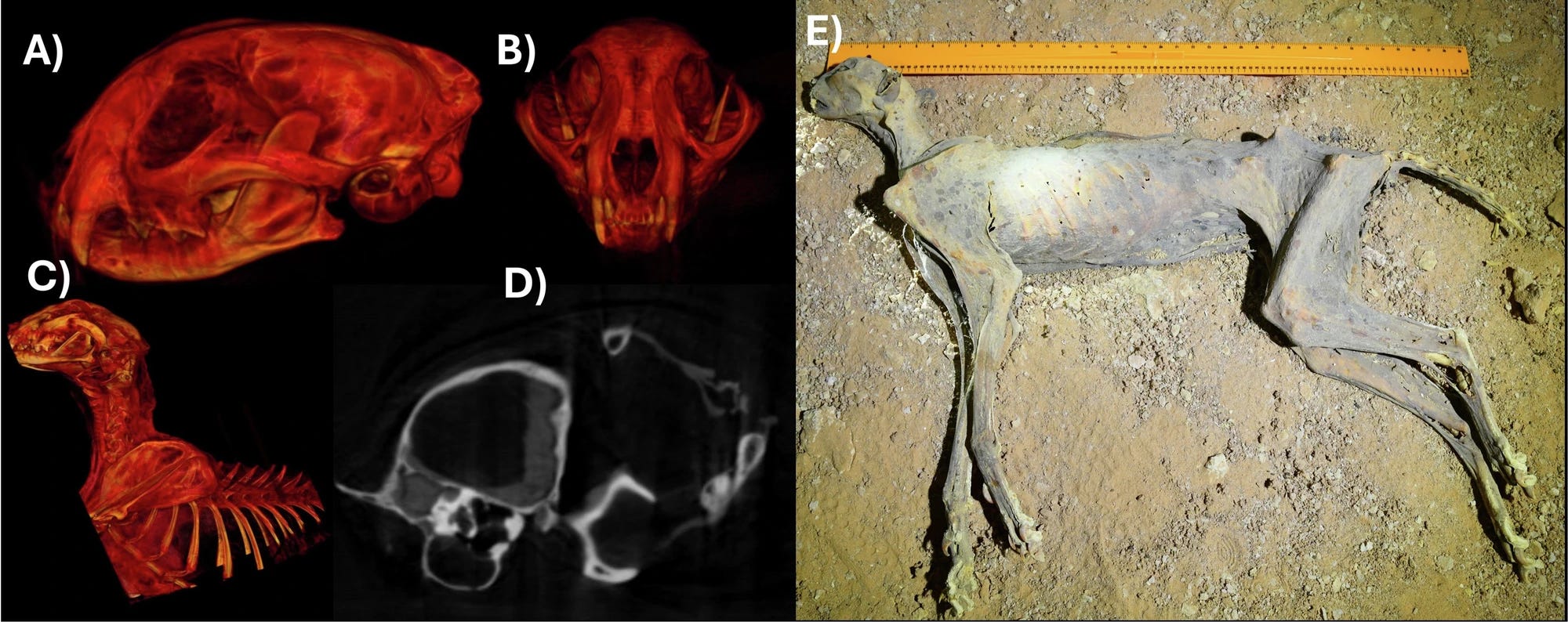
Seven naturally mummified cheetahs discovered in caves in northern Saudi Arabia, some dating back nearly 2,000 years, reveal that at least two cheetah subspecies once lived on the Arabian Peninsula. Genetic evidence from the remains shows the region supported a more diverse cheetah population than previously assumed…
In the 20th century, cheetahs disappeared from the peninsula, and most reintroduction proposals have assumed the area was home only to the Asiatic cheetah, a subspecies now reduced to a single small wild population in Iran…
The mummified cheetah remains were discovered during fieldwork conducted in 2022 and 2023 in five caves near the city of Arar. Inside the caves, researchers found seven naturally mummified cheetahs alongside skeletal remains from 54 additional cats.
Radiocarbon dating shows that the remains span a wide time range. The oldest skeletal material dates to about 4,000 years ago. Two of the mummified cheetahs date to approximately 1,870 years ago and around 130 years ago, indicating that cheetahs persisted on the peninsula well into the historical period.
The state of preservation allowed researchers to extract ancient DNA from several specimens. Complete genome sequences were recovered from three of the mummified cheetahs…
Genetic analysis revealed that the cheetahs were not all closely related. The most recent specimen is genetically closest to the Asiatic cheetah, aligning with earlier assumptions about the region’s late surviving populations. However, the two older mummified cheetahs — including the oldest dated individual — are genetically most similar to the Northwest African cheetah.
This pattern indicates that the Arabian Peninsula supported at least two distinct cheetah lineages over time. Rather than hosting a single, isolated population, the region appears to have been connected to broader cheetah populations spanning Africa and Asia, with different lineages present at different points in history…
In honor of today’s Beast, check out the full paper on its discovery here.