


Good Afternoon:
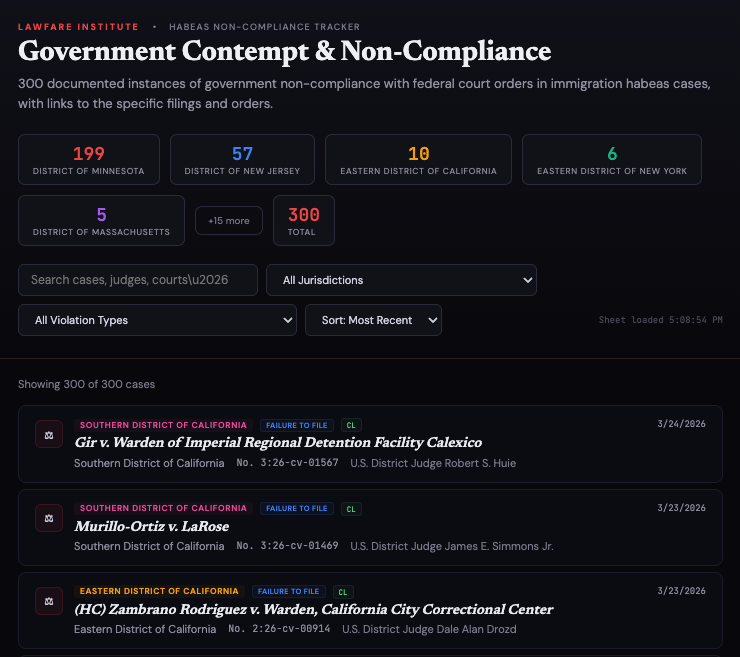
I got behind and missed some dog shirts. I was working on this with the estimable Katherine Pompilio. We published it yesterday:
These cases are but two of the hundreds of immigration habeas cases since the beginning of the second Trump administration in which judges around the country have found that the federal government has not fully complied with court orders. The violations of court orders span a considerable range, from relatively harmless mistakes in which required papers were filed with brief delays to situations in which detainees were transferred to a different district in violation of its order, held for protracted periods despite release orders, or even deported in violation of orders. In numerous cases, detainee property was not returned, despite orders to do so. And in some cases, ICE denied detainees access to medically necessary drugs despite orders to permit such access.
That the government has violated court orders in numerous immigration habeas cases is not, in itself, news. Any number of media stories have focused on particularly high-profile cases. For example, a Minnesota judge’s decision to hold a Justice Department attorney in contempt for failing to return Rigoberto Soto Jimenez’s identification documents after his release from detention made national news. The deportation of hundreds of Venezuelan nationals to the Terrorism Confinement Center (known by its Spanish acronym, CECOT) in El Salvador despite a Washington, D.C., judge’s order enjoining their removal did as well. The range of judges calling out violations of court orders in habeas cases has also garnered notice. “Throughout the first year of Trump’s second term, there have been high-profile examples in which judges have accused ICE and the Department of Homeland Security of violating court orders,” writes Kyle Cheney in Politico. “But the sheer volume of violations judges are now describing reflects an intensification of the mass deportation effort and a system ill-prepared to handle the influx.”
Both in Minnesota and in New Jersey, judges have taken steps to identify the breadth of the pattern in orders that have garnered significant press. For example, U.S. District Judge Patrick Schiltz in Minnesota has identified 210 orders in 143 cases with which the government failed to comply, noting that “the court is not aware of another occasion in the history of the United States in which a federal court has had to threaten contempt—again and again and again—to force the United States government to comply with court orders.” And U.S. District Judge Michael E. Farbiarz in New Jersey ordered the government to identify its own failures of compliance, producing a much-noted list of more than 50 failures of compliance—which U.S. District Judge Christine P. O’Hearn later described as incomplete.
The data assembled here, however, is different—more comprehensive across time and judicial geography than prior lists, vastly wider in number of cases, and analyzed and categorized with a consistent methodology notwithstanding different judges’ differing language about and toleration for government compliance failures. Unlike prior efforts to identify compliance failure on the part of the government, we have also endeavored to make the data underlying this study available to anyone who wants to use it. The data visualization that accompanies this article allows users to search cases by jurisdiction and by violation type, to see the nature of the violation in any case, to access the underlying dockets for each case, and to download data for further analysis.
I am currently working to make the data more comprehensive—and potentially expand it beyond the realm of immigration habeas cases.
But first, let’s catch up with the dog shirts I have missed.
Tuesday on #DogShirtTV, the estimable Carol T continued Sunday’s discussion of Antigone, the estimable Alicia Wanless has begun her war on bugs anew, and the estimable Joel had thoughts about the ethics of AI ownership:
Wednesday on #DogShirtTV, the estimable Mike Feinberg and I discussed the effects of AI on civilization:
Thursday on #DogShirtTV, the estimable Anastasiia Lapatina came on the show with questions about the SCOTUS oral arguments on birthright citizenship. The Greek Chorus and I gave answers:
And Friday on #DogShirtTV, I got jealous of the estimable Mike Pesca’s monologue skills and dragged him on the show to appease me:
Recently On Lawfare
Compiled by the estimable Marissa Wang
Hearing Dispatch: A Catch-22 for the Pentagon Press Corps
Molly Roberts unpacks the arguments made in a March 31 hearing over whether the Department of Defense complied with an earlier ruling striking down the Pentagon’s press access restrictions. The hearing focused on a new dispute between the government and the New York Times over the Pentagon’s revised policy.
“We used more words to say the same thing and to foreclose creative misinterpretations,” Cmdr. Tim Parlatore, special adviser to the self-styled Secretary of War, said in an interview, to, of all outlets, the New York Times. (The Defense Department also added insult to reinjury by closing the Correspondents Corridor that has for years served as a workspace for credentialed journalists covering the military—even physically tearing down the old signage designating the area. Now, reporters can’t enter the main building unescorted, and they will conduct future business in an as-yet-unfinished annex.)
Typically, the government doesn’t admit it’s contravening a judge’s order to the very entity that took it to court to secure that order to start with. But this administration, again and again, proves itself incorrigibly, and often illegally or unconstitutionally, atypical. Which is what brings your correspondent, along with many of the correspondents exiled from their eponymous corridor, to the E. Barrett Prettyman Courthouse at 9:30am on a Monday morning to watch Judge Friedman cheerfully preside over the hearing of the Times’s motion to compel compliance.
Syria: It Is Time to Complete the Work on Sanctions Relief
Ivonne Duarte-Peña argues that despite major sanctions relief, Syria remains economically isolated because lingering restrictions and weak financial governance deter banks and investors. Duarte-Peña suggests that Syria should fully reconnect to the global economy by implementing reforms to meet international financial and anti-corruption standards.
The recent news that the Central Bank of Syria has “completed the procedures for settling [its] banking relationship with the Federal Reserve Bank of New York and reopening [its] account with them” is a major step forward that shows progress is possible. But the task of reintegrating Syria into the global economy must continue. This involves not only the Syrian government but also several international actors in the private and public sectors with the institutional wherewithal and expertise to back Syria’s work toward financial inclusion. Coordination and coherence among these actors will be crucial in the months ahead to ensure that efforts are timely and efficient, for the sake of the Syrian economy and of all Syrians.
The State Department’s X Directive and the End of Platform Independence
Kate Klonick unpacks how a directive from the Department of State instructing U.S. embassies to use Elon Musk’s social platform, X, in coordinated campaigns to counter foreign propaganda is indicative of a broader shift in the relationship between government and tech companies towards the normalization of social media as a tool of statecraft.
The idea that the State Department would issue a formal cable endorsing a specific social media platform by name as a tool of U.S. diplomacy—let alone military psychological operations—would have been, until recently, almost unthinkable. But the structural transformation that has taken place over years has made the news feel almost ordinary today. It was a transformation that dismantled, piece by piece, the legal accountability, operational independence and institutional resilience that once made such a cozy relationship between government and platforms inconceivable.
The Perils of Privatized Cyberwarfare
Ronald J. Deibert explores the broader national security implications of allowing private companies to conduct offensive cyber operations on behalf of the U.S. government. Deibert explains that this shift towards privatization could create cybersecurity risks, complicate oversight mechanisms, provoke unpredictable countermeasures, and undermine international norms.
This piece argues that an authorization permitting the private sector to conduct OCOs would have dire consequences. Enlisting the private sector to undertake OCOs will complicate oversight, empower a dubious and corrupt industry, create counterintelligence risks, fuel a cyber arms race that could lead to system-wide instability, make critical infrastructure insecure, provoke countermeasures against perpetrators, and put civilians at risk. Whereas previous U.S. administrations have sought to contain these dynamics through law and policies, the Trump administration would instead facilitate them. Several U.S. adversaries, including Russia, China, and Iran, and at least one ally, the United Arab Emirates, already outsource offensive cyber operations to private firms. With the United States following in their path, it would normalize private-sector OCOs internationally, emboldening authoritarian and illiberal governments to undertake even more OCOs, and multiplying their negative implications on U.S. security.
Fulton County’s Uphill Battle for Ballots
Anna Bower examines how Judge J.P. Boulee may rule on Fulton County’s motion to compel the return of its 2020 presidential election ballots from the FBI after listening to arguments in a day-long evidentiary hearing.
On March 27, U.S. District Judge J.P. Boulee held a day-long evidentiary hearing in Pitts v. United States, a case in which Fulton County officials are seeking the return of the county’s 2020 election materials, which were seized by the FBI earlier this year.
The hearing offered the clearest indication yet of how Judge Boulee might rule on Fulton County’s motion for return of property. Although the judge pressed both sides with pointed questions during the proceeding, he appeared skeptical that the county has made a sufficient showing to justify its requested relief.
MSPB Strikes Down Tenure Protections for Immigration Judges
Peyton Baker, Nick Bednar, and Amy Wildermuth examine the reasoning and implications of a recent Merit Systems Protection Board decision that reclassified immigration court judges as inferior officers subject to at-will removal.
The board’s conclusion rests on two premises: First, immigration judges are inferior officers under the Appointments Clause. Second, their duties are sufficiently significant that Congress may not insulate them from at-will presidential removal. The first premise is correct, though the board’s reasoning is incomplete. The second is wrong. It misreads the Supreme Court’s precedents and overlooks the supervisory framework that has long justified tenure protections for inferior officers. If accepted, the board’s approach would strip tenure protections from a wide range of career employees.
End of the Sde Teiman Abuse Case: The IDF MAG Withdraws Indictments
Yuval Shany and Amichai Cohen unpack the Israeli Defense Forces’ military advocate general’s decision to withdraw charges against soldiers accused of abusing a Palestinian detainee at Sde Teiman. Shany and Cohen argue that the case and its resolution may indirectly endorse problematic right-wing narratives in Israel and further weaken perceptions of accountability within the Israeli military.
The serious abuse of detainees in Sde Teiman was initially handled strongly by the military police, but the strong political backlash has pushed the military legal system into a tailspin, resulting in professional misconduct and a thwarted prosecution. Cumulatively, the whole affair marks a low point for the rule of law in Israel. In order to bounce back, the legal system, including the military legal system, should find a way to assert its authority vis-a-vis the political environment—a development that appears unlikely in today’s climate of increased hostility between the legal and political universes in Israel.
What Is Trump’s ‘Election Integrity’ Order Even Trying to Achieve?
Molly Roberts and Loren Voss examine how President Trump’s new executive order would achieve its purported goal of heightening restrictions on mail-in ballots by expanding federal control over state-run elections. The duo explain that the order likely runs afoul of the Constitution and is the newest step taken by Trump to call into question the integrity of U.S. elections.
President Trump on Tuesday signed an executive order seeking to create federal lists of eligible voters that could then be used to restrict mail-in ballots. “I believe it’s foolproof,” he said. “And maybe it’ll be tested. Maybe it won’t.”
The order isn’t foolproof: The Constitution explicitly gives the states and Congress, not the White House, power over elections. Also, it will be tested: Already, top elections officials in Arizona and Oregon have vowed to take the White House to court over the directives, and so have a collection of voting groups. One or more are almost certain to have the standing necessary to challenge the measure in court.
But whether or not the president will ultimately lose in court, it’s worth trying to understand what the executive order appears to be trying to achieve, the precise steps the order purports to take, and the enforcement mechanisms by which it purports to take them.
Three Hundred Habeas Cases in Which the Government Has Defied Court Orders
As I mentioned above, Katherine Pompilio and I introduced a dataset of 300 immigration habeas corpus cases in which courts found that the federal government failed to comply with judicial orders. We describe examples of a range of violations—missed filings, delayed releases, unauthorized transfers, failure to return property—that have occurred since the early months of the second Trump administration.
Both in Minnesota and in New Jersey, judges have taken steps to identify the breadth of the pattern in orders that have garnered significant press. For example, U.S. District Judge Patrick Schiltz in Minnesota has identified 210 orders in 143 cases with which the government failed to comply, noting that “the court is not aware of another occasion in the history of the United States in which a federal court has had to threaten contempt—again and again and again—to force the United States government to comply with court orders.” And U.S. District Judge Michael E. Farbiarz in New Jersey ordered the government to identify its own failures of compliance, producing a much-noted list of more than 50 failures of compliance—which U.S. District Judge Christine P. O’Hearn later described as incomplete.
The data assembled here, however, is different—more comprehensive across time and judicial geography than prior lists, vastly wider in number of cases, and analyzed and categorized with a consistent methodology notwithstanding different judges’ differing language about and toleration for government compliance failures. Unlike prior efforts to identify compliance failure on the part of the government, we have also endeavored to make the data underlying this study available to anyone who wants to use it. The data visualization that accompanies this article allows users to search cases by jurisdiction and by violation type, to see the nature of the violation in any case, to access the underlying dockets for each case, and to download data for further analysis.
FISA Section 702 Isn’t Broken. Why Are We Still Trying to Fix It?
Glenn S. Gerstell describes the current debate over reauthorizing Section 702 of FISA as the expiration deadline approaches, outlining the concerns of abuse and disagreements over the inclusion of warrant requirements and data purchases. Gerstell recommends that Congress should hold off on making drastic changes to the national security authority and reauthorize Section 702 before it is too late.
Congress took the time in 2024 to thoughtfully balance the concerns of civil libertarians and others about the FBI’s Section 702 search process, recognizing the need for searches to be conducted quickly and effectively in national security investigations. In the ensuing years, there’s been no serious indication of abuse, the statute has been complied with, and the number of searches dramatically reduced—and the intelligence community feels the balance is about right.
It’s fair to consider intervening developments such as new judicial decisions, and it’s important to have a robust debate about these issues, in part to ensure public trust in the intelligence community’s work. But absent a showing of major new problems or a convincing change in legal opinion, it makes sense to stick with the current statute and see whether after a few years of operations the reforms are working the way Congress intended.
Congress: Give the President Discretion to Remove the Cuba Embargo
Rachel Alpert argues that the U.S. embargo on Cuba is unusually constrained by statute, which hinders the president’s ability to adjust sanctions and act quickly in crisis and limits U.S. policy options in the event of political change in Cuba.
With talk of regime change in the background, the Trump administration has turned up pressure on Cuba in recent weeks. This follows recent developments in Venezuela, where the United States captured Nicolás Maduro in January and has since engaged with Delcy Rodríguez by exerting pressure while also relieving certain sanctions. Without congressional action, however, the president is much more constrained in the ability to change sanctions on Cuba than Venezuela. In contrast to Venezuela, where sanctions are a matter of executive discretion based on a national emergency that President Obama originally declared under the International Emergency Economic Powers Act (IEEPA), the legal basis for the Cuba embargo is more complicated. The statutory codification of the Cuba embargo limits U.S. options to change sanctions, even if such changes are aimed at promoting stability and nudging Cuba toward a more democratic future—the goal of the embargo in the first place. Congress should amend these outdated laws that hinder the president’s ability to act quickly in a crisis by increasing the president’s ability to provide sanctions relief when warranted.
Understanding Iran’s Strategy—Then, Now, and Next
J. Dana Stuster reviews Vali Nasr’s book, “Iran’s Grand Strategy: A Political History,” on Iran’s history and shifts in its security environment over the past century. Stuster applies the lessons learned from Nasr’s narrative to better understand Tehran’s strategy in the current conflict between the U.S., Israel, and Iran.
Now that the war is occurring, this history should inform how U.S. officials read the regime’s signals. It’s possible that the U.S. negotiating team meeting with Iranian diplomats were too dilettantish to understand the deal Iran was offering; it also seems possible that the Trump administration was set on war even as it went through the motions of diplomacy. But going forward U.S. officials should understand why, regardless of whether it was negotiating in good faith or bad, the Iranian leadership sees the Trump administration’s outreach as just the latest feint by Washington. The new war has only reinforced Tehran’s lack of faith in negotiations and the hardliners’ position in the government.
America’s Next Top (Cyber) Model
In the latest edition of the Seriously Risky Business cybersecurity newsletter, Tom Uren unpacks the race in the artificial intelligence (AI) industry to develop the best AI models to identify cyber vulnerabilities, how Russia has turned to a Starlink competitor in its ongoing war against Ukraine, and more.
Based on the reports we are currently seeing, Claude looks to be the model of the month when it comes to finding zero-days. In the short term, cyber organizations should have access to a version of Claude, sans its cyber guardrails. Security requirements can make it hard to bring in outside tools quickly, but this is a necessity. They should be dedicating resources to experimenting with it for both offensive and defensive purposes.
In the long term, the focus should not just be on Claude. Give it a month and America’s next top cyber model may come from OpenAI, Google, or even xAI. Governments should take a portfolio approach so that they can pick and choose the models best suited to specific tasks.
Documents
Peter Beck shares Trump’s new executive order restricting mail-in ballots entitled, “Ensuring Citizenship Verification and Integrity in Federal Elections,” which purports to expand federal control over state-run elections in order to crack down on election fraud.
Podcasts
On Tuesday’s Lawfare Daily, Renée DiResta sits down with Nathaniel Lubin and Philine Widmer to discuss how a platform’s algorithms and most trusted creators work together to shape what users see online and how they interpret it, the implications of this online influence, and the future of political influence in an increasingly digital environment.
On Tuesday’s Scaling Laws, Rep. Nick Begich (R-Alaska) joins Kevin Frazier to unpack the current state of artificial intelligence (AI) policy in Congress, Alaska’s role as a leader in developing AI infrastructure, and the use of AI in Rep. Begich’s office operations.
On Lawfare No Bull, Marissa Wang shares the audio from the Senate Intelligence Committee’s 2026 Worldwide Threats hearing, in which Tulsi Gabbard, John Ratcliffe, Kash Patel, William Hartman, and James Adams testified about critical intelligence issues facing the U.S. in the coming year, including the ongoing war in Iran, the Russia-Ukraine War, cyberthreats posed by China and Russia, foreign threats to U.S. elections, and more.
On Wednesday’s Lawfare Daily, Scott R. Anderson sits down with Joel Braunold to discuss the latest developments in the Israeli-Palestine conflict, including a spike in violence against Palestinians in the West Bank, the new Israeli military offensive in southern Lebanon, its implications for Israel’s parliamentary elections later this year, and the impacts from the ongoing conflict in Iran.
On Thursday’s Lawfare Daily, Ariane Tabatabai sits down with John Ghazvinian to discuss the key events in the history of U.S.-Iran relations that have shaped the countries’ relationship today, their perceptions of one another, and more.
On Rational Security, Anna Bower, Kate Klonick, and Kevin Frazier join Scott R. Anderson to unpack a recent ruling in Anthropic’s lawsuit against the Department of Defense for its designation of the artificial intelligence (AI) company as a supply chain risk, the the global supply chain effects of Iran’s closure of the Strait of Hormuz, and NASA’s Artemis II mission to orbit the moon.
On Friday’s Lawfare Daily, Michael R. Dreeben discusses how Congress and the Supreme Court have addressed online privacy issues, the evolution of the Electronic Communications Privacy Act, its relation to Fourth Amendment privacy and search protections, and where the law stands now.
On Friday’s Scaling Laws, Kevin Frazier sits down with Nicholas Bagley to discuss how the Abundance Agenda—a philosophy focused on solving artificial scarcity by lowering regulatory and cost barriers—fits with AI policy and what this nexus means for the future of legal education and governance.
Videos
At 4 pm ET on April 3, I sat down with Anna Bower, Molly Roberts, and Roger Parloff, to discuss the oral arguments at the Supreme Court in the birthright citizenship case, a judge’s order to pause the White House’s ballroom construction, possible legal challenges to Trump’s new executive order on elections, and more.
Today’s #BeastOfTheDay is the horse, which earns its title for its participation in this entirely baffling video:
In honor of today’s Beast, watch the video again, and appreciate the marvels of living in a world with such weird people.