


Good Evening:
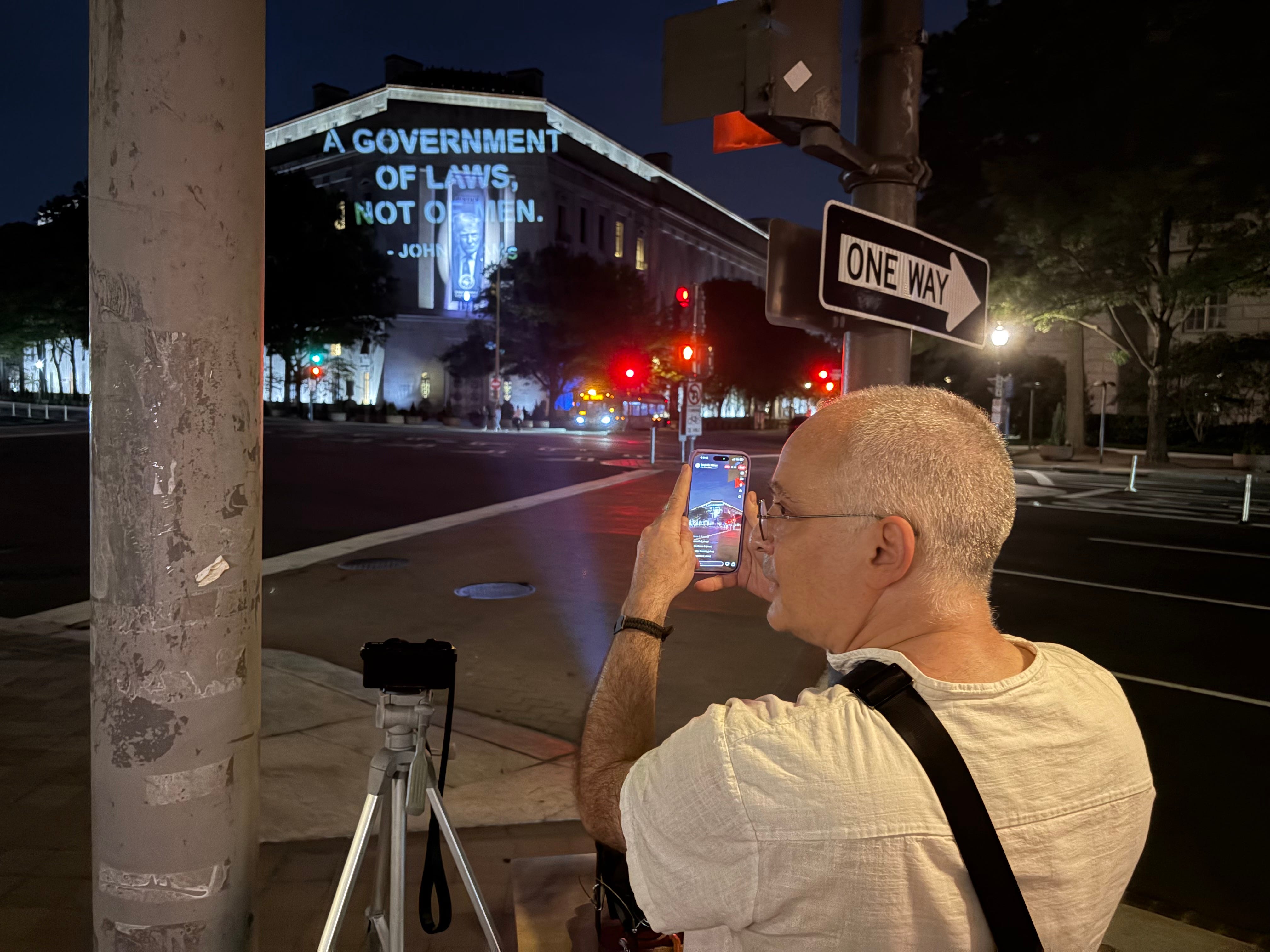
The estimable Holly Berkley Fletcher took a very cool picture of me the other night at the Justice Department that I only just really noticed for the first time. You can even see the image in my phone of the projection. I don’t normally post photographs of myself, but this one is interesting and captures something about special military operations.
Speaking of which, the fifth annual sunflower planting at the #GatesOfHell will be taking place on Sunday. You should join us!
Tuesday on #DogShirtTV, the estimable Anastasiia Lapatina posed an ethical question about the role of journalism in wartime:
Yesterday on #DogShirtTV, the estimable Carol Tsang from the Greek Chorus had some questions about corruption and presidential immunity:
Recently On Lawfare
Compiled by the estimable Marissa Wang
Will the War Change Iran’s Way of War?
Madison Rinder and Ariane Tabatabai argue that, although the U.S.-Iran War has significantly degraded Iran’s military infrastructure, it has also given the Islamic Republic the opportunity to test its military strategy and operational capabilities. Rinder and Tabatabai warn that the war may push Iran closer to pursuing nuclear armament and produce a more radical, militarized post-war regime.
The Iranian political system and military will look different going forward. This war has allowed Iran to test its strategy and operational capabilities, giving the regime an opportunity to adjust them to strengthen its resistance capacity. The Islamic Republic is not new to navigating transitions, and sustaining itself through such transitions is a core component of its strategic approach to contending with its superior adversaries. Already, changes in the military command and political leadership, including the supreme leader, have taken place, and the regime has adapted its infrastructure, processes, and policies to minimize disruption to its core functions.
The day after the war, a more determined Iran is likely to reassess its strategy and capabilities. The war may end, but the United States will be facing the third iteration of the Islamic Republic (following the 1979 revolution and the Iran-Iraq War), one governed by more radical leaders, likely determined to acquire a nuclear weapon, and more focused on organic capabilities than on outsourcing elements of its security to proxies.
AI Governance by Phone Call
Kevin Fraizer and Alan Z. Rozenshtein examine how the Trump administration’s canceled artificial intelligence (AI) executive order, which was already largely deferential to frontier AI developers, reveals weakness in the Trump administration’s resistance to pressure from the AI industry and could leave the U.S. vulnerable to chaotic regulatory decisions without a reliable governance framework.
There’s a line among public policy watchers that policy is personnel. This latest episode adds support to the idea that policy is also personal. However, it would be wrong to treat all of this as just another episode of disorganized personalism in the White House. Two additional elements of this story are worth emphasizing. The first is the substance of what was killed—about as mild an intervention as a serious government response to frontier-model risk could be. The second is the absence of any reliable process for working through frontier-AI disagreements, which matters more right now than it would in most periods: The next three years are likely the inflection point for the technology, and the United States cannot afford to govern them by impulse.
The Invisible Frontline of National Security Governance
In the latest edition of Lawfare’s Foreign Policy Essay series, KaiChieh KJ Hsu unpacks how Chinese gray-zone campaigns in Taiwan are exemplary of authoritarian attacks that operate below the threshold of criminal prosecution and exploit openness, rather than traditional espionage. Hsu argues that Taiwan and other democracies facing similar challenges need to find new ways to recognize and defend against gray-zone authoritarian influence before it escalates.
The central national security challenge facing democracies confronting authoritarian interference is how to respond to infiltration that is eroding institutional resilience but has not yet crossed the threshold of criminal indictment. Taiwan has experienced the transformation of foreign interference operations in particularly concentrated ways. Cross-strait exchanges have created pathways through which influence networks, economic dependencies, and political leverage became embedded within Taiwan’s open society, while the legal tools designed to detect and respond to such risks failed to evolve at the same pace. Taiwan, and other open societies being targeted by influence operations, need to develop a more holistic approach to recognizing and addressing the national security risks of infiltration that occurs in a legal gray zone.
What Is a Cybersecurity Legal Practice, 2.0?
Spencer R. Fisher and Terence A. Check, Jr. examine how cybersecurity law has evolved into a central national security and corporate governance function in the past five years. The pair warn that many organizations still underinvest in cyber legal capacity and public-private coordination, even as cyber lawyers become essential for a safer, more secure digital world.
Five years ago, our former colleague Dan Sutherland wrote in Lawfare about the pressing need to develop cybersecurity law practices among corporate lawyers and in-house counsel. Then the chief counsel of the Cybersecurity and Infrastructure Security Agency (CISA), Sutherland wrote that businesses and organizations of every size, shape, and sector needed lawyers who can operate fluently at the intersection of law, technology, and security risk.
Years later, Sutherland’s thesis still holds true, but the landscape has evolved significantly. With ongoing “hot” conflicts in Europe and the Middle East, computer network operations targeting economies and infrastructure around the world, and the strategic importance of the private sector to the newly issued U.S. Cyber Strategy, we seek to update Sutherland’s guidance to the cybersecurity bar. We intend this article to provide a road map for corporate general counsels looking to deepen their cybersecurity practice groups, government agencies looking to enhance collaboration across the mission space, and university professors seeking to update their cybersecurity law and policy courses. And if companies, agencies, or universities have not yet addressed cybersecurity law, consider this our urgent plea to do so.
Podcasts
Lawfare Daily: How the World Sees Trump’s America with Eve Fairbanks and Madeleine Schwartz: Tyler McBrien sits down with Eve Fairbanks and Madeleine Schwartz to discuss The Dial’s forthcoming book, “How We See it: The World Looks at America in the Age of Trump,” which compiles several essays written by journalists around the world who explore their home countries’ complex relationships with the U.S.
Lawfare Daily: Investigating the Investigators: Sophia Yan on Journalism in the PRC: Michael Feinberg sits down with Sophia Yan to discuss her time reporting on the Chinese government and how she discovered the Chinese government was surveilling her.
Lawfare No Bull: Acting Attorney General Todd Blanche Testifies on DOJ’s 2027 Budget Request: Marissa Wang shares audio from acting Attorney General Todd Blanche’s testimony at the U.S. Senate Appropriations Subcommittee on May 19, in which senators questioned Blanche on the Department of Justice’s recently announced $1.8 billion “Anti-Weaponization Fund,” the proposed budget cuts in the 2027 fiscal year, and more.
Today’s #BeastOfTheDay is the guinea pig, seen here consuming watermelon utterly from under the face of the Eternal:

 Tiktok failed to load.
Enable 3rd party cookies or use another browser
In honor of today’s Beast, avoid food waste.