


Good Afternoon:
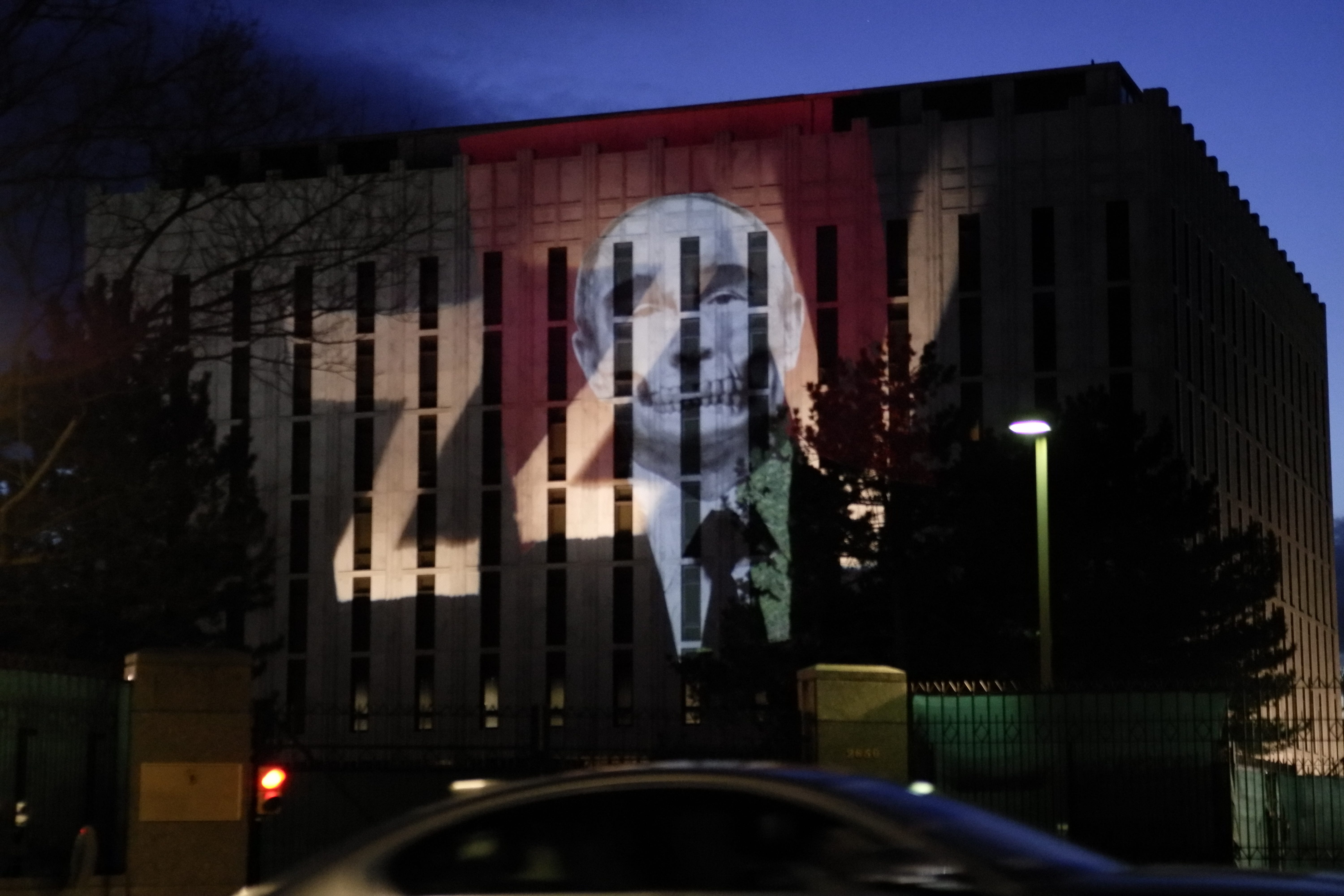
Yesterday was the fourth anniversary of the full-scale invasion of Ukraine. So I did what any red-blooded American would do on the occasion: I projected a Putin Death Head on the Russian embassy. The Russians, who definitely knew I was coming this time, responded instantaneously by projecting the “Z” and “V” spotlight.
I got good pictures.
Yesterday on #DogShirtTV, the estimable Anastasiia Lapatina introduced me to an estimable Ukrainian woman named Svitlana Kivirenko, who told us about her work trying to provide social support to Ukrainian moms and how the Russian bombardment has interrupted it:
Svitlana runs a business called Mamacita, which is a combination drop-in day-care and educational center for children and spa and coffee shop for their moms. Or, at least she used to. As CNN’s Clarissa Ward describes in this story, and as Svitlana described on the show, she has had to close Mamacita because the generator broke and she cannot afford to keep fixing it.
This seemed to Nastya and me like a job for Project Batteries. It’s an expensive one, because a generator that can power a business like this one is bigger than the stuff we’ve bought before and because the maintenance on it will be costly too. That said, we both found Svitlana’s story deeply compelling and believe that by helping her get Mamacita back on its feat, we will be helping not just one business but a large number of women and small children who are using its services.
A bunch of Greek Chorus members seemed enthusiastic about this idea. If you want to help Nastya and me get Mamacita back in business, you can Venmo me at @benjaminwittes. This is the preferred way to contribute as PayPal is taking a larger cut in transactions fees than Venmo. You can also PayPal or Zelle me at benjamin.wittes@gmail.com. As long as money keeps coming in, Nastya and I will keep spending it—on batteries and heated blankets, on Mamacita and its electricity needs, and on other stuff.
The Situation
The Situation Friday just asked some questions.
Today is the fourth anniversary of Russia’s full-scale invasion of Ukraine.
I have nothing wise or novel to say about the war, its progression, or its future. It has all been said.
I have nothing wise or novel either to say about the prospects of President Trump’s itinerant peace talks, which migrate from Abu Dhabi to Miami to Geneva without ever seeming to bring the longest 24 hours in world history to a close. Color me suspicious, but what do I know?
For that matter, I have nothing wise or novel to say about America’s crazed vacillations on the subject of the war—vacillations that have this country alternatively imposing additional sanctions on Russia, adopting Russian negotiating positions, humiliating Ukrainian leaders in public and extorting them for resources, and freeing them up to conduct long-range strikes against Russian targets. It makes my head spin.
I have nothing wise or novel to say about the broader relationship between Russia and The Situation. We have been talking about that for years, and I have long since given up trying to puzzle it out.
I have nothing wise or novel to say about the next four years of Ukraine’s confrontation with Russia—or America’s or Europe’s. I don’t do predictions any more.
I will only say this.
Four years ago today, the dictator of a revisionist power challenged the world order by invading a sovereign country on his borders with the specific objective of obliterating its existence as an independent state, annexing its territory, replacing its democratically elected government with one of his own imposition, and wiping out its language and culture.
The good news is that he has failed—though he is still trying and his failure in the future is not guaranteed.
The less good news is that over the subsequent four years, the world has stood robustly for the proposition that somebody should certainly do something about this.
On the question of exactly who that somebody should be and exactly what that something should be, the world has stood a little less firm.
The United States has been a hot mess. The initial American position was that Ukraine should get all the support that it needs—just not the specific weapons systems it said it needs or in the timeframe that it said it needed them and not in a manner that might make its foe too angry.
That position later evolved into something more like this: Ukraine should get all the support it needs subject to the caveats above just as soon as Congress finishes months-long delays wherein it busily squabbles over domestic politics.
And that position later evolved further into its posture during The Situation: Ukraine should plead and grovel for help, which the United States might then sell it assuming European countries are willing to pay for it and assuming Ukraine agrees to American resource extraction demands.
Europe has performed better, though it hasn’t been the continent’s finest hour either. It declared the war a great turning point—and then turned a few degrees.
Europe, of course, isn’t an it. It is a they. And the parts of it that are further north and further east have tended to turn further than the parts that are further west and further south—and they had less far to turn in any event.
And it’s fair to say that Europe has acquitted itself, on the whole, more honorably than has the United States, largely, though not entirely, on account of the behavior of certain Nordic and Eastern European countries that have skin in Russia’s particularly militaristic game. The United Kingdom deserves an honorable mention here too.
Yet Estonia and Finland and Sweden can only do so much, and one doesn’t look at Europe as a whole over the past four years and see quite the stalwart defense of the order that one might have hoped for. Such a defense requires consensus, after all, and the Europeans are far better at making consensus statements about the defense of the order than they are about actually doing things in concert. A lot of Europe is too far away from Russia for its many countries to reach meaningful consensus about confronting Russia. And a lot of its countries have complicated relationships with Russia anyway. And rearmament is such a drag on a welfare-state economy that relies on the United States for security. And resupplying Ukraine? Surely that’s someone else’s job.
The war was a turning point, sure, but don’t make us turn too much or, God forbid, too quickly.
And so with such friends, the burden of confronting the revisionist dictator has fallen on Ukraine itself. Not alone, of course, never quite alone. Sometimes Ukraine has gotten inadequate American support. Sometimes it has gotten inadequate European support. Sometimes, it has gotten both. The South Koreans have been pretty good. But at the end of the day, the burden of defending the proposition that you can’t acquire territory by force in the post-World War II era—you know, that whole UN Charter thing—has been Ukraine’s burden.
And almost miraculously, it has managed to stay in the fight.
It has managed to stay in the fight despite the fact that everyone who wants Ukraine to prevail thinks it’s someone else’s job actually to make that happen.
And it has managed to stay in the fight despite the fact that it’s not even clear the government of the United States still wants Ukraine to prevail. Indeed, the oddity of The Situation with respect to Ukraine and its war is that the president seems genuinely unsure whether or not he even wants Ukraine to win. Hence the vacillations. Sometimes, he seems positively bullish for Russian victory and enthusiastic about Ukrainian capitulation. Sometimes, he seems to just want a “deal,” irrespective of what terms that deal might contain. Sometimes, he seems genuinely horrified by the magnitude of the losses and seems to understand that it is Russia, not Ukraine, that is preventing a reasonable settlement.
He is, to be sure, at all times wholly untroubled by Putin’s assault on the international order. And he thus shares none of the maddening features of so many other actors over the last few years of declaring the full-scale war an intolerable affront and then considering it someone else’s job to remedy that affront or considers half-measures adequate to address it. Trump doesn’t consider the invasion an intolerable affront; he tolerates that just fine. And it’s genuinely unclear what he actually wants in a resolution—save a Nobel Peace Prize for himself.
It all makes for a confusing environment, four years in. The world’s leadership is chock full of pious suits who say all the right things and whose actions don’t remotely comport with their words. And among them struts one grossly impious man who openly admires evil and also seems to think he is the one element needed to bring peace to the war between the evil he admires and a country he has proudly abandoned.
It is unfathomable why he thinks this, yet The Situation continues tomorrow.
Yesterday On Lawfare
Compiled by the estimable Marissa Wang
Toward a Federal Framework for Online Age Assurance
Soham Mehta argues that Congress should adopt a federal age assurance framework that centers verification at the app-store level rather than pushing obligations onto individual platforms.
Against this backdrop, the House Energy and Commerce Committee’s recent hearing discussing 19 online child safety bills, several of which contain federal age assurance frameworks, represents a serious attempt to grapple with these competing imperatives. Three bills contain explicit age assurance provisions—the Shielding Children’s Retinas from Egregious Exposure on the Net (SCREEN) Act, the App Store Accountability Act (ASAA), and the Parents Over Platforms Act (POPA).
Together, the bills reflect different approaches to balancing goals that have long seemed irreconcilable: protecting children without undermining free expression, empowering parents without overwhelming them, and distributing responsibility across app stores and platforms without constructing an unworkable compliance maze. They offer a meaningful starting point, and, with targeted refinements, Congress can achieve the balance that Americans are aiming for in their often-contradictory desires.
Learning Resources: Götterdämmerung or Skirmish?
Paul Stephan analyzes the Supreme Court’s decision in Learning Resources v. Trump, in which the Court held that IEEPA does not authorize the president to impose tariffs. Stephan contends that although the ruling struck down the use of emergency powers, it is not a complete loss for President Trump’s tariffs, as alternative statutory authorities and less legally constrained powers remain available.
After an impatient wait, the U.S. Supreme Court finally handed down its opinion in Learning Resources, Inc. v. Trump, the tariffs case, on Friday, Feb. 20. Much commentary has ensued about the decision, with more to come. I offer three takeaways: (a) The Court’s justices spent a lot of time talking about how to interpret statutes in a period of governmental upheaval. (b) The Court, perhaps wisely, did not talk about the connection between taxation and takings, an argument that I had pushed. (c) The decision takes away President Trump’s favorite tool for dealing with the rest of the world, but will not necessarily end his obsessive fixation with tariffs as an instrument of state power. The decision may represent a significant loss for the administration, but it is not a crushing defeat.
Podcasts
On Lawfare Daily, Jason Burke joins Michael Feinberg to discuss Burke’s new book on European and Middle Eastern terrorist organizations in the 1970s, how governments responded to their attacks, and how violence from the ‘70s still influences popular culture today.
On Scaling Laws, Alan Rozenshtein sits down with Cullen O’Keefe and Kevin Frazier to discuss O’Keefe and Frazier’s paper on using artificial intelligence (AI) systems to automate regulatory compliance tasks as a way to balance innovation in AI policy with safety concerns.
Today’s #BeastOfTheDay is the newly discovered Spinosaurus mirabilis, about which its discoverer says, “I envision this dinosaur as a kind of ‘hell heron.’”

Congratulations to today’s Beast for being dug up and named and so forth. I implore today’s Beast to be just a little less nightmarish.
Tell Me Something Interesting
Recently, I—EJ Wittes—was reminded of my all-time favorite scholarly hoax, and I feel compelled to share the story with you all. It is entirely unimportant, but it makes me smile.