


Good Morning:

This says it all:
Interesting results from my poll on user reactions to the Rule O’ Law roundup. People seem generally pleased with it, though 30 percent of eligible users haven’t event looked at it yet:
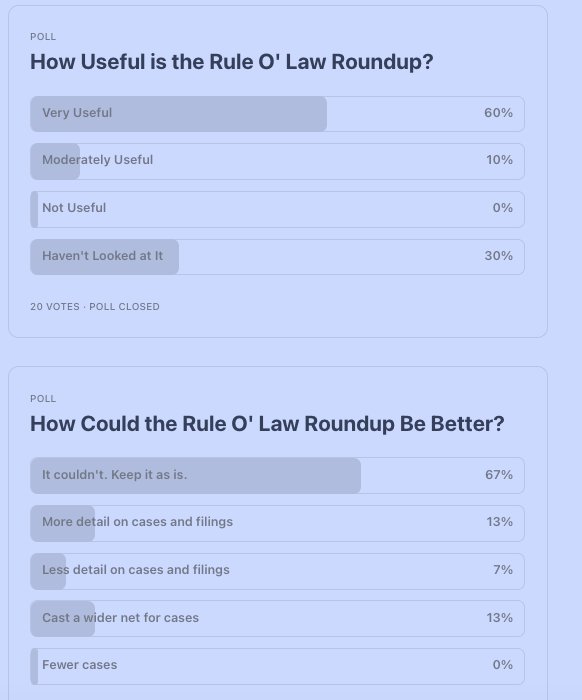
I continue to refine the concept. Feedback is always welcome.
Tuesday on #DogShirtTV, the estimable Holly Berkley Fletcher wanted to discuss the fundamental majesty of the universe.
Yesterday on #DogShirtTV, I introduced the estimable Anastasiia Lapatina and the estimable Mike Feinberg to the game of Tell Me Something Interesting:
The Situation
The Situation last week took a break, because we were working on this: a report on 300 immigration habeas cases around the country in which the government has violated court orders and a database of all of these cases.
We released this project on Friday. The following day, we realized it already needed updating.
We had known, when we released the project, that the database was not comprehensive. The piece itself says as much clearly—that there are undoubtedly non-compliance cases we missed. On Saturday, however, it became clear that the volume of such cases is large. Exactly how large we are still working out.
Since we published our initial piece on April 3, we have added 56 more cases to the non-compliance tracking database—nearly all of them from Minnesota. The new cases come after searches of only five jurisdictions: the District of Minnesota, the District of New Jersey, the Northern District of Illinois, the Western District of Pennsylvania, and the Central District of California. Expect that number to grow over the next few days as we look at more jurisdictions using the methodology that isolated these new cases.
This experience has led to a few observations, observations that all lead to a single conclusion: The federal judiciary should begin keeping data on this subject.
As we described in our piece introducing the tracker:
[J]udges, who are also overwhelmed by a sharp spike in habeas petitions since the beginning of the second Trump administration, are operating on an individual case-by-case basis. The individual judge is faced with an individual detainee and an individual set of orders he or she is trying to enforce—not a broad pattern of violating court orders. Indeed, aside from case captions on joint orders for show cause hearings, and the aforementioned lists produced by Judge Schiltz in Minnesota and the Justice Department in New Jersey, there is no coordinated, publicly-available record keeping of government non-compliance in habeas cases throughout the country. In some cases—like many included in the New Jersey list—evidence of government noncompliance is actually nowhere to be found even on a case’s individual docket. Were it not for the government’s admissions in these instances, which took place in other cases, it’s likely judges would not have even known there had been noncompliance issues in the courts in the first place.
First, in our experience, the accumulation of this data is extremely labor intensive and rather imprecise. The judiciary’s document management system does not code cases for “violated court orders,” nor do judges have a standard lexicon for cases in which the government was ordered to do something but failed to do it, did it late, willfully refused to do it, or did it but then neglected to file the required confirmation that it had done so.
What’s more, judges do not always behave in the same ways when faced with government non-compliance. (And many characterize the same types of noncompliance using different language.) Some make a point of noting it and reiterating their orders. Some don’t bother and just extend the government more time to comply. The more aggressive ones enter show cause orders, effectively threatening civil contempt. Some schedule hearings.
The use of artificial intelligence tools makes it possible to identify many compliance cases without manually examining tens of thousands of habeas cases in which compliance issues might lurk. But this strategy still requires manually examining the dockets—and often the underlying documents—in the thousands of cases that will be flagged by whatever AI system one uses. Depending on how one sets up one’s AI filters, one will be examining very different pools of cases based on different assumptions about what makes a case likely to contain a compliance issue.
This is what happened over the weekend. The new batch of cases arose because of an experiment we did in which we had the AI look for possible cases for our review in a different fashion than it had looked before. The earlier approach had been to query the Courtlistener database for certain terms in the dockets suggestive of possible violations. In the new approach, we had Claude scrape the database for the full texts of the dockets themselves, then analyze the text of the dockets that do and don’t have compliance issues and build queries around the specific vocabulary in the ones that do. The result is a bunch of cases we had not previously seen, but because it casts a much narrower net, this approach also misses cases our old approach caught by bringing in many more cases.
In short, we know of no reliable way to identify all of the compliance issues among the roughly 25,000 habeas corpus matters litigated in federal court since the dawn of the second Trump administration in a reasonable period of time with a manageable expenditure of human labor. And we therefore have no firm sense of what percentage of the universe of such non-compliance cases the current dataset represents. The fact that a few days of work increased the size of the dataset by 19 percent—with a large number of additional cases still to be examined—suggests that the current dataset may not constitute an overwhelming percentage of the true universe of cases. The result, in other words, is imprecision and uncertainty. And that is not good. It means that the full contours of the problem remain a bit of a mystery.
Second, there are other questions the current data leave obscure. It is clear that Minnesota is a wild outlier in the number of compliance cases it has seen—a function of the perfect storm in that city of aggressive ICE action, a breakdown in the U.S. attorney’s office that left it woefully unable to respond to the litigation rush, and the government’s mandatory detention policy which helped trigger a flood of cases. Before Operation Metro Surge, ICE had conducted major operations in Chicago—and the government had lost a lot of habeas cases there. But Chicago has not seen a large volume of non-compliance—at least not that we have been able to detect. In Chicago, when the government lost cases and was ordered to release people, it released them.
What’s not clear is exactly how much of an outlier Minnesota really is. New Jersey has been a somewhat lesser hotspot of non-compliance. Yet a lot of the problems in that state are invisible from the dockets in the specific cases. We know of them only because the Justice Department was ordered to self-report its non-compliance, and it produced a list of violations—many of which are not reflected in the dockets of the cases in which they took place. Is it possible that similar things have happened in other jurisdictions but we can’t detect them because, like in New Jersey, they are not showing up in the case dockets?
Third, it is important for judges to understand the environment against which the errors taking place in their courtroom are happening. Many, though by no means all, of the violations we have documented are, in and of themselves, harmless. A filing comes in a few hours late—big deal, right? Well, it’s a much bigger for a judge if she knows that the late filing is part of a broad pattern of the government’s violating court orders and that this pattern includes deporting people in violation of court orders, failing to free people courts have ordered released, failing to return people’s property, and moving them to other states in violation of judicial instruction. It’s a much bigger deal, we suspect, for a judge who is aware that there are literally hundreds of other such cases—cases in which the same Justice Department is failing to file documents or making false representations or obfuscating detention and removal gamesmanship on behalf of the same client agency.
Yet no judge today has a full sense of the big picture against which he is operating when confronted with a seemingly trivial incidence of government non-compliance in his courtroom. The judges in Minnesota know what is happening in Minnesota. Judges elsewhere presumably have a sense of that too because of the press. But who would guessed that the jurisdiction with the third-most compliance cases in our sample would be the Eastern District of California—home of Sacramento? And is that, in fact, the case because things are really bad there, or is it because the cases there just happened to pop up in our scans more frequently than cases in Los Angeles, where ICE was particularly active and where one might have expected to see a lot of cases? We don’t know—though we hope to shed more light on such questions in the coming days. And, more importantly, nobody else knows either, including federal judges who are faced with non-compliance issues. And that’s really not good.
It is generally not the province of the federal judiciary’s case tracking to track interstitial outcomes within cases—like whether the government is violating court orders. We humbly submit that when a coordinate branch of government has violated court orders in no fewer than, and surely more than, 355 separate cases in district courts around the country over a brief period of time, some kind of institutional monitoring is called for. And as long as the federal judiciary isn’t doing it, Lawfare will.
So, if you are a federal judge or a clerk to a federal judge aware of compliance issues in your court or elsewhere, or if you’re an advocate in cases where compliance has been an issue, please send us any public documents, docket links, or opinions reflecting compliance issues. We plan to expand our tracking beyond the habeas context, so feel free to flag for us any cases in which the government has not complied with clear orders of district courts.
We can be reached at compliance@lawfaremedia.org. Let’s get the judicial hivemind working to nail down the scope and parameters of the problem.
Because The Situation continues tomorrow.
Yesterday On Lawfare
Compiled by the estimable Marissa Wang
The Prosecution of Smartmatic
Molly Roberts unpacks the Department of Justice’s current investigation into voting systems vendor Smartmatic over an alleged violation of the Foreign Corrupt Practices Act following the 2020 presidential election. Roberts explains that the case fits into a larger narrative of vindictive and selective prosecutions under the Trump administration.
What has Smartmatic done to run afoul of the White House? In reality, nothing—apart from providing ballot-marking devices to Los Angeles County for use in the 2020 race for the White House. But in the wild world of MAGA election denialism, Smartmatic is responsible for the rigging of voting systems around the world, including in the United States to steal that contest from Trump. The success of the company’s new motion depends on whether it can convince a judge that prosecutors are targeting Smartmatic not because of the facts of the case but because of this fantasy.
Breaking Down OMB’s Growing Use of Category C
William Ford and Cerin Lindgrensavage describe how the Trump administration has increasingly used “Category C” apportionments across a wider range of accounts than previous administrations to withhold or delay federal funds from agencies until the end of the fiscal year.
Since January 2025, the White House Office of Management and Budget (OMB) has led an aggressive campaign to withhold federal funds from agencies and programs the Trump administration disfavors. Central to this effort has been OMB’s vigorous use—and at times abuse—of its authority under the Antideficiency Act to apportion the funds Congress appropriates. OMB has used its apportionment authority to delay agency access to funds by designating funds as “unallocated,” conditioning the release of funds on OMB’s approval of detailed “spend plans,” and waiting “longer than in past administrations” to approve apportionments in the first place.
But there is another, less publicized, tactic that OMB has used to tighten its control over—and in some cases deny agencies access to—congressionally appropriated funds: Category C. A Category C action sets aside, for use in a future fiscal year, funds that Congress has made available across multiple fiscal years (multi-year money) or without fiscal-year limitation (no-year money). When OMB apportions funds in Category C, it blocks an agency from spending that money in the current year unless OMB provides otherwise in a new apportionment or in a binding apportionment footnote.
The AI Revolution in Cyber Conflict
Lennart Maschmeyer describes how artificial intelligence (AI) is shaping cyber conflict unevenly amongst actors and operations of different scales. Maschmeyer argues that while AI can improve the efficiency of large offensive operations, AI adoption is more effectively implemented in defensive strategies carried out by lower-level actors.
In short, the era of AI-powered cyberattacks has arrived. Consequently, determining the likely impact on cyber conflict and conflict at large is both urgent and important. As one report on the Mexican government intrusion put it, “[f]or any cyber-defender continuing to deny the impact of AI on attacker efficiency, welcome to Exhibit A.” But here lies the crux: Efficiency does not equal effectiveness.
How AI Data Centers Are Shaping Politics
Lam Tran examines how the rapid development of AI data centers and its stress on local infrastructure is growing into a political flashpoint—which has led to bipartisan backlash and is likely to continue influencing election, legislative, and policy debates at state and national levels.
Across the United States, the rapid buildout of hyperscale data centers to support artificial intelligence (AI) infrastructure is no longer just a technological or economic development, but a political flashpoint with intense bipartisan pushback from local communities. The scale of the backlash has escalated a sense of urgency to act from both ends of the ideological spectrum. President Trump’s recent deal with major technology companies, also included in the White House’s National AI Legislative Framework—aimed at protecting American consumers from rising electricity costs tied to the AI data center boom—and the Artificial Intelligence Data Center Moratorium Act, introduced by Sen. Bernie Sanders (I-Vt.) and Rep. Alexandria Ocasio-Cortez (D-N.Y.) to impose a nationwide pause on new data center construction, both show that the politics of AI infrastructure has reached the national stage.
Podcasts
On Tuesday’s Lawfare Daily, Michael Feinberg sits down with Arne Westad to discuss 19th and 20th century global power politics and how the lessons learned from those conflicts can inform a better understanding of the rise of China on the contemporary global stage.
On Wednesday’s Lawfare Daily, Michael Feinberg sits down with Yanqiu Wang to discuss the role of emerging technologies in China’s surveillance and censorship apparatus.
Today’s #BeastOfTheDay is the moose, seen here noticing a photographer:
In honor of today’s Beast, absolutely do not under any circumstances pat a moose. Don’t do it.