


Good Evening:

I haven’t had a chance yet to do a careful tabulation of the incredible response to my call for help yesterday in buying these big batteries for Kyiv families, but it’s right around $20,000 so far.
And, well, folks, I’m verklempt.
For those who missed it, here’s the plea:

And for those who still want to contribute, here’s my PayPal and Venmo QR codes:


I don’t know what I expected, but it was nothing like waking up in the morning and finding that people had sent enough to buy five or six big-ass batteries that will keep warm several families with no power and under bombardment during a major cold snap.
The overwhelming response actually caused unexpected logistical difficulties. What is the fastest way to get $20,000 into Ukraine on a day when Verizon is having a major outage and everything internet just does not work quite right—and without looking like a member of the mob to law enforcement and bankers alike? I spent my day on this problem.
The most estimable Anastasiia Lapatina, meanwhile, spent time today scrambling to find batteries that are available for purchase, which given the cold snap turns out to be not all that many.
Never fear. We are getting it done.
As I write, $5,000 of the money has already been transferred. And every few hours, I try another transfer to see if the banking tech and law gods will get another $5,000 through.
The first batteries will be purchased tomorrow and distributed as quickly as Nastya can get them to families.
Thank you to all who are contributing. There are too many of you for prompt individual thanks. But you are all great Americans, whether you be Americans or not.
And keep it coming. We’ll spend $100 percent of what we get. As I said on the show today, our overhead is limited to bank transfer fees.
Yesterday on #DogShirtTV, Nastya gave us a dispatch from Kyiv under Russian bombardment. Spoiler alert: it’s cold.
The Situation
The Situation on Sunday catalogued my many areas of agreement with the White House’s grotesque characterization of Jan. 6.
And then it came to pass that the administration discovered a new instrument of monetary policy: criminal investigation.
Criminal law, to be sure, has historically played only the most minor of roles in the setting of interest rates. As a general matter, it just isn’t among the levers that the Fed—much less anyone else—pulls to influence an agency that is supposedly and designedly not subject to outside influence. We just don’t think of law enforcement, either by or against Federal Reserve governors, as one of the means by which they nudge the economy this way or that by adjusting rates a quarter of a percentage point every few months.
But the thing about thinking like a gangster is that it becomes a matter of habit. It doesn’t start with Fed governors.
It starts with garden variety obstruction of justice.
You have something you don’t want to become public—like, say, the details of your campaign’s relationship with Russian operatives or your own personal history of engaging with the leadership of the Russian Federation. And there are these witnesses who know things inconvenient to that objective and who are in trouble with the law. So you send them messages to stay loyal, reassuring them that they’ll be taken care of. You pardon the ones who do so. You threaten the ones who don’t.
And it works. There’s a damaging report, but that’s all.
And so the gangster tactics migrate to the conduct of governance itself. And you find that these tactics work in other situations too—like international diplomacy, for example. A new president in an emerging democracy shows up wanting military aid to deal with an ongoing foreign war by an invading power. You want him to announce he’s investigating your political opponent. So you tell him the two are linked. He knows he’s being shaken down, but what’s he going to do about it?
These gangster tactics are old. In Book I of Plato’s Republic, one of Socrates’s interlocutors even defines justice as “doing good to your friends and harm to your enemies.” And they work.
So when you return to power, you make them the centerpiece of your governance. You pardon 1,500 of your friends, and they’re really your friends now. And you pardon a lot more people, some of them very rich. And they are grateful. And you indict your enemies, whether they’re guilty or not. It’s almost better if they’re not guilty, because then they really feel your power. They know it’s not because of anything they did wrong. They know it’s just because they incurred your wrath.
And you put your own people in the halls of power, and mostly—mostly—that’s the way you work your will.
But there are still a few of these other people, people you don’t or can’t control for one reason or another. There are some you didn’t appoint, though that doesn’t include Mr. Powell. There are some—particularly in Congress or in state government—who have electoral bases separate from you and who don’t report to you at all. There are others who find they have this thing called a soul, or integrity, or whatever, or who mysteriously take seriously that oath they swore to the Constitution. And there are others, including at the Fed, whom you can’t so easily fire, because of combinations of law and politics and anticipated market reactions.
And so the gangster tactics migrate into the Fed.
Expensive renovation you got going on there, Chairman Powell. A lot of taxpayer money at issue. And you made that building pretty fancy, didn’t you? You gave some congressional testimony about it too. And spoken words in a congressional hearing—there are so many ways to slip up and get a fact wrong. And you know, even if you don’t slip up, words can be interpreted as erroneous, anyway. And you never know what an investigation is going to find about your intent, do you? And juries just don’t love people who build themselves fancy offices with taxpayer money, do they? And even if you never face charges, an investigation is a long and ugly process. The kind of thing that ruins an economist’s reputation. Kind of thing that sucks up a lot of time and ends up high up in a man’s obituary. That would be a shame.
And you know, Mr. Powell, that all you have to do to make this go away is lower interest rates.
Extortion is a matter of habit. Like lying. Do it a few times, and it becomes easier. Do it a few more times, and it becomes a way of life.
And thus does criminal investigation become an instrument of monetary policy.
Or perhaps we should say thus does criminal investigation become also an instrument of monetary policy.
The Situation continues tomorrow.
Yesterday On Lawfare
Compiled by the estimable Marissa Wang
Explaining Trump’s Oil Grab
In the latest installment of Lawfare’s Foreign Policy Essay series, Emily Meierding argues that the U.S. invasion of Venezuela to seize its oil reflects a fundamental miscalculation about the economic realities of modern oil politics. Meierding shows how investor reluctance, political instability, and reputational damage make Venezuelan oil far less valuable than the Trump administration assumes.
The Trump administration seems to have devoted little consideration to these investment obstacles before launching Saturday’s raid. As others have noted, the president’s perspective on natural resources seems to be anchored in the early 20th century, not the early 21st. In 1926, it was economically and normatively viable for an outside power to fully control another country’s oil resources, through direct imperial authority or 99-year concessions agreements. In 2026, it is not.
Public Attitudes on U.S. Intelligence (2023-2024)
Joshua Busby, Kim Nguyen, and Steve Slick share key takeaways from the results of University of Texas at Austin’s national surveys of public attitudes on U.S. intelligence, highlighting that partisanship is increasingly shaping views of the intelligence community.
In December 2025, the Chicago Council on Global Affairs published the results of two annual polls sponsored by the University of Texas at Austin. The university’s 2023 and 2024 national surveys of public attitudes confirm that most Americans believe the U.S. intelligence agencies are vital to protecting the nation and effective in carrying out their specialized tasks. These final polls of the Biden presidency also affirm that partisan preference plays a significant role in shaping views on the intelligence community’s (IC’s) performance, respect for civil liberties, and democratic oversight.
Podcasts
On Lawfare Daily, Ariane Tabatabai joins Richard Nephew to discuss the protests in Iran, its rebuilding of its nuclear program, the history of U.S.-Iran policy under Trump, and what to expect as the situation develops.
On Scaling Laws, Alan Rozenshtein sits down with Francis Shen to explore the intersection of AI, criminal justice, and neuroscience, including ethical concerns of AI bias, practical challenges, and what an AI-augmented justice system might look like.
More Weirdness From Italian Duolingo


Today’s #BeastOfTheDay is the lion, seen here in absolutely the wrong ecosystem:
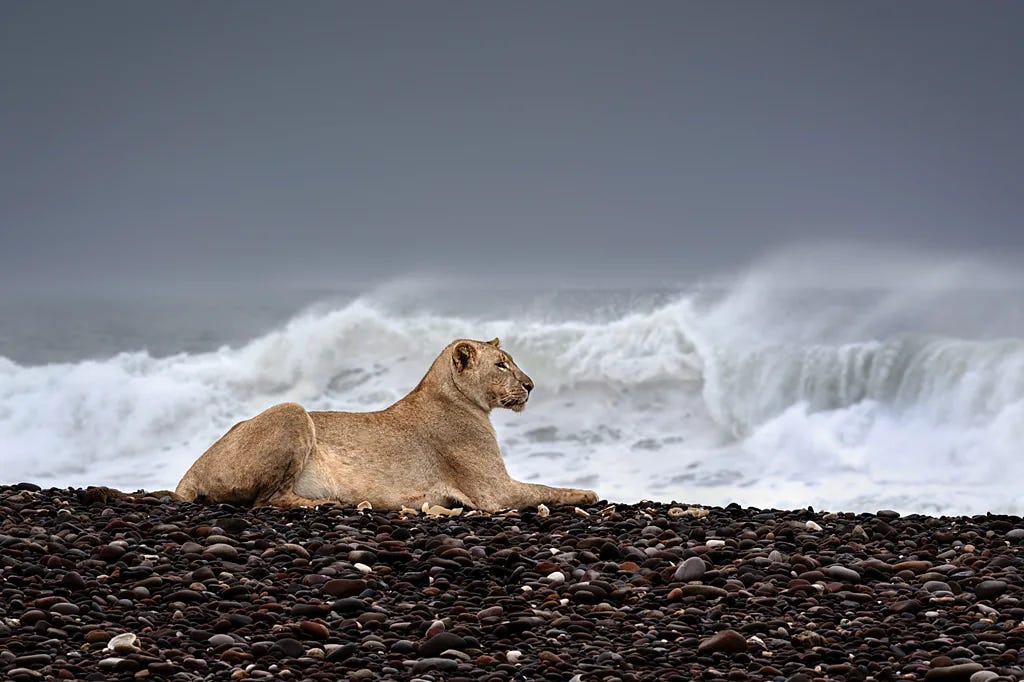
It is an incredibly striking photo: a lioness gazes into the distance on a pebbled beach in Namibia as tempestuous waves crash in the background. She guards her prey, just out of view – the carcass of a Cape fur seal.
Belgian photographer Griet Van Malderen captured this dramatic shot of Gamma, one of Namibia’s desert lions who has learned to hunt seals to survive in the harsh environment of the Skeleton Coast…
There are just 12 desert lions living along the Skeleton Coast, out of a total population of around 80. They have moved from the arid Namib Desert to the Atlantic Ocean in search of food, drastically changing their diet and behaviour in 2017 to adapt to this new habitat – and appearing to thrive from the change…
Gamma is a member of the first generation of lions to have grown up on the Skeleton Coast, says Philip Stander, a conservation expert who has been tracking Namibia’s desert lions since 1980. He says Van Malderen’s photo is “really significant” as it shows Gamma’s “first day alone on the beach”.
Namibia’s desert lions used to live along the Skeleton Coast in the 1980s but retreated to the desert after a drought and conflict with farmers wiped out most of the population, says Stander. More than 30 years later, the animals “have found their way back to the coast”, he says.
These animals have adapted to live in “the most inhospitable terrain you can imagine, a huge sea of sand dunes, with no vegetation”, says Stander, who founded the non-profit Desert Lion Conservation Trust in 1997.
“The desert lions are incredibly unique,” says Stander. They have the largest home range of any lion, he says, adding: “They are super fit, top athletes.” The average home range of a desert lion is around 12,000 sq km (4,600 sq miles), he says, adding that a lion in the Serengeti would typically have a home range of around 100 sq km (39 sq miles). They have even adapted to survive without water. “They get most of their hydration from the meat they eat,” Stander says…
In 2015, the lions found the sea again and started hunting coastal prey on the beach, after a drought decimated their usual inland prey of ostriches, oryxes and springboks. “The seals were a blessing,” says Van Malderen. “Climate change has pushed these desert lions to the edge, forcing them to adapt in extraordinary ways, to survive along the beaches of the Atlantic coast.”
“It’s amazing” to see the lions’ changing behaviour across several generations, she says. The first desert lioness to be studied over 30 years ago “was specialised in [hunting] giraffes,” she says. “Now this seal colony is giving these lions a little breathing space.”
In honor of today’s Beast, don’t feel out of place. You belong here. Settle in. Hunt a seal. Fake it till you make it.